

Egypt lays out efforts to fight instability
Egyptian Ambassador Ahmed Haggag describes the Arab Republic's plan to combat instability in North Africa, emphasizes goal to "practice what it preaches."


 Messenger
 Whatsapp
 Threads
 Email
Email
 Print
Print
 X
X
 Facebook
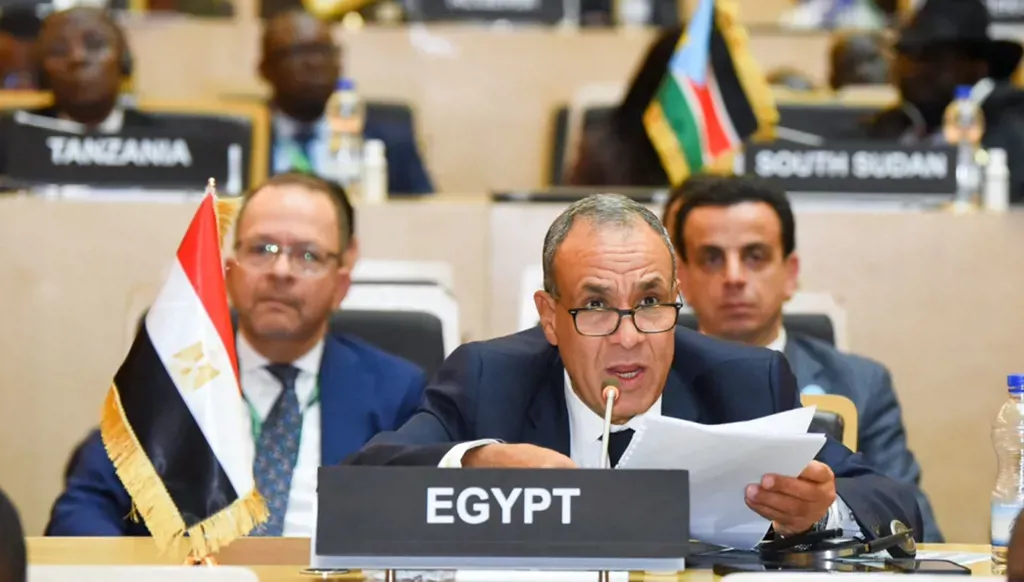


Egypt is making determined efforts to promote the use of diplomacy instead of being drawn into violent armed conflicts in Africa. These efforts became particularly evident during Cairo’s current chairmanship of the African Peace and Security Council in February.
This was reflected when Egyptian Foreign Minister Dr. Badr Abdel Aaty presented the Council’s annual report to the African Union summit in Addis Ababa, on behalf of President Abdel Fattah el-Sisi.
During his presentation, the Egyptian minister emphasized “the importance of strengthening early warning systems and activating preventive diplomacy and mediation tools to address hotspots in their early stages and prevent escalation, contributing to stability and safeguarding the resources of African countries.”
Complex conflicts
Former Assistant Secretary-General of the Organization of African Unity, Ambassador Ahmed Haggag, believes that “conflicts in Africa are highly complex, with many separatist movements within the continent’s countries.”
He therefore thinks that “wars will continue, and may even increase.”
Despite this complexity, Ambassador Haggag told Annahar that “promoting diplomatic solutions is important, and the efforts being made by Cairo will bear fruit over time and with sustained effort.”
Africa is rife with violent wars and conflicts. Among the 55 African Union member states, confrontations are currently active in 12 countries, while other regions remain at risk of erupting.
The countries currently affected by conflicts include Libya, Sudan, South Sudan, Ethiopia, the Democratic Republic of Congo, and the Central African Republic. In addition, some countries are facing extensive activity by extremist religious groups, such as Somalia and the Sahel region states: Mali, Niger, Burkina Faso, Nigeria, and Chad.
The Assistant Secretary-General notes that “working to resolve current conflicts through the African Peace and Security Council, with the support of neighboring countries that have a stake in ending these wars, will help stop armed confrontations and promote the principle of diplomatic solutions over war.”
According to Haggag, what Egypt seeks to achieve in Africa is consistent with its approach even in existential crises, such as the Grand Ethiopian Renaissance Dam dispute that threatens its main freshwater source. He says, “Cairo has not resorted to military solutions, but exhausts all diplomatic and political avenues first. This enhances its credibility among leaders and people across the continent, because it simply practices what it preaches.”
A comprehensive approach
African affairs expert Rami Zahdi told Annahar: “The complexities of African conflicts lead to similarly complex solutions. The causes are intertwined and multifaceted, some linked to internal factors, others to external interventions or proxy wars.”
Zahdi believes that “Egypt presents a comprehensive approach aimed at resolving conflicts at their roots, preventing potential escalations, supporting post-war reconstruction, strengthening national institutions, and even providing psychological rehabilitation for affected citizens, particularly the most vulnerable groups in society, such as children and women.”
He notes that Egypt’s approach “began even before Cairo assumed responsibility for the Council. What was recently presented is the result of a year of work.”
The widespread nature of conflicts, he explains, is partly because “many African populations have become accustomed to resorting to armed confrontation when a crisis occurs,” highlighting the role of “historical conditions that deprived Africans of democratic processes, acceptance of others, and entrenched racism and exclusion. As a result, taking up arms is often the first reaction in a crisis.”
He adds: “The Egyptian approach not only reinforces diplomacy as an alternative to conflict but also strengthens early warning systems. Many African conflicts show signs on the horizon before they explode, and these can be contained before they ignite.”
Defeating terrorism
Jihadist movements play a central role in conflicts in several Sahel countries (West Africa) as well as in the Horn of Africa (East Africa). Here, Cairo seeks to strengthen cooperation with these countries by sharing its experience in defeating terrorist organizations.
Experts on political Islam told Annahar that Egypt collaborates extensively with most of these countries, training their forces and exchanging intelligence information.
Zahdi explains that “Egypt shares its successful experience in this field with several African countries, including Mali, Somalia, Libya, Sudan, Eritrea, the Democratic Republic of Congo, Rwanda, and Uganda.”
Since the defeat of ISIS and the collapse of its so-called state in Iraq and Syria, its members, along with Al-Qaeda operatives, have moved to African countries with fragile security, where local groups have pledged allegiance to these terrorist organizations. In response, Cairo acted early to enhance security and intelligence cooperation with Sahel and Horn of Africa countries, as a preventive measure to stop these elements from infiltrating its territory.