

Jean-Yves Le Drian: Hezbollah Chose Iran Over Lebanon and Is Controlled by Iran’s Revolutionary Guard
Former French Foreign Minister reveals how Hezbollah’s alignment with Iran fuels tensions with Israel, the limits of Lebanese authority, and France’s efforts to mediate a path toward peace.


 Messenger
 Whatsapp
 Threads
 Email
Email
 Print
Print
 X
X
 Facebook
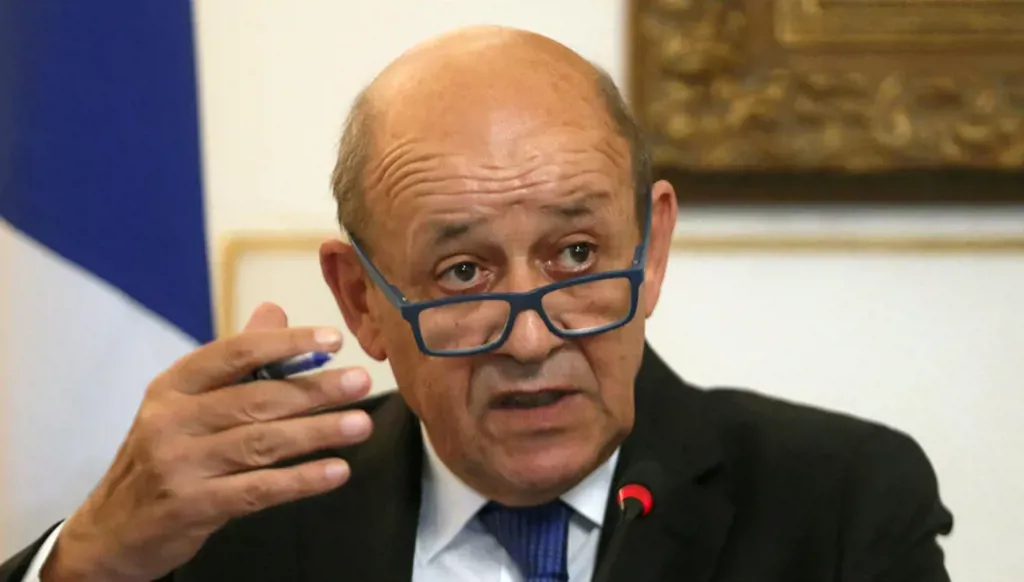


Former French Foreign Minister and French Presidential Envoy to Lebanon, Jean-Yves Le Drian, stated that the military wing of Hezbollah, a political party, is considered a terrorist group and is permanently linked to Iran. When Iran responded to Israeli strikes, Hezbollah immediately and synchronously acted in coordination with Iran. “This is why I have repeatedly said that the party has chosen Iran over Lebanon and against the interests of the country it is part of. However, Hezbollah represents about two million Shiites. They are not all members of the party, but they are, in some way, hostages to the choices of the party’s leaders. Today, Hezbollah is activated by the Iranian Revolutionary Guard Corps.”
Isn't this the right way to achieve that?
“It should not happen this way. Because in the past, in 2024, there was already a conflict. Hezbollah attacked Israel in solidarity with Hamas, and a ceasefire was reached, guaranteed by France and the United States. After the ceasefire, the Lebanese authorities devised a plan to gradually disarm Hezbollah, piece by piece, sector by sector. This plan was approved through discussions held in southern Lebanon, mediated by the Americans and French, with the presence of Israelis and Lebanese. Progress was being made. But we are not in the same spirit today. When the President of the Republic says that we must return to the mechanisms we adopted previously, this is possible, but we are no longer in the same situation. Therefore, we should talk more about the spirit of those negotiations that took place back then and can be resumed anew.
Today's core difficulty was in the operation carried out by Hezbollah last week, as it was an organized provocation. But we expected it since last October, and we knew about it. The big new thing in Lebanon, in my opinion, is that there is a bold, decisive, and strict government, which announced a year ago, when President Aoun was elected, that the Lebanese state alone holds the monopoly on weapons, and it will work firmly to establish this principle until the monopoly on weapons becomes a reality held by the state. The army does not have sufficient means to fully implement this, as the Lebanese army is not enough to carry out this task, even though it has implemented part of it in the south of the Litani River during the events I mentioned earlier. Therefore, it should be helped, and this is why the President of the Republic wanted to organize a conference in Paris last week to support the Lebanese armed forces, in order to provide them with technical means, capabilities, and financial resources. We can advance on this necessary path, provided that Lebanese authorities maintain this will, and this is indeed the case.
After the intervention I mentioned earlier by Hezbollah against Israel, which led to these complications and Israeli interventions, Prime Minister Nawaf Salam's government, under President Aoun's authority, decided to consider Hezbollah illegal and to ban it. The issue is no longer just about the monopoly on weapons, but Hezbollah's weaponry itself is prohibited, and this decision will be worked on to be implemented.”
President Emmanuel Macron contacted Israeli Prime Minister Benjamin Netanyahu, so what did he achieve?
Can France regain its exact position? Messages arrive from the White House, and when you talk about the firmness of the Lebanese state, President Aoun's words are already very strong. But what can he actually implement, given that it seems all the proxies of the Islamic Republic, with Hezbollah at the forefront, act as a shield to protect Iranian territories?
"Pressure must be exerted, as France has its full place in this framework, having participated in the monitoring and mediation mechanism in the previous framework, recognized on this basis. And when a significant difficulty arises, President Aoun turns to France, and Israel also listens to France when we talk about Lebanon. Therefore, the discussion is there. Whether they will implement what France proposes is another matter, but France is heard and speaks with everyone on this issue. Negotiations must be opened, and an agreement reached, and this is done in cooperation with the four countries."