Bodies vanished, families shattered: The unseen horror of Gaza’s mass evaporations

Middle East 20-02-2026 | 11:24

Bodies vanished, families shattered: The unseen horror of Gaza’s mass evaporations

Amid relentless bombings, thousands of Palestinians in Gaza have disappeared without a trace, leaving families to grieve not just death, but the absence of their loved ones—and revealing the devastating effects of high-powered, banned weapons.
Bodies vanished, families shattered: The unseen horror of Gaza’s mass evaporations
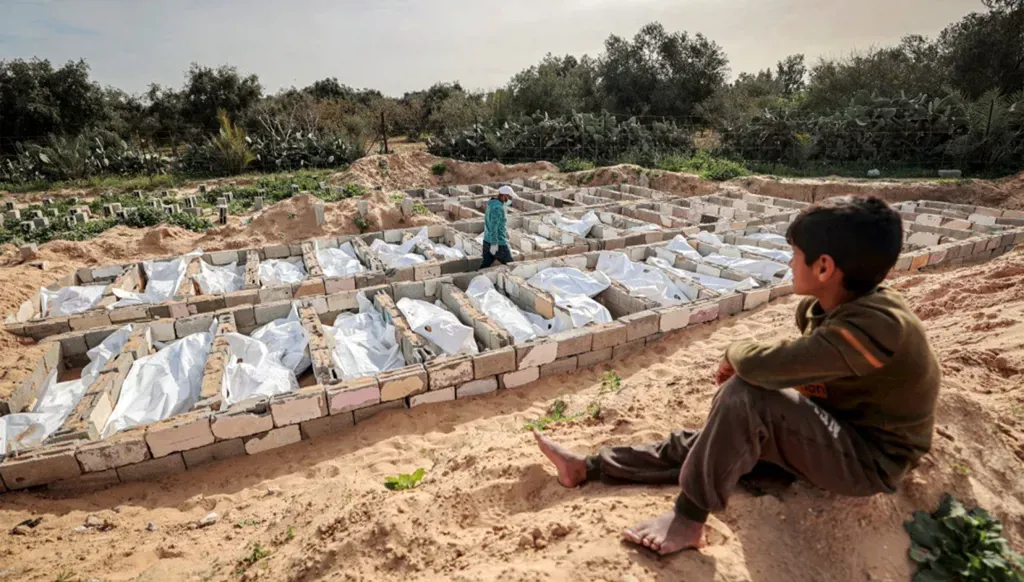
A Palestinian child looks at a mass grave in Deir al-Balah, central Gaza Strip, where 53 unidentified bodies were buried, on February 13, 2026. (AFP)
Smaller Bigger

“I cannot forget the darkest day of my life. We were sleeping peacefully and woke at dawn on August 10, 2024, for the morning prayer when the Israeli army blew up the mosque. We heard the explosions and people screaming, "The mosque!" My children were there. I rushed down to see what had happened and to search for them.”


This is how Mustafa Mohani, from the Shujaiya neighborhood in Gaza, recalls his suffering, filled with pain, agony, and heartache.


Mustafa tells Annahar: “At first, there was no smoke; the fire was raging inside the mosque, and people were scattered outside. Those who had gone in to pray were killed by shell fragments, and anyone still alive was either carried out on a stretcher or succumbed to their injuries. I entered the mosque searching for my three children. One was still alive, and I asked him about his siblings; those present told me one was near the bathrooms. I went there and found someone martyred. As for my eldest son, Saad, I searched in vain. I took my other son, who was still alive, spoke to him, and placed him in the ambulance.”


"I was calling for my son Saad but couldn’t find him, nor did I find his body or remains. Flesh lay scattered on the floor, human flesh. The mosque still stood, with between 15 and 28 people lying on the ground, not a single intact body in sight. They were all torn apart... Later, my wife and I went to the hospital to look for my son who was still alive, only to find him dead."


Mustafa continues his story, saying, “The injured were evacuated to the Baptist Hospital; some survived for a week or five days, others for just one day, and some lived for a month before dying. I spent four days searching for Saad in the morgue, hoping to find him, but I never did.”


Methods of identifying bodies

When asked how the bodies were identified, Mustafa answers: “Among the martyrs were men and women, with only their remains left. In the case of the mosque Sheikh, his head was found; in another case, a hand and the martyr’s watch were found. The rest were identified in a similar way, as families gathered the remains of their loved ones to identify and bury them. The remains were collected in shrouds weighing between 150 and 200 kilograms and buried in a mass grave marked with their names.”


He continues: “My tears are still on my cheeks, and I still wake up screaming. I went through a severe psychological state after seeing my children torn to pieces. I suffered head and eye injuries, and a broken jaw. What can I say about the war, about the horrors we endured and what they did to us? The Israelis killed us in cold blood, and no one stopped the genocide and massacres. I am not the only one searching for his children; there are many like me.”


Other cases of complete evaporation

Mohammad Al-Barsh, from Jabalia al-Balad in northern Gaza, tells Annahar: “My uncle Bassam’s house was bombed by Israeli occupation forces while the entire family was inside — his wife and children, about 12 people. When we returned after the army invaded our area and examined the rubble, we found almost all the bodies except for two. They belonged to a boy named Eyad, the youngest, and another named Mahmoud… Eyad and Mahmoud evaporated.”


He adds: "We only found a small piece (three centimeters) of Eyad's skull, and some of his flesh and bones burnt and stuck together, hanging from the ceiling. But the rest disappeared. As for Mahmoud's body, we saw no bones, skull, or eyes, nothing at all, it vanished completely."


He says: “Civil defense was helping us retrieve the bodies; they specialize in this work, but they told us they had never seen bodies evaporate before. They had heard of such cases but didn’t believe them until they saw it with their own eyes. A civil defense worker told us that two bodies had evaporated.”


Mohammad continues: “I cannot forget that spirit-shaking and overwhelmingly terrifying scene… The hardest part for a genocide survivor is feeling alone in this world, knowing he survived the massacre by himself. Can anyone truly comprehend that? What goes through his mind? Can he carry on? His mixed emotions and mental struggles are beyond description, especially since this scene recurs daily in his memory.”


Ashes and fragments

During the ongoing war on Gaza, the bodies of nearly 3,000 Palestinians evaporated. Civil defense spokesman Mahmoud Bassal tells Annahar: “What we witnessed, based on what people told me, was that there were individuals in specific locations who disappeared completely, evaporated without a trace.”


He explains that in some cases, "the body completely melted away, leaving nothing but perhaps blood stains or bone fragments, or part of the scalp."


Bassal adds: “Israel used internationally banned weapons targeting civilians and civilian buildings, constituting a violation of international humanitarian law. Lethal weapons were used that could melt and dismember people’s bodies, violating the rules of warfare, but in Gaza, anything seems allowed.”


He explains: “According to experts, internationally banned weapons emit extremely high temperatures, causing bodies to evaporate. We observed this clearly during humanitarian response operations while searching for civilians, but we could not find them after inspecting the sites.”


The civil defense spokesman continues: “Some might say the bodies were under the rubble, but this is not true. We encountered this situation inside residential apartments and beneath the rubble; bodies don’t just disappear. Everything is usually visible to the naked eye, and if someone inside a building is hit by a GBU-39 missile, that type generates extreme heat, causing the body to melt.”

Bassal confirms that the assassination of the military spokesperson for the Qassam Brigades, Hudhayfa Al-Kahlout, resulted in his body evaporating after six bombs struck his location along with his family.


The impact of explosions on bodies

For his part, military and strategic expert Brigadier General Akram Suwayri states, during an interview with Annahar, that “the impact on bodies depends on several factors, most notably their proximity to the explosion’s center and the type of ammunition used. The stronger the explosion, the more any body becomes fragmented, and the further away a person is, the lesser the damage.”


Suwayri points out that “being exposed to a severe explosion tears and fragments the body, making identification difficult except through laboratory DNA tests. The features disappear completely, and the body is left with disfigurements that make recognition nearly impossible afterward.”


He adds: "In regular armies, soldiers carry metal numbers for identification if killed, but this doesn't apply to civilians in Gaza. Therefore, rescuers face great difficulties, especially since some bodies turned to fragments or nearly completely evaporated."


Suwayri explains: “The other problem is the mixing of victims’ remains when residential gatherings of displaced people in schools or tents are targeted, all crowded together, which complicates the sorting process, in addition to the lack of laboratories and sufficient capacity to analyze and identify them.”


He indicates that Israel uses types of lethal weapons that cause bodies to nearly completely vanish, particularly thermobaric bombs (pressure and heat), also known as vacuum bombs, designed to kill as many people as possible and inflict maximum destruction, often used to demolish high-rise towers and residential buildings.


Suwayri says: "The danger lies in how thermobarics work: a cloud of highly explosive materials penetrates the place from a small hole, enters the body through the respiratory system to the lungs, then explodes, causing some bodies to explode from within and evaporate."


He adds: “Neither tunnels nor walls or barricades can protect people, as the cloud of explosive materials spreads rapidly, leaving no chance of survival for those within the explosion’s radius, which can extend tens of meters. Even fortified places like tunnels and houses suffer a reverse pressure wave, leading to their complete destruction because of the explosive materials’ interaction with the air. Temperatures rise above 3,000 degrees Celsius, creating a significant pressure difference inside and outside the building, resulting in its total collapse.”


Also, according to Suwayri, “Israel uses incendiary, high-explosive weapons with warheads weighing about a ton of highly explosive materials, reducing individuals to fragments that are difficult to identify after death.”


Between the testimonies of families and expert analyses, a picture of tragedy emerges that transcends traditional loss. In Gaza, the pain does not end with death but extends to the absence of the body itself, denying families a final farewell or a known grave. The loss becomes an open wound, doubling the suffering and leaving a heavy burden on the memories of survivors.


Tags