

Decentralization in Syria: Al-Sharaa's gamble pays off
The international community now eyes the SDF-Damascus agreement as a formula for bringing Syria's minority groups into the fold. Has hope for a comprehensive settlement disappeared?


 Messenger
 Whatsapp
 Threads
 Email
Email
 Print
Print
 X
X
 Facebook
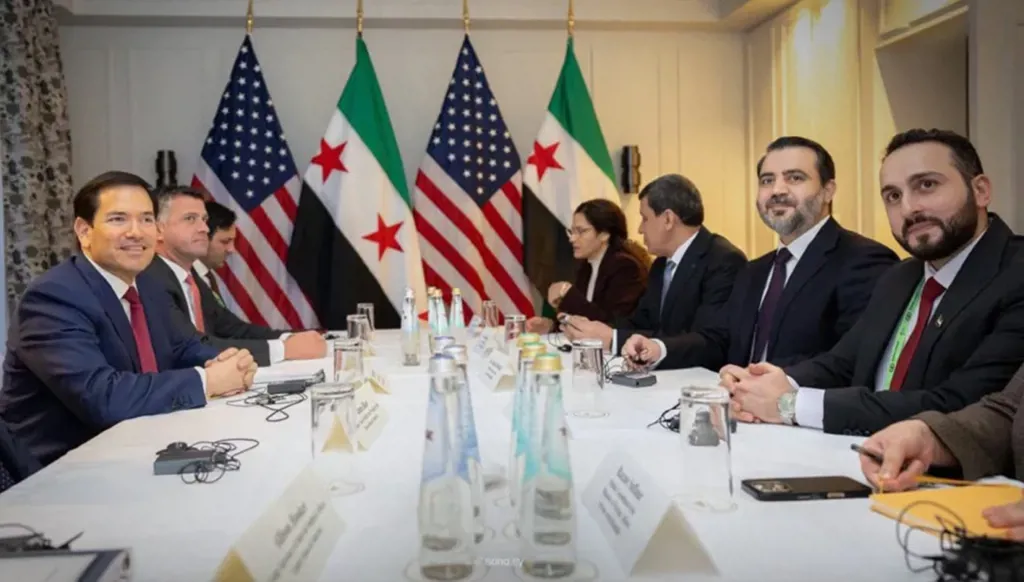


In recent days, discussions about decentralization in Syria have intensified from a diverse array of actors including a major country’s foreign minister, Kurdish leaders in Munich, and highly-publicized testimony before Congress. What was previously understood as a largely-domestic matter has once again re-surfaced in international discourse, in the context of an agreement underway between Damascus and the Syrian Democratic Forces (SDF). Are we witnessing a redefinition of decentralization within the Syrian state, or will subsequent agreements simply vest more power in a centralized Damascene government?
The spark came from U.S. Secretary of State Marco Rubio’s statement, in which he said the United States is “satisfied with the current track in Syria,” following the agreement between the Syrian government and the Syrian Democratic Forces (SDF). However, he emphasized the need to reach “similar agreements with the Druze, Bedouins, Alawites, and all components of Syria’s highly diverse society.” Rubio did not specify the nature of these agreements, but the context suggests he was referring to understandings similar to the one signed between Damascus and the SDF. The most significant aspect of his statement was the mention of specific Syrian minority groups, placing the idea of bilateral understandings with societal components at the center of the discussion about the state’s future.
Parallel to this, the participation of Syrian Democratic Forces (SDF) commander Mazloum Abdi and Ilham Ahmed, co-chair of the Autonomous Administration’s Foreign Relations Department, in the Munich Security Conference was particularly notable. They attended a meeting with Syrian Foreign Minister Asaad Al-Shaibani and the U.S. Secretary of State. This was striking because Abdi and Ahmed do not hold official positions within Syrian state institutions, and yet they joined an international meeting alongside the country’s foreign minister in the context of discussing the implementation of military and administrative integration agreements between Damascus and the SDF. Their unofficial presence at an international conference and participation in such a high-level meeting signal a shift from a local administrative role to a negotiating position on the international stage.
Ilham Ahmed stated that the agreement with Damascus “does not include a solution for the Autonomous Administration,” but rather addresses the reorganization of its institutions “within a decentralized framework inside the unified Syrian state.” Meanwhile, Mazloum Abdi emphasized that the Kurds “want local Kurdish governance under any name,” noting that the disagreement with the Syrian government revolves around “titles and terms,” rather than the principle of locally managing areas and preserving their particularities. Abdi had previously asserted that Kurdish areas should be managed militarily and administratively by their own inhabitants.
Several days earlier, during a hearing before the U.S. House of Representatives Foreign Affairs Committee, former U.S. Ambassador James Jeffrey discussed the necessity of “enhancing local governance” in Syria, describing it as essential for securing the loyalty of the Kurds and other minority groups. He linked tangible progress in this area to gaining broad support for reconstruction, citing Articles 122 and 123 of the 2005 Iraqi Constitution as examples of local governance authorities operating within a single state. In this context, the focus was not on partial agreements, but on establishing an institutional framework for local governance within a unified Syrian state.
This parallel between Rubio’s statements and Jeffrey’s testimony highlights a divergence within U.S. policy itself. U.S. envoy Tom Barrack had previously affirmed his support for a strong central government in Syria, arguing that federalism and political decentralization models in the region had failed to achieve the desired stability. In contrast, Rubio’s statements and Jeffrey’s testimony demonstrate openness to reaching agreements with specific components and enhancing local governance as a pathway to stability. The divergence here is not merely a matter of terminology, but reflects a deeper difference in vision: a strong centralized state versus a state built on negotiated understandings with its components.
Nothing new
Kurdish leaders have been discussing federalism or autonomy in various forms for months. Druze voices, in the wake of violent incidents in the coastal and Sweida regions and escalating military tensions in the northeast, raised their demands to the point of talking about secession. In the coastal region, Alawite calls for broader local governance emerged following a wave of violence there. Sheikh Ghazal Ghazal had repeatedly advocated for decentralization and federalism, although in his most recent statements, these terms were replaced by discussions of power-sharing and representation.
In contrast, the temporary authority in Damascus emphasized the centrality and territorial unity of the state, rejecting any proposals perceived as promoting division or secession, and describing certain calls for decentralization as harmful to the country’s cohesion.
Amid this debate, the Minister of Local Administration and Environment issued a decision delegating several of his powers to governors, in what the ministry described as a step to enhance “service decentralization” and expedite procedures. However, this measure falls within the scope of administrative decentralization stipulated by Law No. 107, which was enacted during the tenure of former President Bashar al-Assad, and does not seem to address the demands for political decentralization pushed for by many local actors. Some observers interpreted this as an olive branch, with Damascus hoping to confine the discussion to administrative matters. This followed discussions within the Interior Ministry about a plan to restructure the security system by dividing the country into five security sectors under joint supervision—a step that sparked intense debate but was never implemented in practice.
The paradox is that this surge in discussions about decentralization came after the implementation of the Damascus–SDF agreement, which some viewed as a practical end to autonomy demands by returning the northeastern regions to state authority. Yet the same mechanism, initially presented as a reinforcement of centralism, is now being proposed as a model for similar understandings with other components. An agreement assumed to reaffirm central authority in the northeast is transforming in international discourse into a formula for solving the governance problem in Syria.
Here a deeper question emerges: Will decentralization in Syria abandon the idea of a comprehensive constitutional project to pursue a series of bilateral agreements with specific groups? Will the state redefine itself internally through clear institutional reform, or is power being redistributed through partial understandings framed as measures for stability? The answer is yet to be determined, but one thing is clear: decentralization is no longer merely a local demand—it has become an integral part of the political discourse shaping international discussions about Syria’s future.