

Syria’s SDF integration plan falters as tensions rise in Aleppo


 Messenger
 Whatsapp
 Threads
 Email
Email
 Print
Print
 X
X
 Facebook
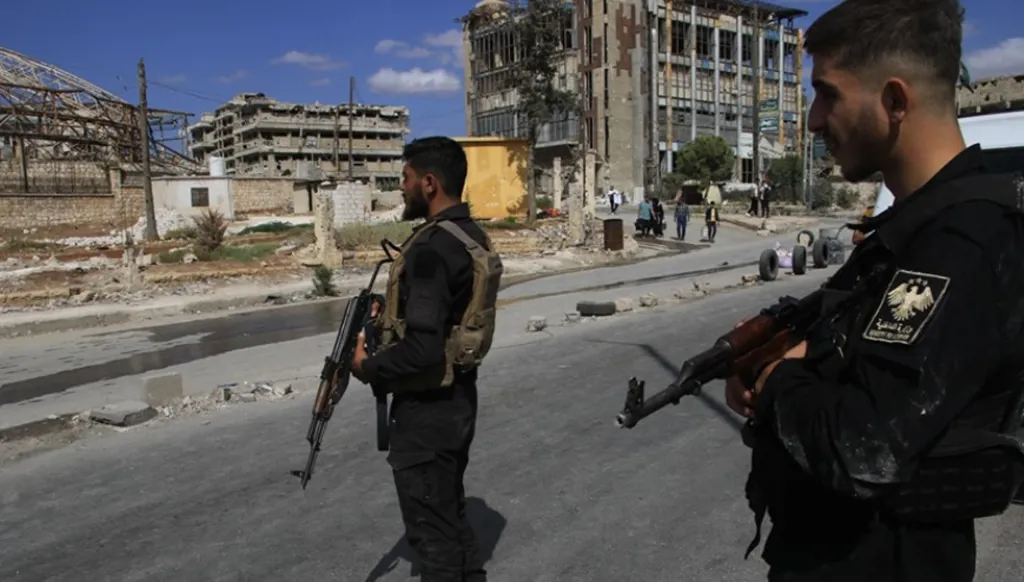


As the year-end deadline approaches for the planned, locally and U.S.-backed integration of the Syrian Democratic Forces (SDF) into the new Syrian army, signs are growing of a diplomatic stalemate between the two sides, accompanied by escalating tensions on the ground.
Predominantly Kurdish neighborhoods in northern Aleppo witnessed clashes twice in one week, threatening to undermine the March 10 agreement between Syrian President Ahmed al-Sharaa and SDF commander Mazloum Abdi, were it not for swift containment efforts. This unfolded amid an escalation in rhetoric from Damascus against Washington’s allies, whom the Interior Ministry described as “militias” for the first time.
A negotiation game between control and flexibility
The dilemma of integrating the SDF into the Syrian army extends beyond the military dimension. Beyond its links to internal politics and local identity, the issue represents a cornerstone of efforts to rebuild Syria’s collapsed state, amid deep challenges that continue to obstruct the practical implementation of agreed frameworks, raising questions about Syria’s political and security future.
The SDF has maintained its readiness to negotiate with Damascus, while insisting on clear conditions: preserving its internal force structure, ensuring the continuity of its counterterrorism units, and pursuing gradual integration into the Syrian army through specialized formations.
Its rejection of full dissolution stems from fears of losing political and security gains and, more critically, exposing fighters who battled ISIS and allied extremist groups to direct retaliation.
Presenting itself as a responsible partner, the SDF promotes an “integrated divisions” model, whereby fighters are gradually absorbed into army units while retaining a limited internal structure to manage security coordination and oversee self-administration areas - both Kurdish-majority and predominantly Arab - considered among Syria’s most stable regions today.
This formula grants Damascus a degree of control on the ground while allowing the SDF to preserve flexibility and protect local gains. Yet its practical application faces serious obstacles. Integrating specialized units requires unified training systems, shared command mechanisms, and effective intelligence coordination - conditions far removed from the Syrian army’s current reliance on formal and largely theoretical training models.
Mutual distrust further complicates the process. Damascus fears the emergence of a “state within a state,” while the SDF fears that full integration would erase its influence over its territories.
SDF faces mounting pressure
Damascus has intensified pressure on the SDF in recent days, driven by a desire to reassert full control over northern and eastern Syria. Official statements have escalated warnings against the SDF’s refusal of full integration, reflecting both Syrian and Turkish perspectives.
Kurdish neighborhoods in northern Aleppo - particularly Sheikh Maqsoud and Ashrafiyeh - have emerged as pressure points, with escalatory messaging coinciding with Ankara’s recent diplomatic engagement in Damascus, marked by the visit of Turkey’s foreign and defense ministers and intelligence chief.
Turkey, which considers the SDF an extension of the Kurdistan Workers’ Party (PKK), has played a central role in escalating tensions through political and military pressure and by backing local factions opposed to the SDF. Ankara seeks to prevent any autonomous armed structure from gaining institutional recognition within the Syrian state, rendering integration formulas vulnerable to obstruction.
This escalation is evident in continued military activity along the border and sustained pressure on Washington to curb support for the SDF, particularly in areas adjacent to Turkey.
Reports of a rejection of Abdi’s planned visit to Damascus added to tensions, though the SDF later clarified that the postponement was due to “technical reasons,” confirming that a new date would be set by mutual agreement.
Fragile balances under strain
The United States, a key backer of the SDF in recent years, has adopted a more cautious stance. Washington fears that direct confrontation between Damascus and the SDF could trigger renewed chaos, facilitate the resurgence of ISIS cells, and destabilize the region - while also diminishing U.S. leverage in Syria.
As a result, Washington is seeking to de-escalate tensions through mediation, emphasizing the need for integration that preserves SDF gains while preventing the emergence of an independent armed force outside state authority.
Yet U.S. mediation faces limits. Fundamental disagreements over the form of integration, administrative and political rights, combined with Turkish pressure and Damascus’s reluctance to compromise, suggest Washington can only manage the crisis rather than impose a definitive solution.
Current indicators point to stalled implementation of the March 10 agreement within the U.S.-set timeframe, raising the likelihood of a fragile status quo. This would leave the SDF in a semi-autonomous position, suspend meaningful integration, and sustain security tensions - particularly with the possible activation of Turkey-aligned factions in northern Aleppo and other Kurdish neighborhoods.
Against the backdrop of overlapping local, regional, and international pressures shaping Syria’s future, failure to implement the agreement risks upsetting an already delicate balance, especially as southern Syria witnesses a hardened Druze stance and central and western regions see growing Alawite mobilization, underscored by mass responses to recent protest calls.