

Iraq faces Washington’s pressure and deep factional divisions over the future of weapon restrictions
The debate comes at an especially sensitive moment, coinciding with consultations to form a new government, making the weapons issue a key factor in shaping the state’s future direction.


 Messenger
 Whatsapp
 Threads
 Email
Email
 Print
Print
 X
X
 Facebook
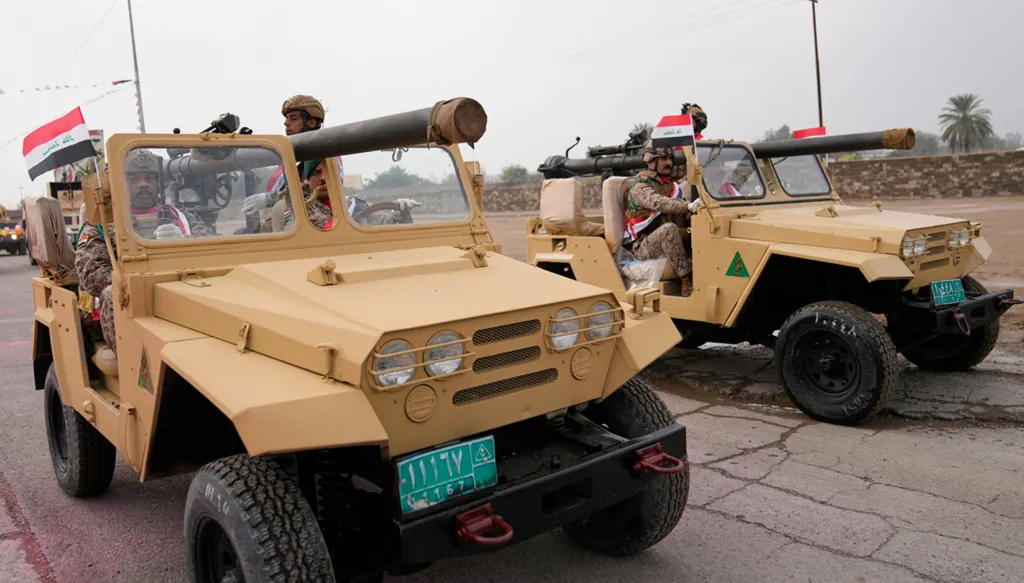


The political and security debate intensifies regarding the issue of restricting weapons to the Iraqi state, amid increasing American pressures and deep regional transformations following the Gaza War, and a clear division within the armed factions themselves between those who see weapons as a "guarantee of existence" and those who lean towards repositioning politically and institutionally.
This debate comes at a highly sensitive timing, coinciding with consultations for forming the new government, making the weapons issue one of the major determinants of the state’s future shape and course.
In this context, the U.S. President's envoy to Iraq, Mark Savaya, commented on the recent calls from some Iraqi forces and factions regarding disarmament, describing them as a 'welcome development,' but also emphasized that the process cannot be partial or superficial. It must be comprehensive and irreversible, involving the complete disbandment of armed factions and ensuring an organized and legal transition of their elements into civilian life, based on the Iraqi constitution and the rule of law.
This American stance has reopened internal discussions about the feasibility of weapon restriction and its possible implementation, amid clear differences in factions' positions. While some forces involved in the political process are showing increasing flexibility, other factions still see weapons as necessary amid continued foreign military presence and regional interferences.
This division is reflected in the stances of prominent faction leaders, including Qais al-Khazali (Secretary General of Asa'ib Ahl al-Haq) and Shibl al-Zaydi (Secretary General of Kata'ib Imam Ali), who expressed initial support for limiting weapons to the state. In contrast, Kata'ib Hezbollah and the Nujaba Movement made their acceptance conditional on a total withdrawal of foreign forces and achieving full Iraqi sovereignty.
Conversely, voices within some factions are emerging, showcasing readiness to positively engage with the path of weapon restriction.
Ali al-Fatlawi, a leader in the Ansar Allah Awfiya movement, states that 'the concept of resistance has been deliberately or unintentionally misunderstood, explaining that "the origin of resistance is linked to the existence of occupation and addressing major threats like ISIS and Al-Qaeda."
He adds, in a talk with Annahar, that the military defeat of ISIS and the diminished threat of terrorist organizations, alongside the changing American policy and its announced gradual withdrawal, impose "a transition to a new phase based on organizing and rationalizing weapons in alignment with the state's strength."
He affirms that the Iraqi state today has become "stronger with its institutions, security forces, and political powers that have integrated within its constitutional framework," emphasizing that his movement's stance is based on the principle of "no weapons outside the state's framework," distinguishing between "restricting weapons within the official system and concepts of sale, stripping, or surrender, which many armed actors reject."
Meanwhile, Khaled Al-Marsoumi, a leader in the Reconstruction and Development Coalition, sees the issue of weapons outside the state’s framework as a purely Iraqi matter, which cannot be resolved under any external pressures.
Al-Marsoumi tells Annahar that this issue "directly affects the citizen’s security and the state’s sovereignty and monopoly over peace and war decisions," pointing out that the past months have witnessed extensive political and social movements "where forces from various provinces have expressed their rejection of any armed activity outside the state's authority."
On the other hand, legal experts present a stricter interpretation regarding the American stances. International law professor and former advisory council member to the U.S. President Gabriel Soma emphasizes that Washington "has not yet received any clear positive messages from the Iraqi factions themselves regarding disarmament and full political engagement."
Speaking to Annahar, he notes that the declared positions "still tend towards holding on to weapons, either as part of domestic security or linking their relinquishment to preconditions."
He adds that American officials, including Secretary of State Marco Rubio, have clearly expressed their demand for the disarmament of factions loyal to Iran and their integration into the Iraqi armed forces, considering that "the ongoing dialogues have not yet led to any explicit commitments or final agreements."
As the issue of the Prime Minister's position nears resolution within the Coordination Framework the question remains open as to whether Iraq is truly moving towards a phase where the state monopolizes force, or if weapons will remain a decisive pressure factor in shaping power equations in the coming years?