

On the Anniversary of Assad’s Escape... Has Hezbollah Found a Rationale to Retain Its Weapons


 Messenger
 Whatsapp
 Threads
 Email
Email
 Print
Print
 X
X
 Facebook
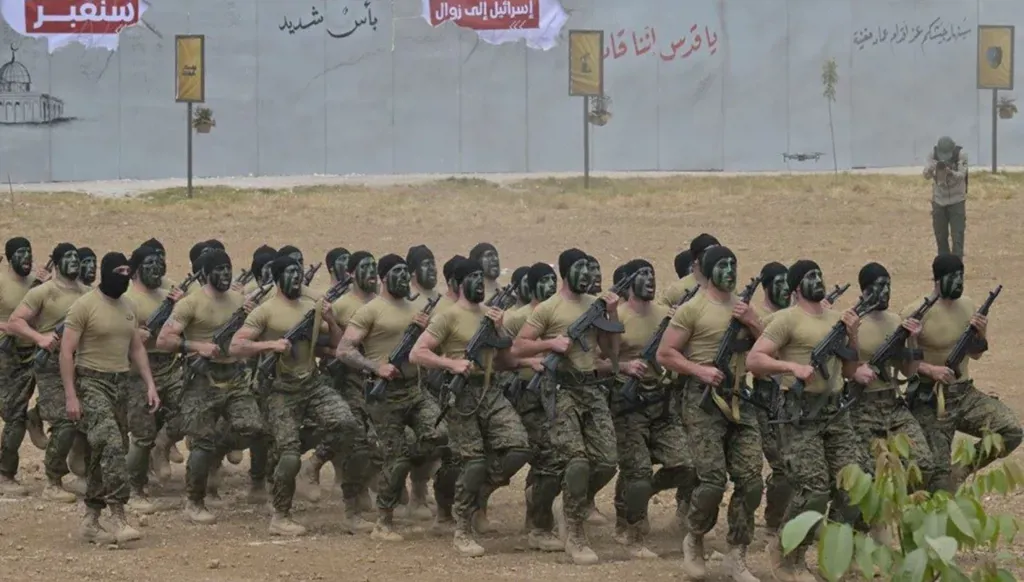


Lebanese squares witnessed popular demonstrations celebrating the first anniversary of the fall of Bashar al-Assad's regime in Syria, or as many prefer to call it, the anniversary of the "escape of the criminal Bashar al-Assad."
These popular expressions would have been natural and carried many spontaneous and popular connotations, expressing a sincere hatred for that regime, which subjected both Syrians and Lebanese to over four decades of torture, killing, and oppression.
However, these were marred by security issues that arose in some areas supporting the Shiite duo, as happened in the Haret Saida area, in the south, or elsewhere, warning of a sectarian "inflation" that could ignite at any moment into a conflict between factions within the country or at the border with the Syrian regime.
The slogans that emerged from supporters of "Hezbollah" and the "Amal Movement" were provocative, particularly in relation to slandering President Ahmad al-Sharaa.
Therefore, it was not surprising that Lebanese squares witnessed these demonstrations, which formed to express and celebrate this anniversary, especially in Tripoli, the capital of northern Lebanon, which had suffered significantly under this regime in earlier times, and in Beirut's Rouche area, where "Hezbollah" recently posed a challenge to the state and the Lebanese people by expressing its insistence on retaining its weapons and presence despite calls for exclusive arms control.
After November 27, 2024, "Hezbollah" lives with the obsession of defending its weapons and works diligently to convince different Lebanese sects of the nature of its weapons and defense of Lebanon.
Numerous party officials consistently affirm that the purpose of these weapons remains unchanged and that their surrender is not an option, despite the Council of Ministers' decision on August 5 and its continuation on August 7, requesting the Lebanese army to devise a plan to centralize weapons in the hands of official institutions.
Domestic factions in Lebanon never miss an opportunity to demand the surrender of the party's weapons, arguing that state-building should not be based on the existence of two armies, and that restoring confidence in the Arab and Western worlds cannot occur with the existence of an armed organization outside the state framework, particularly one that operates according to foreign agendas linked to Tehran's interests.
This is despite multiple Iranian officials emphasizing the need to centralize weapon decisions in the hands of Beirut leaders, with Tehran having no involvement.
Prime Minister Nawaf Salam raised an intriguing debate in an article published by the "Financial Times" regarding who would be the first to implement the provisions of Resolution 1701—"Hezbollah" surrendering its weapons or Israel ceasing its attacks, withdrawing from Lebanon, and releasing hostages?
These are the themes of the current phase, where the Lebanese arena is experiencing active diplomatic movement stressing the necessity of exclusive arms control as a fundamental step towards building the country.
The French envoy, Jean-Yves Le Drian, completed a visit to Beirut amid reports of his call to expedite the issues of reforms and exclusive arms control south and north of the Litani, both of which are hindering the convening of a conference to support the Lebanese army.
The issue does not stop at the American side, which rejects any settlement in light of the presence of weapons, nor even the French side which aligns with the American direction but extends to the Arab position, which opposes Lebanon's reconstruction amid talk of unconfined weapons.
The complication arises for the party, and Israeli threats are increasing. The Israeli newspaper "Yedioth Ahronoth" reported that the head of intelligence "AMAN," Shlomi Binder, met the US envoy, Morgan Ortagus, during her recent visit to Israel before she attended the mechanism meeting in Lebanon, where she was provided with information about "Hezbollah's increasing power and the inability of the Lebanese army to confront it."
It does not seem that the party, which is repositioning and working on recovery after the last war, is moving towards surrendering its weapons but is rather searching for justifications for retaining them.
Thus, some believe that these demonstrations in Lebanon, supporting Al-Sharaa, inadvertently took a path to support the ideology of clinging to weapons and entrenched it under the premise that the existential threat to the Shiites may not come from Israel but from east and north Lebanon, particularly from the Syrian regime and its supporters in Lebanon, as indicated by these demonstrations.
There is no debate whether the demonstrations veered off the intended course, or if according to some sources, a fifth column, in the manner of the Assad regime, infiltrated the protesters and caused issues with those areas, aiming to instill the awareness that someone is coming to eliminate them, justifying the stance of holding onto weapons.
Iranian Foreign Minister Abbas Araqchi's statement during a conversation with his French counterpart that the withdrawal of the party's weapons could lead to a civil war and destruction of the Shiite sect was more than just words. This, if indicative of anything, suggests that the party has no intention of surrendering its arms, leaving Lebanon waiting for a war whose source matters less than its title: the weapons of "Hezbollah" and the mechanism of their withdrawal.
-The perspective provided does not necessarily reflect the opinion of the "Annahar" media group.