

Syria’s missing: When the search for the lost leads to mass graves


 Messenger
 Whatsapp
 Threads
 Email
Email
 Print
Print
 X
X
 Facebook
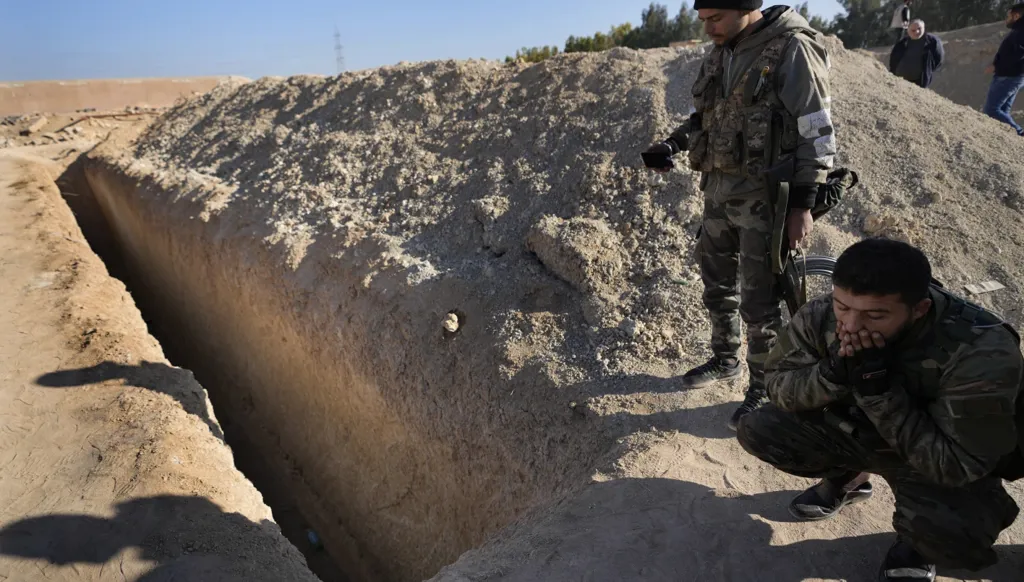


The search for thousands of Syrians who went missing during the civil war reflects a deep that remains unhealed, as mass graves scattered across the country reveal the full scale of the tragedy. With the political landscape changing, the new government now faces the difficult challenge of exhuming remains and identifying the victims, in the hope of granting families some measure of peace.
During the 13-year civil war, more than 100,000 people disappeared. To bring some relief to their families, the new government faces the daunting task of exhuming their remains from dozens of graves. Families of the missing no longer arrive in groups every day at the Najha Cemetery in search of their loved ones’ remains, as they did a year ago. In the days following the overthrow of dictator Bashar al-Assad in December, some families even came carrying shovels, determined to dig up the mass grave there. But in the end, they gave up when they realized they would find nothing but bones inside body bags, with no way to identify their owners, according to a report by The New York Times.
The former authorities arrested tens of thousands of people deemed opponents of the regime during the war. Many disappeared, and countless others were executed or killed under torture, according to human rights organizations. It is believed that hundreds, and perhaps thousands, were buried in the Najha Cemetery, located on the outskirts of the Syrian capital, Damascus.
Officials have stated that at least 60 mass graves have been identified across Syria so far, with new ones being discovered regularly. However, identifying those buried in them is part of a broader and more complex problem facing the country’s new leaders, who are attempting to achieve a measure of accountability and justice for the war crimes committed by the Assad regime.
Syrian academic and George Washington University professor Radwan Ziadeh told Annahar that this issue “is among the top priorities of the Syrian government today, especially determining the fate of the missing.” He noted that “the Syrian government has formed the National Commission for the Missing,” stressing that “the number of missing persons exceeds the government’s capacity to uncover their fate.”
Ziadeh added: “Therefore, international cooperation is essential in this regard.” He pointed out that “in Bosnia and Herzegovina, the international community established the ICMP to help the Bosnian government determine the fate of more than 73,000 missing persons. In Syria, of course, the number is far greater, and therefore the international community must assist in this extremely important file.”
Families of the missing are therefore calling on the government and international organizations to exhume bodies and identify them. Officials warn, however, that this will be a long and grueling process, as the new government lacks the technical expertise and forensic capabilities required and will need the support of international organizations.
The Syrian Minister of Emergency and Disaster Management has stated that nearly 140,000 Syrians are still considered missing.
The true scale of the number of people who may have been killed by the Assad regime became even clearer when rebels stormed Syrian prisons a year ago. The rebels emptied open-air cells, according to the Syrian Network for Human Rights. However, families of the missing expected to find more.
In some prisons, families and rescue workers spent weeks digging through concrete floors in search of what they believed were underground cells holding large numbers of additional prisoners. They found nothing. It was then that they realized the missing were most likely to be found in mass graves.
Human rights activist and founder of the Syrian Observatory for Human Rights, Rami Abdel Rahman, told Annahar:
“First, regarding the issue of mass graves and the missing, it cannot be ignored that the missing were a fundamental part of Syria’s tragedy, and that the international community showed widespread sympathy for this file after the fall of the tyrant Bashar al-Assad’s regime. During the first two weeks after the regime’s collapse, international media focused on claims about Sednaya Prison and the existence of seven underground floors, despite the fact that everyone knew the prison had one underground level and two above it, according to its known structure.”
He added: “During those days, media attention shifted to the issue of the missing and their bodies, while Israel was bombing Syrian territory, making the issue exploited politically rather than treated as a purely humanitarian file. Today, nearly a year after the regime’s fall, the question remains: Where are the bodies of the tens of thousands of detainees who disappeared in the regime’s prisons? Is it conceivable that the current authorities, despite arresting officials from the former intelligence services, have been unable to locate the sites of the bodies and mass graves? And why was tampering with files inside security branches allowed in the first days following the regime’s collapse?”
Abdel Rahman stressed that “the Syrian government today must fully assume its responsibilities. Yes, we seek life, but this life was not gained easily, it came through the sacrifices of the missing who perished in the regime’s prisons. And we must not forget that the Caesar Syrian Civilian Protection Act played a fundamental role in crippling the regime through U.S. sanctions and contributed significantly to its collapse and downfall".
Indeed, there were initiatives led by Syrians living abroad on this issue, but the current Syrian government showed no willingness to work with them. A Syrian academic residing outside the country, who asked not to be named and who founded a genetic-based initiative to search for the missing, told Annahar:
“The initiative we launched was halted due to the government’s lack of willingness, at least, to continue working with us. Currently, according to our information, the Red Cross is working on establishing a genetic laboratory or providing some genetic technology for the forensic medicine department at the Syrian Ministry of Health. That is what is currently underway.”
Rahman added: “There are also some very modest initiatives by the Syrian Atomic Energy Commission, but there is no information about the development of this initiative or about its strength and capacity in this field.”
As for why the Syrian government was unwilling to move forward with the initiative, he told Annahar:
“In truth, we received no clarification as to why there was no desire to continue with this initiative. Their view was that there were other offers, initiatives, or opportunities more suitable for working on the project of establishing genetic laboratories, and accordingly, work on this matter was stopped immediately.”
Rahman believes that “the government, with the existence of the National Commission for the Missing and the National Transitional Justice Commission, is showing seriousness in uncovering the fate of the missing. In addition to the Atomic Energy Commission, the government is working on establishing a genetic laboratory and has requested support from the Red Cross, alongside the role of the Ministry of Health and forensic medicine.”
Rahman emphasized that “practical steps are being taken. They may take longer than we had expected, but progress appears real, even if slow. Nevertheless, I still believe that seriousness in this direction continues to exist for now.”
The issue of the missing constitutes a profound humanitarian challenge and a real test for the new Syria. Their fate remains the key to understanding the scale of the tragedy and achieving justice. Between mass graves and the lack of technical expertise, international cooperation remains essential to give families the truth and justice for which they have waited so long.