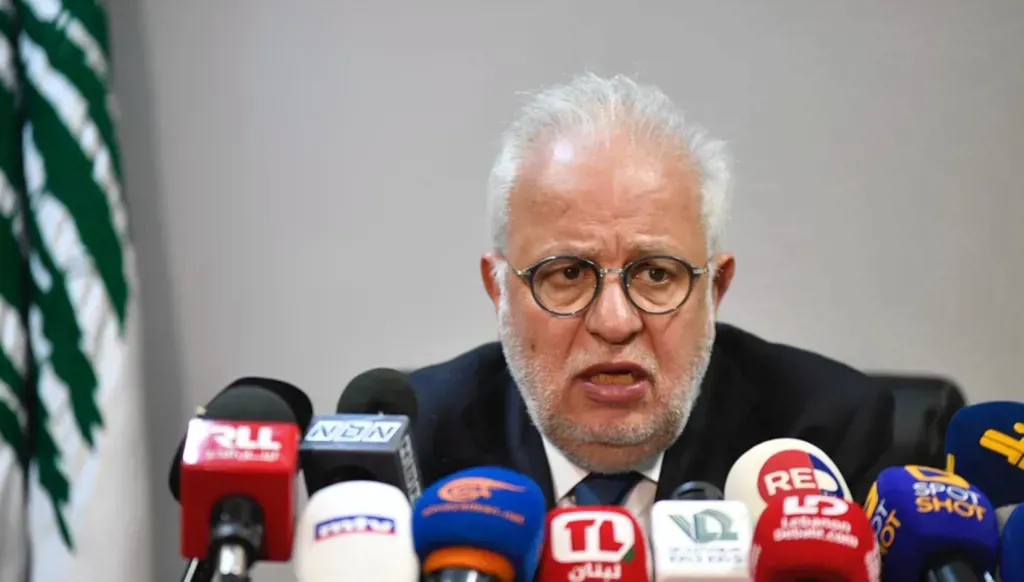
“The confrontation has become one between Hezbollah and the Lebanese state.” With this clarity, Minister of Justice Adel Nassar summarizes the Lebanese scene in an interview with Annahar. Following the Council of Ministers’ decision to deem the party’s security and military activities illegal, and after dragging the nation into a war of attrition in support of Iran, the Lebanese state now finds itself facing a serious and complex predicament.
In parallel, the judiciary faces enormous pressure from numerous files, decisions, and rulings, amid growing strain on state institutions—starting with the prison issue, continuing through the war, and extending to government decisions concerning exclusive control over weapons.
On the issue of transferring Syrian prisoners to their country, Nassar reveals that the operation “was carried out at the border between the Lebanese General Security and the Syrian General Security, where 137 prisoners who met the conditions—out of approximately 300—were transferred to complete their sentences in Syrian prisons according to a signed agreement.”
Regarding the protests in Roumieh prison, and whether he considers them justified given the years of trial delays, Nassar rejects this view, although he acknowledges delays in some cases due to past circumstances, stating: “Aside from these cases, the courts are following the files, and all issues are being addressed with utmost speed. Judicial procedures are ongoing, and if the duration of pre-trial detention exceeds the legal limit, the relevant judges and the Judicial Inspection Authority follow up to ensure releases when the legal term is exceeded.”
He adds: “It is natural for prisoners to request reduced sentences, so I prepared a draft law and sent it to Parliament, granting the Sentence Reduction Committee broader powers and executive authority, so that its decisions become enforceable without exceptions, enabling it to consider various cases.”
Amid the issue of transferring Syrian prisoners and the problem of overcrowding, the topic of a general amnesty arises again, with Nassar stating decisively: “This matter is up to Parliament to decide.”
When asked about the perception among some Lebanese, particularly Sunnis, of injustice in prisons—feeling that they were stopped while others passed freely with weapons—Nassar rejects the sectarian approach, deeming it unacceptable to view anyone as a representative of a sect. He emphasizes: “The Lebanese state is responsible for the security and protection of all Lebanese individually. The main problem lies in the parties’ attempts to speak for the sects, but the state is responsible for all its citizens without exception.”
He stresses: “There was an ambiguous stance from the Lebanese state before this government was formed regarding Hezbollah’s possession of weapons, but it is no longer possible to say this ambiguity still exists. The state has affirmed that weapon control is a final, irreversible decision, as stated in the ministerial statement on which the government’s confidence was built.”
He notes: “The party has a public, but it does not represent a sect and cannot speak for it, and this applies to all parties.”
On the issue of releasing detainees with arms for $20, he points out: “The previous ambiguity in the state’s stance on weapons has ended, and this decision broke the notion that membership in the party legitimizes bearing arms.” He adds: “As Minister of Justice, I do not assess whether the penalty is high or not, as there are judicial and regulatory paths that fulfill this role. Cases still pending before the courts are decided based on legal and constitutional realities. In instances of detention followed by release, it falls within judicial powers. If there are suspicions of interference or pressure, the litigant or concerned party—or even the Minister of Justice—can turn to the competent authority to investigate any procedural irregularities.”
Hezbollah weakens Lebanon's capacity
In the political and security aspect, Nassar paints a clear picture of the state's stance change, asserting that "all ambiguity was removed after the state confirmed that weapon control is a final, irreversible decision." He emphasizes that the concept of "resistance" ended after 2000, and subsequent events, from 2006 to 2008, including the intervention in Syria and the current war, "are entirely outside the logic of resistance."
He goes further, noting that recent events “exposed Lebanon to war,” pointing out the existence of “coordination between operations launched from Lebanon and those from Iran, in a complementary logic, as if Hezbollah is part of Iran’s defense system, which is entirely against Lebanese interests.”
Conversely, he acknowledges Israeli aggression, highlighting that it “leads to humanitarian disasters, killing children, and massive displacement,” and asserts that the state “strongly condemns it, but the effectiveness of the confrontation is tied to the state's capability,” deeming that “Lebanon's interest lies in dragging Israel into the diplomatic and political arena instead of being dragged into the military arena, where it enjoys destructive power and massive external support, as Hezbollah itself admits to the imbalance of power.”
Regarding the state's ability to implement its decisions, he acknowledges a backlog extending 30 years, clarifying that the previous phase relied on either “adopting Hezbollah's arms” or considering it a “contentious issue,” but today “the confrontation is between the party and the Lebanese state.”
He confirms that the decision to control weapons “is not a compliance with an American or Israeli demand,” but “is directly linked to the Lebanese state's and people's interest,” noting that this decision was made before being drawn into war. He adds that this “does not mean at all that the state is unaware of the need to confront Israeli aggression, but this confrontation should not come at the expense of Lebanese blood, but through international forums, provided they are effective, an effectiveness which Hezbollah obstructs.”
On the party's obstinacy, Nassar states that its defiance “diminishes Lebanon's ability for diplomatic confrontation, as it disrupts this path while simultaneously complaining about its failure.” He holds it responsible for shifting Lebanon “from a state of Israeli aggressions to a state of war.”
Regarding international legal measures, he emphasizes the need to “pursue any channel that can halt attacks on Lebanon,” but reiterates that this path “is disrupted by the existence of weapons outside state control.”
When asked about the alleged Hezbollah cell in Kuwait, he responds: “I have not received any information about this, and I am waiting to see whether a judicial assistance request will be submitted if an actual case file is established. If confirmed, Lebanon will cooperate according to established rules and applicable laws.”
In the midst of the war's pressing scene, Lebanon's battle today appears dual: justice at home and sovereignty abroad. At the heart of this confrontation, the question arises: Is it still possible to implement the weapon control decision after the war ends? The Minister of Justice sums up his response by saying: “It must be implemented, or there is no building of a state!”



 Messenger
 Whatsapp
 Threads
 Email
Email
 Print
Print
 X
X
 Facebook