

France’s Ambassador to Lebanon Hervé Magro: Paris–Washington differences will not harm Lebanon, war is not inevitable
France’s ambassador to Lebanon says war is not inevitable, reaffirming Paris’s support for the Lebanese army, state monopoly on arms, and political solutions despite regional tensions.


 Messenger
 Whatsapp
 Threads
 Email
Email
 Print
Print
 X
X
 Facebook
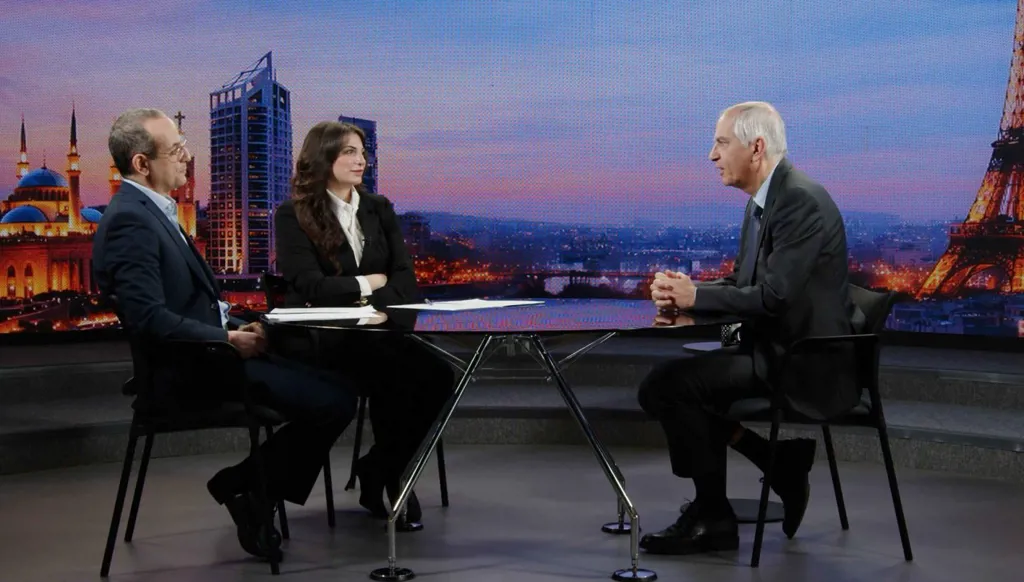


From the studios of An-Nahar in Beirut, Hervé Magro, France’s ambassador to Lebanon, offered an in-depth reading of Lebanon’s key files—from security and sovereignty to reforms, the economy, culture, and Francophonie. The interview was marked by a firm and coherent discourse, faithful to what the diplomat described as Paris’s “consistent and continuous policy” toward Lebanon.
“It Is Not Inevitable”
At the outset, Mr. Magro placed the tensions along the Lebanese–Israeli border within a broader context of global uncertainty. He reaffirmed France’s constant position: respect for international law, rejection of any violation of Lebanese sovereignty, and a call for the full implementation of the cessation of hostilities agreement signed in November 2024.
While condemning Israeli strikes on Lebanese territory, he stressed an essential internal requirement: restoring the state’s exclusive monopoly over arms, arguing that “the time has come” to apply this principle, in line with the positions of the President of the Republic, General Joseph Aoun, and Prime Minister Nawaf Salam.
Asked about the risk of war, the ambassador underscored the primacy of political solutions. “Nothing is inevitable in politics,” he said, recalling that the alternative to a political path is merely a chain of successive conflicts, as recent regional history has shown.
Clarifying the Monitoring Mechanism
Regarding the monitoring mechanism, Mr. Magro sought to dispel a common misconception: the mechanism operates daily, thanks to constant communication among military officials, despite occasional delays in formal meetings.
From the outset, France has advocated adding a civilian level, as certain issues go beyond a strictly military framework. As for parallel meetings conducted by the United States, they are предусмотрed by the cessation of hostilities agreement and fall within U.S. competence, with no objection from Paris.
Support for the Lebanese Army and the Paris Conference
Support for the Lebanese Army featured prominently in the interview, ahead of the Paris conference scheduled for March 5. Mr. Magro was clear: without American and Saudi engagement, the conference would not have been possible.
The goal is to coordinate international support for the Lebanese Armed Forces, both to meet immediate needs and to ensure long-term assistance, particularly during a transition phase that could alter UNIFIL’s role. He stressed that the conference is part of a sustained process, not a one-off initiative.
Reconstruction and the Question of Arms
On Hezbollah’s weapons, the ambassador reaffirmed France’s full support for the Lebanese government’s five-step plan, in line with UN resolutions and covering the entire territory. He declined to go into details on “containment” or disarmament, considering these decisions to be exclusively a matter of Lebanese sovereignty.
On reconstruction, he highlighted the humanitarian urgency. Paris supports a $250 million World Bank project for the South, as well as a French contribution of €75 million. Reconstruction, he argued, cannot be conditioned on lengthy political processes: “Yes, there is the question of the monopoly of arms, but there is also the question of the daily lives of people who have been hit by the crises of recent years. So we must move forward.”
Sovereignty and Negotiations
Asked about the possibility of direct negotiations between Lebanon and Israel under U.S. auspices, Mr. Magro said France does not oppose any process that leads to stability, even if Paris is not involved. What matters, in his view, is the outcome, with the final decision resting with the Lebanese authorities.
On reforms, he refrained from assessing the government’s performance, noting that France supports reforms because they are indispensable for Lebanon, before being an international requirement. He described 2024 as a “catastrophic” year, compared with 2025, which he called a year of a “new beginning,” even if expectations have not yet been fully met.
Paris–Washington Differences and Lebanese Multilingualism
Regarding differences between Paris and the Trump administration, the ambassador downplayed their impact on Lebanon: differing approaches do not mean a rupture. France and the United States remain allies, even as Paris insists on European sovereignty.
In conclusion, Mr. Magro welcomed the launch of An-Nahar’s French-language website, saying it primarily responds to a Lebanese need. He strongly defended multilingualism as a pillar of Lebanese identity and a source of its resilience, reaffirming that France will continue to support education and culture, which it considers the cornerstone of Lebanon’s stability.