

Lebanon lawmaker warns new financial law risks forced bank sales and deeper collapse


 Messenger
 Whatsapp
 Threads
 Email
Email
 Print
Print
 X
X
 Facebook
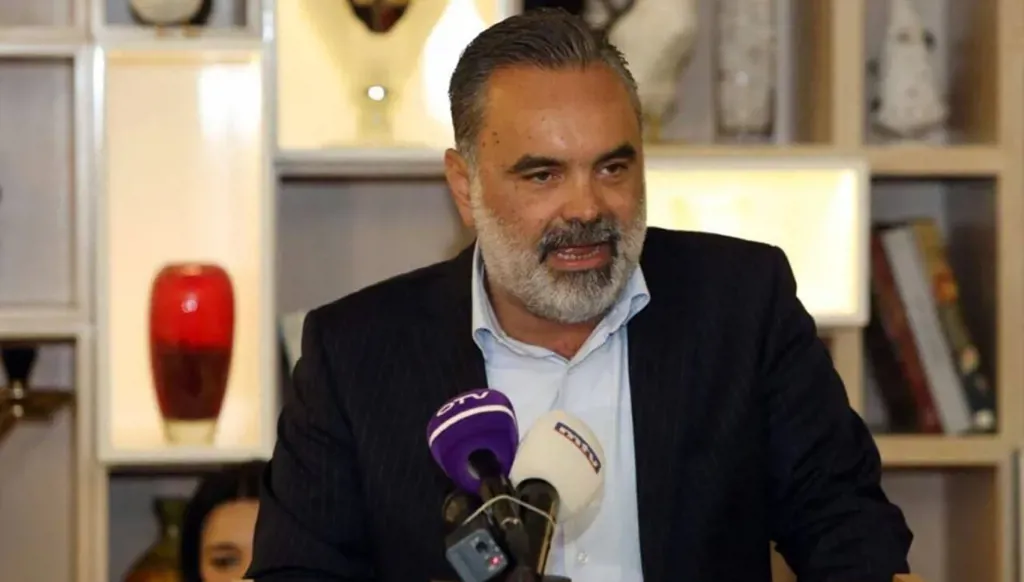


Lebanese MP Hagop Terzian described the new financial law as a failure, amid sweeping criticism and outright rejection of the law approved by the government, commonly referred to as the Financial Gap Law.
However, its technical and official designation is the Law on Financial Regularization and the Recovery of Deposits.
Starting from its name, Terzian seems to dissect the law, opting to inform the public periodically about some of its details or hidden aspects, hence his statement: "To be continued."
Through Annahar, Terzian revealed part of this “continuation.” He said: “The problem is that responsibility is being shifted onto a party other than the state. The state is like the head of a household, the party ultimately responsible, yet this law shows a striking absence of that responsibility. This does not mean the other party bears no responsibility, but there is a hierarchy and a proportion that must be clearly defined.”
In short, Terzian argues that “the author of this law is a Eurobond holder,” which is why he describes it as the “Eurobond Holders Law.” While he prefers not to name individuals to avoid embarrassment, he believes that “the optimal path to a solution lies in restructuring public debt, especially since the link between the public and private sectors is the Banque du Liban (Lebanon’s central bank). After such a restructuring, the private sector would inevitably reposition itself, allowing the economy to breathe again.”
Although the law, after being approved by the Cabinet, is set to move to parliament, its passage there will be far from straightforward.
Terzian, a member of the Parliamentary Economic Committee, rejects working in a rubber-stamping approach, as the matter requires extensive and precise discussions.
He recalls that since 2019 he has opposed “any proposal that entrenches the forced sale of banks under the banner of reform, especially when it is not preceded by a clear and serious process to restructure public debt, because such proposals can only come at the expense of depositors. And today, I can only reconnect the issue of forced bank sales through the recent law's approval."
He notes that "I cannot be a false witness to the passage of laws that negatively impact honest citizens, meaning depositors," fearing that "it may just be a tactic and preparation for foreign banks to buy Lebanese banks at low prices. Thus, any deviation from the serious path represented by restructuring public debt inevitably resorts to offloading losses onto depositors and emptying the financial sector of its content. And worse still, it does not offer a solution to the crisis. Instead, it deepens the collapse and opens the door to dubious schemes targeting what remains of citizens’ wealth."
Terzian also reveals that he had previously submitted a draft law “aimed at preventing banks from writing off, zeroing out, or deducting deposits.”
The proposal was sent from parliament to the Cabinet for review and paradoxically, he says the government’s response was grounded in the constitution. “The reply stated that the constitution guarantees the protection of private property, and therefore banks are obligated to return deposits. That was the government’s position, so how does that align with the essence of the law it has now approved?” he asks. “This goes beyond a mere contradiction.”
He concludes: “Several countries have experienced similar crises, such as Cyprus, Greece and Ireland and managed to handle them. Why don’t we learn from their experiences and their solutions?”