

A year into Lebanon’s presidency: Balancing reform promises and structural constraints
Lebanon’s first year under President Joseph Aoun and Prime Minister Nawaf Salam shows progress in security and diplomacy but exposes persistent challenges in governance, the economy, and state institutions.


 Messenger
 Whatsapp
 Threads
 Email
Email
 Print
Print
 X
X
 Facebook
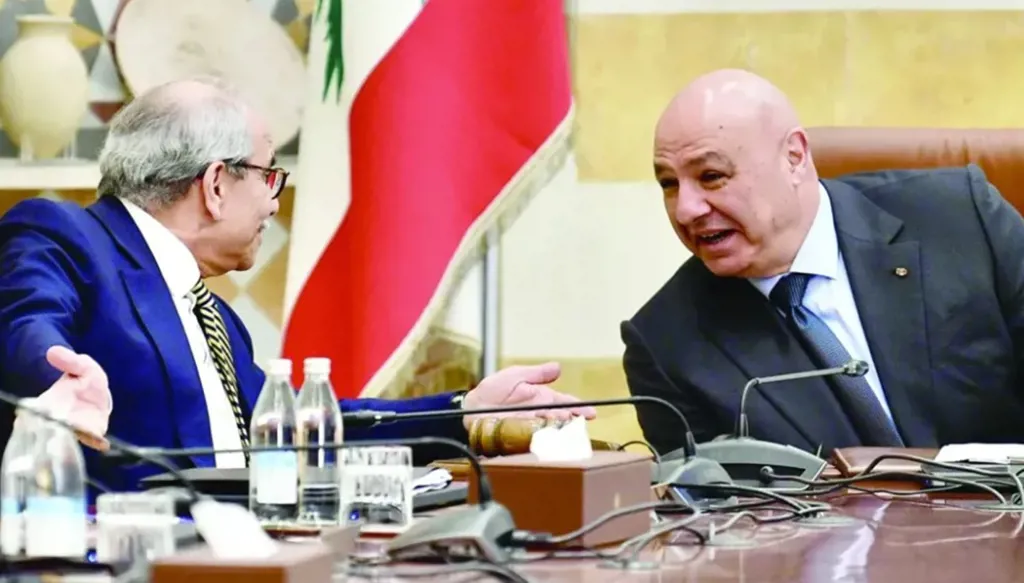


Nearly one year after former army chief Joseph Aoun was elected President of Lebanon, and after the formation of a government led by Prime Minister Nawaf Salam, which won parliamentary confidence on the basis of an ambitious policy statement, the moment has arrived to move from expectations and early optimism to a calm assessment. The new presidency began under exceptional circumstances: a prolonged presidential vacuum, alongside an unprecedented financial and institutional collapse. From day one, the administration presented itself as an attempt to rebuild the Lebanese state, positioning the president’s inaugural address as a guiding political reference, while the government’s policy statement was meant to serve as the executive roadmap.
However, a full year revealed the scale of challenges faced in this process and the gap between the high promises and the actual implementation potential.
In the inaugural address, the President outlined a clear political project aimed at reclaiming the state's sovereign decision, monopolizing weapons under its control, and extending its authority over all Lebanese territories, alongside judicial independence, combating corruption, and launching an economic recovery path to restore internal and external confidence. This speech gained special significance as it was issued by a president coming from the military establishment with the approval of the majority of Lebanese through their representatives, at a time when the state was suffering from a decline in its prestige and ability to impose its authority. Later, Nawaf Salam's government ministerial statement entrenched these themes, adding commitments related to financial and administrative reforms, and reconnecting Lebanon with its Arab surroundings and the international community.
Security plan and weapons control
In the sovereign aspect, which formed the most prominent theme in the inaugural address, a notable development was recorded last year with the launch of a security and military plan to limit weapons south of the Litani River, in coordination with the Lebanese army and with international support. This plan led to an expanded army presence at key locations, the closure of illegal crossings, and the seizure of weapons, as part of Lebanon’s efforts to implement UN Security Council Resolution 1701, which ended the 2006 war between Israel and Hezbollah and calls for limiting armed groups in southern Lebanon. However, this progress, despite its importance, remained geographically restricted and did not become a comprehensive approach to monopolizing weapons across all Lebanese territories, including Palestinian weapons. Although efforts began to collect them, the steps executed remain symbolic and do not touch on disarming, making the achievement partial compared to the commitments outlined in the inaugural address and the ministerial statement.
Regarding Resolution 1701, the Lebanese state politically and diplomatically committed to its implementation and reaffirmed its responsibility for the south while rejecting Israeli violations in international forums. However, the field reality remained complicated, as this commitment was not translated into full sovereignty or permanent stability, but rather a relative reduction in tensions in a specific geographical area, amid ongoing internal and regional factors beyond the Lebanese state's control.
Judicial reform: Below expectations
Judicial reform, another central pillar of the inaugural address, has also fallen short of expectations. Despite repeated political declarations stressing the need for an independent judiciary protected from political interference, a final version of the judicial independence law was adopted that, while representing some progress, remains weaker than anticipated, particularly regarding judicial appointments and safeguards. Moreover, no decisive breakthroughs have occurred in major cases, including the Beirut port explosion investigation or those of financial or political nature, keeping this file in the circle of postponed promises amid continued public distrust in the judiciary as an accountable authority.
The Economy: Preliminary steps
Economically, the presidency and government faced their toughest test. The policy statement pledged to restructure the banking sector, protect depositors’ funds, and restore confidence in the national economy. Over the year, preliminary steps were recorded, notably amending banking secrecy rules and referring draft laws for bank restructuring and deposit recovery to parliament, along with reopening negotiation channels with international entities. The government started studying the financial gap law in the final days of the year, but these steps have not yet yielded tangible results, as the Lebanese have not witnessed actual improvements in their living conditions, nor the recovery of any deposits, while the social crisis has remained nearly unchanged.
Revitalizing diplomatic relations
Conversely, a relative improvement is noted in Lebanon's external position. The presidency and government succeeded in revitalizing diplomatic relations with Arab countries and the international community, adopting a less confrontational official discourse more aligned with the state's logic and international legitimacy. This improvement reflected clear political support and renewed external interest in Lebanon’s situation. However, it has not yet led to substantial financial assistance or major investments, as international partners continue to condition aid on deeper internal reforms, foremost among them weapons control and economic restructuring.
Within the public administration, no structural transformation occurred over the past year. While some appointments were made, key institutions remain understaffed, and no comprehensive administrative reform has been launched to restore state effectiveness or curb inefficiency and patronage. Administrative reform thus remains another postponed priority, despite official acknowledgment of its central role in any recovery process.
An open-ended path amid deep crisis
In conclusion, the first-year record of the presidency and government presents a mixed picture. The new leadership succeeded in restoring state-centered rhetoric and opening political, security, and diplomatic pathways that were previously blocked. At the same time, it collided with the depth of Lebanon’s structural crisis and the limits imposed by internal and regional power balances.
Between promises and outcomes, the first year appears more like a phase of setting direction and managing risk than one of decisive action or transformative change. The real test ahead lies in whether this preparatory phase can evolve into a genuine state-building project, one that moves beyond managing constraints to asserting the authority of the state and its institutions.