

Lebanon
11-12-2025 | 13:25
At Hotel Palmyra –Steps from Baalbek’s ruins– The golden age persists
The journey of resilience did not end with the recent war; the Palmyra hotel stands as a living witness to the passage of time and the transformations that have shaped civilizations.


 Messenger
 Whatsapp
 Threads
 Email
Email
 Print
Print
 X
X
 Facebook
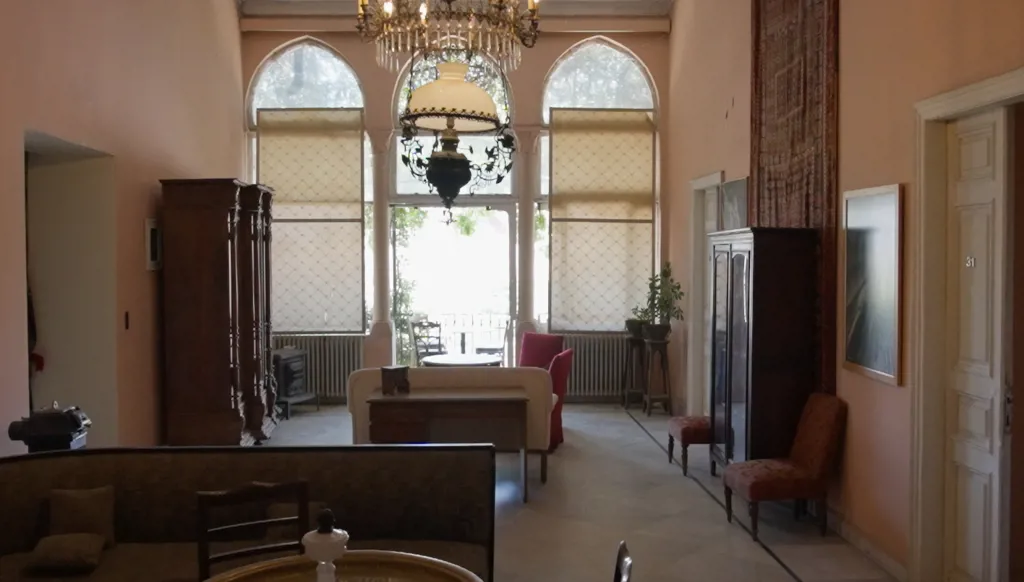
The Palmyra Hotel in Baalbek (Annahar)


Carla Samaha
The Palmyra Hotel in Baalbek stands as a bridge between its golden age and the modern era—a historic landmark shaped by more than a century of change.. Built in 1860, it greets visitors with architecture that echoes the elegance and legacy of the Roman era. You are greeted first by grand, weathered masonry, followed by ceramic tiles and bourgeois furnishings, such as ostrich-leather lamps that cast warm light over oriental carpets. Yet the hotel’s long tradition of elegance was abruptly interrupted when the recent Israeli war in Lebanon left visible marks, reshaping its reputation into one of “luxury bound to endurance.”
Despite everything it has experienced, Palmyra’s resilience endures. It stands as a living record of changing eras and civilizations, holding onto its original character, gently complemented by modern updates.
The hotel’s story is also that of Hassan Al-Husseini, son of its current owner. Built by the Greek architect Pericles Memkakis, Palmyra was intended as a resting point for European travelers journeying to Jerusalem through Baalbek. From its earliest days, it was far more than a simple inn; it became a crossroads of cultures and classes, hosting caravan riders, explorers, and dignitaries alike. Its guest registry, meticulously preserved since the 19th century, is practically a museum, bearing the signatures of kings, artists, writers, and thinkers who passed through and left their imprint on its rooms.
Agatha Christie stayed in one chamber, and wrote part of a novel within its walls. Fairuz slept in another while performing at the Baalbek Festivals. Poet Talal Haidar wandered its corridors; Jean Cocteau sketched in its salons; General de Gaulle, Gibran Tueni the grandfather, Nina Simone, Sabah, Nasri Shamseddine, Miles Davis, and Louis Armstrong, all found refuge in Palmyra’s quiet majesty. They looked out from the same windows that still frame the timeless ruins of Baalbek, as if the hotel were a guardian of memory, watching history unfold and return.
The hotel has undergone only two restorations in its long history—first in 1924, then in 1967—which were carried out with great care to safeguard its original charm. Al-Husseini notes that when his father purchased Palmyra in the 1980s, he approached its renovation with great care, seeking to expand its artistic archive rather than altering its character. He added a rare collection of works by French artist Jean Cocteau, who fell so deeply in love with Baalbek that he returned for thirteen consecutive years. Today, Cocteau’s paintings still grace the hotel’s corridors as silent witnesses to the city’s artistic and cultural magnetism.
In its golden age, Palmyra pulsed with life. Al-Husseini recalls that before 2006, the hotel received nearly 300 guests a day. But the war—and Baalbek’s subsequent classification as a “red zone”—brought this vitality to an abrupt halt. Tourism vanished. The music that once echoed through its hallways fell silent.
Yet despite the scars of conflict, the rooms continue to guard their stories. General de Gaulle slept in Room 30. And in the aftermath of the Sykes–Picot Agreement of 1920, General Gouraud and Georges Picot met at Palmyra, signing the hotel's guestbook during what became France’s earliest acknowledgment of Baalbek as part of Lebanon. That gesture served as a symbolic cornerstone in the narrative of Greater Lebanon.
Today, Palmyra is far more than a hotel. Its two-story structure and 32 rooms form a living archive—a human, cultural, and poetic chronicle woven into stone and wood. Each room carries a narrative; every corner preserves the echo of a visitor, whether a Lebanese poet, an American jazz legend, or a wanderer enchanted by the proximity of history.
Though the recent Israeli aggression left its mark on the building, Palmyra remains the steadfast heart of Baalbek—a landmark where the city’s past converges with its future.