

Annahar documents the scale of damage in the frontline border villages: An attempt to uproot the south from its roots
Israel’s destruction of southern Lebanese villages, mass uprooting of ancient trees, and continued attacks after the ceasefire reflect a deliberate strategy to depopulate the region and prevent its communities from returning.



 Messenger
 Whatsapp
 Threads
 Email
Email
 Print
Print
 X
X
 Facebook
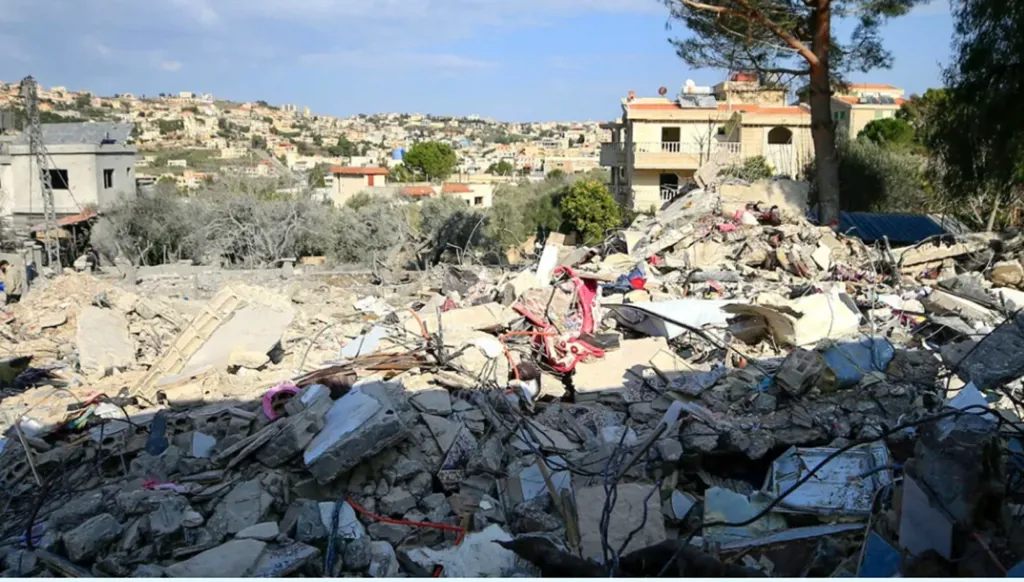


“Israel uprooted olive and oak trees that were hundreds of years old and transported them across the border,” says mayor of Yaroun, Ali Tohfa, capturing the harsh reality now imposed on the border villages.
This is the first time Israel has uprooted hundreds of olive trees and transferred them into Palestine, inflicting a painful loss and a devastating blow to the residents of the stricken villages and towns.
In southern Lebanon, the Israeli war has left behind more than rubble: villages leveled to the ground, homes reduced to ruins, trees torn from their roots, and a cultural heritage erased. Israel’s intention has been clear since the first day of the war, from October 8, 2024, until November 27, 2025: preventing life from returning to certain southern villages.
The mayor of Ayta ash-Shaab, Mohammad Srour, confirms to Annahar: “After the ceasefire was announced, Israel encircled the neighborhoods and completely razed them to the ground, annihilating everything that indicated the presence of life.”
Israeli forces remain stationed today on Lebanese territory at five border hills: Labbouneh, Jabal Blat, Jal al-Deir, Al-Dawawir, and the Hamames Hill. Since the beginning of the war until the end of November, they targeted 429 Lebanese areas, fully or partially destroying more than 40 towns, from An-Naqoura in the west, to Shebaa in the east.
Israel deliberately destroyed the frontline southern villages, alongside others nearby, in an attempt to impose a calculated demographic change. Former commander of the Lebanese Army’s South Litani sector, retired Brigadier General Khalil al-Jamil, confirms that “Israel is pursuing a deliberate strategy to prevent the return of residents to the border areas and to strip them of the foundations of life in order to weaken their social and demographic structure, by increasing psychological pressure on returning residents and pushing them toward forced migration.”
Israel deliberately destroyed the frontline southern villages, alongside others nearby, in an attempt to impose a calculated demographic change.
He believes that Israel’s occupation of the five hills and certain roads it still cuts off along the Lebanese border has implicit objectives, foremost among them facilitating rapid access of its forces into nearby Lebanese territory if needed. This reflects a broader security strategy aimed at keeping the conflict with Lebanon unresolved and maintaining the notion that the war continues, which Israel sees as justification for violating the ceasefire and carrying out daily strikes and assassinations.
Amid the testimonies we collected from the mayors of 15 towns before the municipal elections in May, as well as from residents of southern villages over recent months, two critical conclusions emerged. First, the bulk of the destruction did not occur during the war but rather after the ceasefire, raising major questions about Israel’s intentions regarding the future of the southern villages.
The second conclusion is no less dangerous: for the first time, according to corroborated testimonies, organized operations were recorded to uproot thousands of olive trees and transport them into occupied Palestine, an unprecedented step even in previous wars, inflicting a devastating psychological blow on the residents of the affected towns.
Israeli attacks did not stop with the ceasefire announcement, prompting the National Council for Scientific Research to continue monitoring and documentation without interruption. The Council’s Secretary-General, Dr. Shadi Abdallah, confirms that “since the ceasefire, more than 4,527 Israeli attacks on Lebanese territory have been recorded (as of November 3, 2025), including shelling, burning, bulldozing, direct destruction, and targeted killings.”
Meanwhile, the Lebanese Army announced that “the number of Israeli attacks has exceeded 4,500 since the ceasefire agreement came into effect.” The United Nations Interim Force in Lebanon (UNIFIL) documented more than 2,200 Israeli military activities north of the Blue Line, in addition to more than 6,200 Israeli airspace violations since the ceasefire agreement took effect last November.
The disparity in figures reflects differences in documentation methodologies among the concerned entities. The National Council for Scientific Research, in particular, calculates violations, especially aerial ones, based on geographical and temporal distribution, while other bodies record each violation separately.
Repeated Israeli violations have ended many innocent lives. Seventeen-year-old Khadija Atwi was killed while heading to her hometown of Houla to inspect her home after the ceasefire. As she prepared to visit the grave of her father, Hussein Atwi, Israel launched a sudden bombardment on the town that killed her. In a single moment, her mother, Haifa Hassan, became both the mother and wife of another Israeli victim.
In the absence of any meaningful accountability and amid deafening international silence, this documentary investigation by Annahar stands as a witness to the devastation caused by the Israeli assault and as a record of the cries of southerners struggling to reclaim what remains of their lives. This is but a small sample of a far broader destruction and a much harsher reality, documenting what befell several southern Lebanese villages where the Israeli army deliberately erased all foundations of life.
More than 3,000 olive trees were uprooted in Kfar Kila alone, while citrus groves were turned to ash after another 3,000 trees were destroyed. “For the first time, we are witnessing this type of aggression that turns land into rubble and tears life from its roots,” says Mayor Hassan Shite, adding: “The destruction did not occur all at once but in three phases: the first during the shelling period, the second on the eve of the ceasefire announcement, when Israeli forces planted explosives in about 21 residential and commercial buildings and blew them up. The third phase came after the truce, when they completed the targeting of what remained of the infrastructure and facilities.”
What hurts most today is the loss of ancient olive trees that are beyond price. Estimates by the Research Council indicate that Israel burned no less than 2,100 hectares and 60,000 olive trees, and severely damaged more than 6,000 dunams of forest and agricultural lands that were directly targeted.
Violations did not stop on a single front but extended across multiple levels in various forms. White phosphorus was among the weapons Israel used in its war on Lebanon, directly affecting 52 border villages.
The massive losses suffered by the southern villages, particularly in the agricultural sector, raise a critical question: can war alter the nature of the local economy in the South? Economic expert Professor Jassem Ajaka confirms to Annahar that the South contributes more than 30–35% of Lebanon’s agricultural production. As a result of phosphorus shelling, many lands have become unfit for cultivation and require rehabilitation. “This means that in the absence of reconstruction aid and economic sector recovery, the residents will become dependent on assistance from relatives and from local and international charitable organizations,” he explains.
There are fears that the state may be unable, and that the international community may be unwilling, to reconstruct the destroyed areas. According to Ajaka, this is primarily linked to “political conditions Lebanon has yet to fulfill, as well as a financial crisis that prevents the government from funding reconstruction. Consequently, collapse could become permanent in the absence of aid.”
This reality is confirmed by former Nabatieh mayor and current municipal council member Khodor Qdeih, who tells Annahar: “Every reconstruction project underway in the city today is funded privately by the property owners and carried out on lands free of legal or zoning disputes. Otherwise, we await an absent decision and funding that remains postponed.”
Hassan Baydoun stands in front of his factory in Bint Jbeil, unable to believe what his eyes see. For the first time, tears betray him as he looks at his sole source of livelihood destroyed. He counts his losses one by one and says bitterly, “Nothing is left.” His losses are estimated at around $3 million, including the value of the factory, containing industrial iron, electrical tools, and hardware, and two residential buildings, each three stories high, covering an area of 400 square meters. When asked about the pain of his loss, he pauses and replies, “God will compensate.” Yet he knows that what he lost will not easily return and that he must start again from zero. He adds, “Fifty years of my father’s labor in Bint Jbeil has turned into rubble.”
The reality today is harsh and painful. Every attempt to revive life in the South is met with Israeli targeting to prevent reconstruction once again. The mayor of Taybeh, Abbas Diab, admits to Annahar that his town is “disaster-stricken. We have never witnessed destruction on this scale before, and the cost of reconstruction will be enormous.” Meanwhile, the mayor of Mais El-Jabal, Abdel Monaem Shoucair, described what happened there as “akin to a partial earthquake, its residents live as though they narrowly escaped death.”
The scene of devastation stretches along the frontline border villages: cracked houses, walls gnawed by shells, and roads turned into earthen trenches. “A comprehensive destruction of the foundations of life,” as summarized by Naqoura mayor Abbas Awada. What happened here, he says, is “more than a war, it is a calculated attempt to uproot people from their roots and erase everything that binds them to their land and identity.”
“I may rebuild my home, stone by stone, but how can I restore ancient trees? Nothing heals the wound of the land when it is stripped of what it holds.” This is the testimony of Ali al-Rida, a native of Yaroun, whose livelihood and memories were torn away by Israeli bombardment. He tells Annahar: “I lost 250 olive, pine, grape, and walnut trees. I watched my life being bulldozed before my eyes until nothing remained. It’s an indescribable feeling. Some of these trees were over 100 years old. It’s as if I lost a part of myself, my childhood, my life. Trees are not just a source of income, they are stories and memory. We have lost beautiful memories that can never be replaced.”
Some losses can be recovered, but others are so profound that even speaking of them is difficult, as their personal cultural worth exceeds any calculation.. One sentence by the mayor of Al-Aadaissah, Mohammad Rammal, sums up the pain: “The harshest blow was to Al-Aadaissah’s heritage buildings, where landmarks rich in history and the memories of generations vanished.” Meanwhile, the mayor of Chamaa, Abdel Qader Safi al-Din, noted that “the historical castle, dating back to the Crusader era (1116), was leveled to the ground and turned into a pile of stones.”
This reality compelled the Secretary-General of the Research Council, Shadi Abdallah, to pause and reflect. He explains to Annahar that “what has been revealed is the extent of systematic destruction targeting both buildings and cultural heritage together. The scale of destruction inflicted on homes, infrastructure, and archaeological sites is unprecedented by any measure.”
In every stone there is a story and a history, and in every landmark an irreplaceable heritage. Archaeological sites did not escape targeting. The conclusion reached by the Directorate General of Antiquities is that “Israel’s war was, above all, a cultural war,” according to its Director-General Sarkis Khoury. He states bluntly: “Israel deliberately, with premeditation, sought to erase Lebanese memory by targeting archaeological sites and villages that preserve the history of our ancestors, and by destroying their natural surroundings of olive, carob, and fig fields, in an attempt to obliterate Lebanon’s cultural identity.”
One year has passed since the ceasefire decision and many years may follow before the green light for reconstruction is granted. Amid all these realities, the loss of people remains the most painful and resounding and the greatest fear is the loss of the land itself.