

“Now They Just Watch the Sky”: Lebanon’s Collective Trauma
Repeated wars and crises in Lebanon are leaving a generation of children emotionally numb and psychologically scarred, as cumulative trauma deepens alongside mass displacement.


 Messenger
 Whatsapp
 Threads
 Email
Email
 Print
Print
 X
X
 Facebook


“I asked her how the children were coping,” a psychologist at Restart recalls after meeting a displaced family in a temporary shelter in northern Lebanon.
“She looked at me very calmly and said:
‘This is the fourth war my children have lived through. The first time, they were afraid. The second time, they cried. Now they just watch the sky.’”
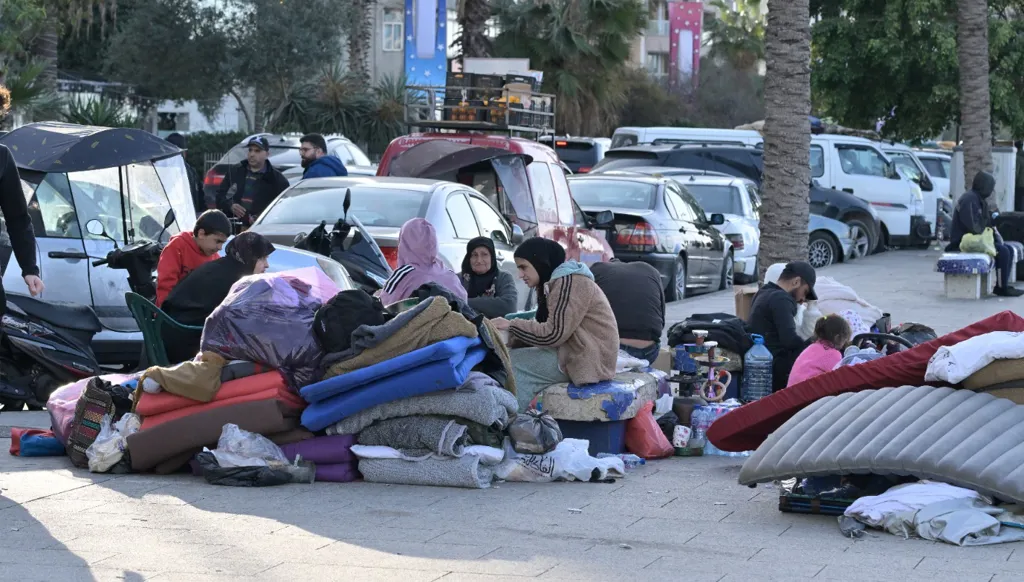
In recent weeks, around 750,000 people across Lebanon have been displaced as Israeli airstrikes and artillery bombardment intensified in the southern regions, forcing families to flee toward safer areas in other parts of the country. Schools and public buildings have been converted into temporary shelters. Families sleep on classroom floors, often arriving with little more than a few belongings carried in plastic bags.
What makes the current moment particularly concerning is not only the scale of displacement, but the psychological context in which it is unfolding.
For many Lebanese, this war is not an isolated event. It is the latest shock in a prolonged sequence of national crises — so prolonged that those of us who write about Lebanon often find ourselves repeating the same list of disasters.
Over the past five years alone, the country has endured one of the most severe economic collapses in modern history, the Beirut port explosion in 2020, repeated political paralysis, and the gradual erosion of public services and institutions.
Each crisis has arrived before the population has had the opportunity to recover from the previous one.
From a psychological perspective, trauma becomes significantly more damaging when it accumulates over time. When individuals and communities are repeatedly exposed to instability without periods of recovery, stress responses that are normally temporary begin to become chronic. Fear, uncertainty, and insecurity become embedded in everyday life.
Mental health professionals refer to this phenomenon as cumulative or chronic trauma.
Across Lebanon today, psychologists increasingly observe symptoms typically associated with prolonged exposure to instability: persistent anxiety, sleep disturbances, emotional numbing, hypervigilance, and a growing sense of helplessness about the future.
At Restart Center, where for nearly three decades we have worked with survivors of severe trauma, including victims of torture, violence, and conflict, our teams are now observing similar patterns among families displaced by the current escalation.
In one shelter in Mount Lebanon, a Restart psychologist recently met a nine-year-old boy who refused to sleep inside the classroom where his family had taken refuge. Each night, he insisted on lying near the door.
When asked why, he answered quietly:
“If the bombs come, I want to be the first to run.”
Restart’s teams have worked with populations displaced by multiple crises in Lebanon and the wider region. During the June 2006 war alone, an estimated one million people — nearly a quarter of Lebanon’s population — were displaced.
In the years that followed, Lebanon received tens of thousands of Iraqi refugees fleeing violence after 2007. Beginning in 2011, the Syrian conflict triggered one of the largest displacement crises in modern history, with more than one million Syrian refugees seeking refuge in Lebanon, making the country host to the highest number of refugees per capita in the world.
The Beirut port explosion of 4 August 2020 displaced an estimated 300,000 residents overnight. Since 2023, renewed armed confrontations along the southern border have again forced hundreds of thousands of people to flee their homes.
Today, our teams report that many displaced families are not only reacting to the current violence. They are reliving unresolved distress linked to previous crises.
What that mother described — her children no longer reacting to the sound of war but simply “watching the sky” — reflects a phenomenon psychologists often observe in contexts of repeated exposure to violence: emotional desensitization.
When danger becomes constant, the mind sometimes protects itself by numbing emotion. Fear does not disappear; it becomes internalized.
For a society, however, this psychological adaptation carries serious risks.
Children who grow up under repeated cycles of violence and instability often internalize insecurity as a permanent condition of life. Young adults increasingly view emigration not as a personal ambition but as the only viable future. Trust in institutions erodes. Social tensions become easier to ignite.
The long-term consequences of collective trauma are therefore not limited to individual suffering. They shape the political and social trajectory of entire societies.
Lebanon’s current crisis illustrates a broader lesson that the international community has repeatedly struggled to recognize.
Humanitarian emergencies are often measured through visible indicators — the number of displaced people, damaged infrastructure, or economic losses. Yet the psychological dimension of prolonged crisis rarely receives the same attention or resources.
The rebuilding of roads, bridges, and homes is essential. But the rebuilding of human resilience is just as critical — and far more complex.
Without sustained investment in mental health and psychosocial support, the consequences of prolonged trauma risk extending far beyond the current crisis. Entire communities may enter cycles of fear, hopelessness, and social fragmentation that undermine recovery for years to come.
Today in Lebanon, despite remarkable solidarity — families hosting displaced relatives, volunteers distributing food, civil society organizations providing support — psychologists working in shelters increasingly observe signs of psychological exhaustion among both displaced families and host communities.
The country’s capacity to absorb continuous shocks is reaching its limits.
Resilience is not an infinite resource.
At some point, even the most resilient societies begin to fracture under the weight of unresolved trauma.
A generation of Lebanese children is growing up in a state of permanent uncertainty. The consequences of that reality will not disappear when the bombs stop falling.
When the violence eventually ends, the world will begin counting destroyed buildings and damaged infrastructure.
But Lebanon will still be counting something far harder to repair: the invisible scars carried by an entire generation.
Disclaimer: The opinions expressed by the writers are their own and do not necessarily represent the views of Annahar.