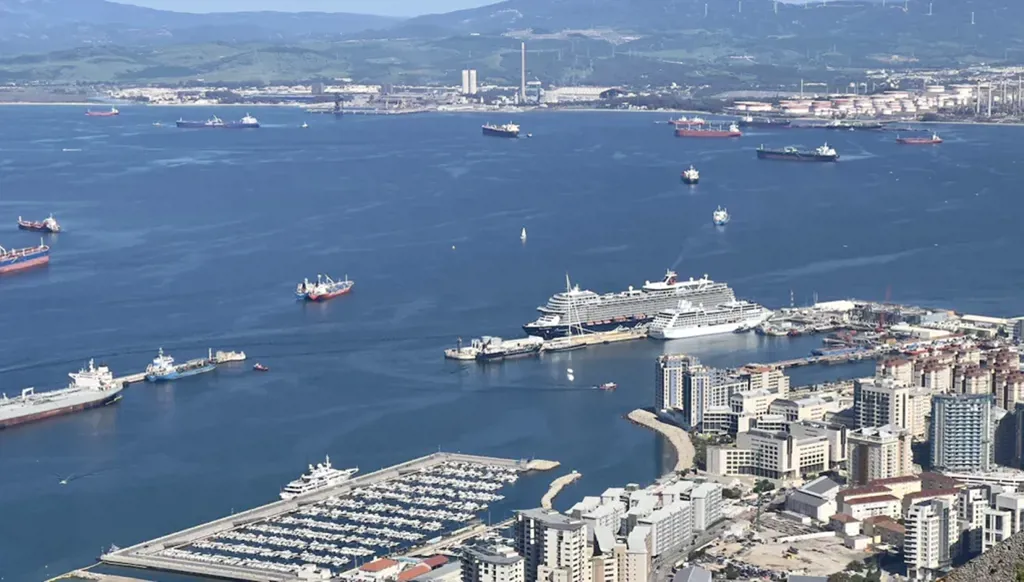
The Strait of Gibraltar is no longer merely a waterway connecting the Atlantic Ocean and the Mediterranean Sea; it has become a gauge of global stability, underscoring its geostrategic importance amid the ongoing war in the Middle East.
This artery, through which more than 150,000 ships pass annually and 80% of Europe’s energy and trade needs flow, is now at the heart of a complex international struggle, intertwining Morocco's "Port Weapons" ambitions with Iranian "Stranglehold of the Straits" threats.
Preemptive strategy
The geopolitical landscape shows that the security of the Strait of Gibraltar is no accident but the result of a Moroccan preemptive strategy. Morocco has transformed its position from merely a state bordering the strait into a 'logistic arsenal' with Tanger Med Port and, soon, Nador West Med. This economic soft power is reinforced by "sharp nails," represented by the royal navy, demonstrated in the "Sarex" maneuvers and close NATO cooperation in the "Sea Guardian" operation. Indeed, the joint drills between the Moroccan frigate Tariq Ibn Ziyad and the Spanish frigate Reina Sofia in November 2025, together with the British base in Gibraltar and Morocco's efforts to enhance its naval arsenal, including submarines, send a clear message to all concerned that the strait is secured by both law and military power.
Bully of the Straits
In contrast, an Iranian strategy, described by Dr. Anwar Gargash, UAE diplomatic advisor, as the "bully of the straits," has emerged. Since the threats by Brigadier General Mohammad Reza Naghdi of the Iranian Revolutionary Guard in December 2023 to close the Mediterranean and Gibraltar, it has become clear that Tehran seeks to replicate the chaos of Bab al-Mandab at the heart of global trade. This is particularly significant as part of global trade has effectively shifted from crossing Bab al-Mandab to passing around the Cape of Good Hope in southern Africa and entering the Mediterranean via the Strait of Gibraltar, where Tanger Med Port plays a crucial role in securing the global supply chain.
Iran’s threats to close the Strait of Hormuz and disrupt international maritime passages are not merely military maneuvers but a form of economic blackmail aimed at raising maritime insurance costs and unsettling the global economy. This represents a globalization of war intended to pressure the US president. Regardless of the outcomes of the ongoing conflict or whether President Trump is affected, the question remains: does Iran truly have the capability to choke or close the Strait of Gibraltar?
The reality suggests that any Iranian threat can succeed only through a "proxy war," a strategy in which Iran is highly skilled. Here, the concerning alliance between Tehran and the Polisario Front emerges. Iranian support for the separatists—which prompted Rabat to cut ties with Tehran in 2018—is not merely a matter of political alignment or military backing for a separatist organization. It represents an attempt to establish a strategic foothold at the Atlantic threshold, similar to Iran’s engagement with the Houthis in the Red Sea. Iran has perfected collaboration with armed groups outside formal state structures or with those effectively controlling their countries, such as Hezbollah in Lebanon, the Popular Mobilization Forces in Iraq, and the Houthis in Yemen.
Although the rhetoric of "closing Gibraltar" so far remains confined to media propaganda, given the absence of a direct Iranian military presence in the area, underestimating these threats would be a strategic mistake.
Morocco, with its intelligence reach across the Sahel, the Sahara, and West Africa, and strong partnerships with the US, France, Spain, Britain, and NATO, recognizes that any interference with the strait’s security constitutes a direct challenge to its national sovereignty. Morocco’s success in managing substantial annual human flows—illustrated by over 3 million Moroccan migrants returning home during the 2024–2025 summer crossings—while maintaining strict security control, demonstrates that Rabat is the true guardian of this vital waterway.
Significant portions of today’s global energy and trade security depend on Moroccan efforts to counter threats from any source, ensuring that the Strait of Gibraltar remains secure as long as a nation like Morocco embraces its role in protecting the gateway of global trade in the western Mediterranean. The security of navigation is not merely an economic concern but a battle for sovereignty that admits no compromise.
Disclaimer: The opinions expressed by the writers are their own and do not necessarily represent the views of Annahar.



 Messenger
 Whatsapp
 Threads
 Email
Email
 Print
Print
 X
X
 Facebook