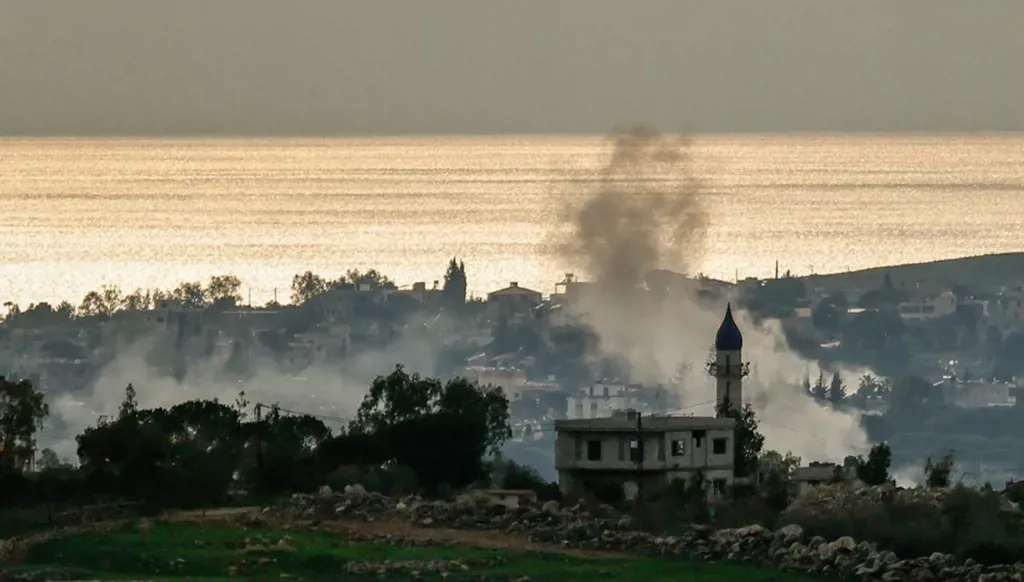
The latest disasters caused by “Hezbollah” in Lebanon, by igniting a support war for Iran, are heading toward the most dangerous turning point ever—first for its sect, and then for all of Lebanon—amid the party dragging its sect into an internal crisis whose dangers outweigh the frightening realities unfolding on the ground in the south, the southern suburbs of Beirut, and the northern Bekaa.
Despair from the Shiite duo
The decisive repercussions of the emerging crisis will be immeasurable, amid the gradual expansion of the buffer zone that Israel is drawing in the south, with all the bloody and destructive experiences committed by the party and its allies in previous eras. Despair has reached its ultimate peak, to the point that fear for a million displaced refugees so far no longer serves as a deterrent for the party, nor as a motivator for its partner in the catastrophic Shiite duo, nor for the Shiite religious authorities to halt the cycle of “national suicide.”
Crisis of loyalty to the homeland
The blatant sectarian stance of the Shiite duo, alongside the Shiite religious authorities, in opposing the Lebanese government and state’s decision to expel the Iranian ambassador from Lebanon—and their overt support for what was called the “March 8 Forces” aligned with Iran—leads to the eruption of a deeper equation now and after the war, regardless of its outcomes. It reflects the loyalty of a Lebanese component to a foreign state to the extent of jeopardizing Lebanon, violating its land and sovereignty, and then turning on the internal Lebanese situation by confronting other sects and components, provoking strife that has systematically eroded Lebanon’s unity to the point of dangerous disintegration.
Focusing solely on the catastrophic historical consequences of “Hezbollah,” without considering its partner represented by the “Amal” Movement, as well as the Shiite religious authorities or any political, personal, or party ally of the group—not to mention what is referred to as the supportive environment—has become akin to mere rhetoric that the party exploits through its mastery of media propaganda and brainwashing. This fuels sectarian fervor among its followers and diverts attention from the catastrophes it continues to inflict on the Shiites of Lebanon.
The cumulative “historical legacy” of the Shiite duo’s alliance and partnership—formed after bloody confrontations between them, and shaped by sectarian dynamics originally imposed through Syrian-Iranian tutelage under the banner of “resistance to the Israeli occupation”—has, in this war, reached a point at which silence about its continuation is no longer possible, nor can there be complacency about its consequences. It is well known that its “trial” before Lebanese and international public opinion is already underway, morally and nationally by all standards, as its legal and judicial accountability remains nearly impossible.
No sectarian faction in Lebanon, despite the shifting record of historical blunders and mistakes among sects, has committed the level of repeated catastrophes inflicted by the Shiite duo in dragging Lebanon into wars and crises, even if it is argued that “Hezbollah” alone led the country into them.
The catastrophic Christian cover once provided to the party—through Michel Aoun, his movement, and his presidency—constituted one of the most destructive alliances, leading to his era being recorded among the worst periods Lebanon has endured. The collapse of the Mar Mikhael Understanding will not erase the historical responsibility for that ominous alliance, nor for what drove Lebanon toward its most dangerous collapses. No justificatory claim of sectarian partnership can now excuse the gravest actions “Hezbollah” has undertaken in turning Lebanon into a suicidal outpost for defending the Iranian mullahs’ regime.
Israel has advanced, as never before in all its previous occupations, with extreme severity in carrying out a comprehensive population evacuation extending from south of the Litani to the southern suburbs, and to areas likely to face similar evacuation in the northern Bekaa. It is, exclusively, the “victory” of the Shiite duo.
Disclaimer: The opinions expressed by the writers are their own and do not necessarily represent the views of Annahar.





 Messenger
 Whatsapp
 Threads
 Email
Email
 Print
Print
 X
X
 Facebook