

Opinion
24-03-2026 | 11:42
Is peace with Israel still possible?
Iran is portrayed as using proxies like Hamas and Hezbollah to systematically derail Arab-Israeli normalization, leaving any potential Lebanon-Israel peace theoretically possible but structurally fragile due to Hezbollah’s power and the Lebanese state’s weakness.



 Messenger
 Whatsapp
 Threads
 Email
Email
 Print
Print
 X
X
 Facebook
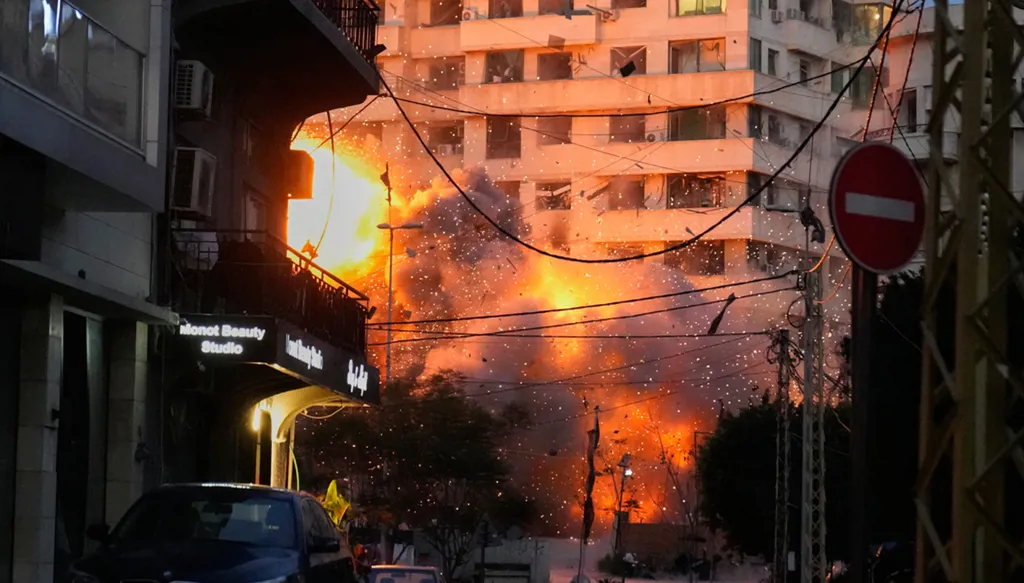


The question goes beyond the Israeli-Palestinian framework alone: it exposes a regional strategy in which Tehran leverages armed proxies to sabotage any momentum toward normalization between Israel and its Arab neighbors. The October 7 attack stands as the most striking illustration. Carried out by Hamas, it was less about achieving a military objective than a strategic one: disrupting a process of rapprochement between Israel, the United Arab Emirates, and Saudi Arabia that was beginning to outline a new regional security architecture.
By upending this emerging balance, Iran reaffirmed a constant of its doctrine: it does not fear war, it fears peace. A stabilized Middle East would significantly reduce its influence and that of its proxies. As a result, every diplomatic advance triggers an asymmetric response. A few years after October 7, the same pattern is now unfolding in Lebanon.
On paper, Lebanon could follow the path of Egypt or Jordan and engage in a peace process with Israel. Part of the country even sees this as an economic necessity, particularly to secure its borders and fully exploit its offshore gas resources. In reality, however, this prospect runs up against an unavoidable fact: Hezbollah. As Iran’s armed proxy, the group is structurally opposed to any form of normalization.
On March 1, it launched a barrage of rockets into Israeli territory. This was not an isolated act. It reflects a clear logic: to prevent any attempt at agreement on security, borders, or energy cooperation. For Hezbollah, peace would undermine its military and political legitimacy. For Iran, it would mean losing a major strategic lever in the region.
The question therefore becomes more pressing: is peace still possible? Hezbollah has deployed its forces across the entirety of Lebanese territory, creating a situation in which no strategic decision can be made independently of its capacity for disruption. Under such conditions, Lebanon risks becoming, in the event of an agreement, a structurally unstable and potentially unmanageable territory for Israel.
Peace cannot hold when an armed actor continues to operate outside the control of the state. If a treaty were signed, Israel would be legally constrained in its ability to act, while Hezbollah would retain its arsenal and operational freedom. Such an asymmetry would turn peace into vulnerability.
The core issue therefore lies in the very nature of the Lebanese state. Neither the presidency nor the government has demonstrated the ability to fully assert authority over the territory, ensure national security, or contain armed factions. This structural weakness fuels Israeli doubts and makes any projection of peace deeply uncertain.
Some point out that technical agreements have already been reached, particularly on maritime delimitation. That is true. But these arrangements remain limited and do not amount to political normalization. They were possible precisely because they did not directly alter the internal military balance.
Israel thus faces a complex equation: can peace be signed with a state that does not control its entire territory? And if so, what would the future of such an agreement look like? Would it not risk once again enabling militias to arm themselves and thrive in plain sight of the state?
To claim that peace is impossible would, however, be excessive. But it cannot be envisioned without clear conditions. A real and verifiable ceasefire, the restoration of the Lebanese state’s monopoly over the use of force, and strong international guarantees are essential prerequisites. Without them, any agreement would be little more than an illusion of stability.
Peace with Israel therefore remains theoretically possible. But under current conditions, it is politically fragile and militarily risky. Between a weakened state, a dominant militia, and a regional power determined to prevent normalization, peace is not out of reach. It is simply not within the realm of immediate implementation.
Disclaimer: The opinions expressed by the writers are their own and do not necessarily represent the views of Annahar.