

Brad Cooper signals delayed Iranian uprising: Timing controlled within military strategy
U.S. Central Command Commander Admiral Brad Cooper’s message does not deny the realism of an Iranian uprising after the regime has been destabilized. Rather, it represents a precise recalibration of its timing within a war plan: not now, but after the military and security conditions have been met.


 Messenger
 Whatsapp
 Threads
 Email
Email
 Print
Print
 X
X
 Facebook
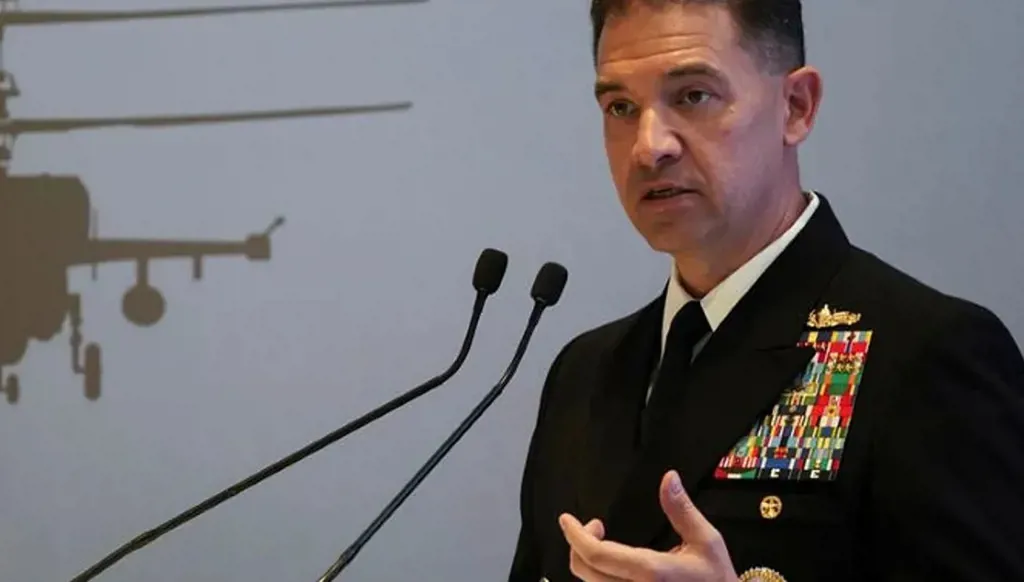


It is not surprising that the commander of the U.S. Central Command, Admiral Brad Cooper, would choose an Iranian opposition media outlet to address the Iranian public. That is expected. The paradox, however, lies in the content of the message: a clear call to hold back and not take action, because “the time has not yet come.”
In an interview broadcast early Monday morning on the opposition channel Iran International, Cooper said that the time is not yet right for Iranians to take to the streets. He urged them to stay at home amid missile launches from populated areas, explaining that a “clear signal” will be issued later allowing them to act.
These consecutive statements cannot be read as casual remarks. They are part of managing the stages of the conflict. They contradict the narrative circulated in recent days, which suggested that the U.S.-Israeli campaign had failed to achieve one of its key objectives: prompting Iranians to rise against their regime. That impression even led to the opposite conclusion, namely that the regime remains internally cohesive and that bets on its internal collapse have failed.
The New York Times went so far as to suggest that the Israeli Mossad bears responsibility for involving both the political levels in Washington and Tel Aviv in this narrative about an Iranian popular uprising against their regime, simply by starting the war against it.
Cooper’s statement, however, completely reverses this interpretation. He does not dismiss the idea of an uprising; rather, he confirms that it is postponed within a calculated timeline.
The significance here is not only in the content of the statement but also in its source. Cooper is not merely a commentator or analyst. He is the operational commander of the war, involved in planning its phases, and best positioned to assess its course and field developments. From this perspective, his words must be taken very seriously.
From his reasoning, any popular movement at this stage may not weaken the regime but could disrupt ongoing military operations against it, especially given Tehran’s reliance on launching missiles and drones from populated areas. In other words, the streets at this moment could become a source of disruption for the strikes rather than a decisive pressure point on the regime. Therefore, the proper timing, which will be announced by the military leadership, must be awaited.
On the ground, developments point to cautious optimism about “the Iranians’ phase.” The U.S.-Israeli strikes are not limited to traditional military targets; they also aim to dismantle the regime’s security infrastructure. This includes directly targeting the Basij’s capabilities, eliminating its leaders, pursuing its members at primary and secondary bases, and even striking the checkpoints they set up in cities. In other words, what is happening is a gradual weakening of the regime’s tools of repression before any domestic action is encouraged.
From this, a clear hierarchy of priorities can be discerned:
First, complete the dismantling of military and security capacities; then, at a later stage, allow space for internal action in a safer and more changeable environment.
According to this reading, the military campaign has a roughly defined timeframe of about six weeks, during which its primary objectives are expected to be achieved. As this period nears its end, the prospect of street-level movements becomes more realistic and effective.
Within this context, U.S. and Israeli military assessments suggest that the campaign is advancing faster than anticipated toward its goals. From this perspective, losses on internal fronts in Israel and the Gulf, or international disruptions caused by tighter navigation in the Strait of Hormuz, are less analytically important than the progress made in dismantling Iranian capabilities.
Some of these developments are even interpreted as signs of increasing pressure and tactical frustration in Tehran, rather than evidence of balance or superiority.
The key question remains: when will “the right time” come?
The answer, as Cooper’s words suggest, is not purely political. It depends on the rhythm of the military operations themselves. Once the process of weakening the regime’s instruments of repression is complete and its control capacity diminishes, street-level action will be more effective and less costly.
Cooper’s message does not deny the realism of an Iranian uprising after the regime has been destabilized. Rather, it represents a precise recalibration of its timing within a war plan: not now, but after the military and security conditions have been met.
Disclaimer: The opinions expressed by the writers are their own and do not necessarily represent the views of Annahar