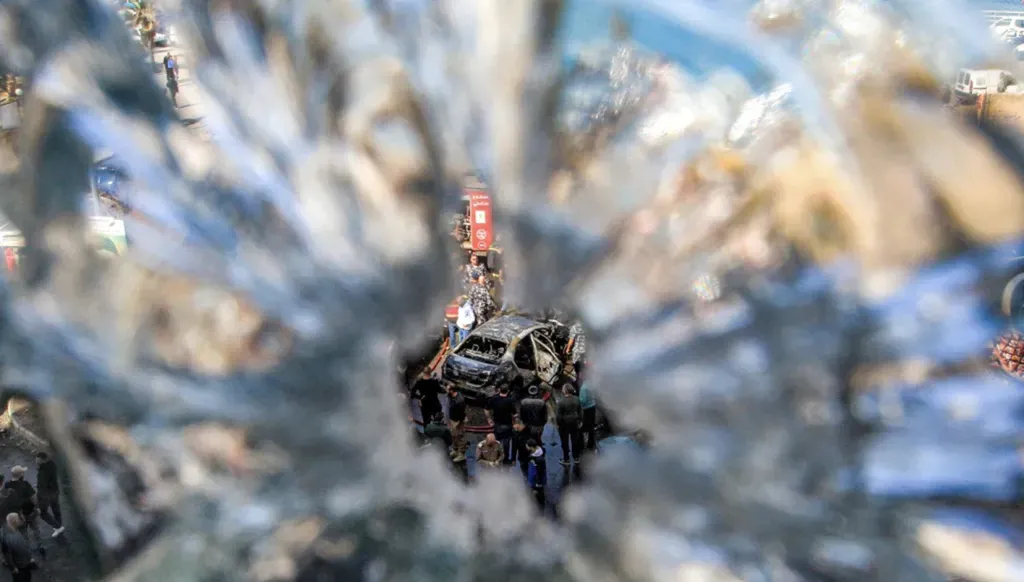
Civil defense at vehicle hit in Israeli strike, Saida, Lebanon, March 18, 2026 (AFP)
Despite the differences in military and field realities related to each of the stages currently open for the wars in Iran and Lebanon, with fewer violent “links” and derivatives across the Middle East — which is open to a full‑scale strategic regional war — extraordinary risks of prolonged exhaustion loom in both theaters after three weeks of warfare.
Just as the oil war began to threaten the diversion of the American-Israeli war on Iran from its major objectives, after Iran turned it into a security inferno for the Arab Gulf states, the rolling war in Lebanon threatens to burden the Lebanese people with a threat exceeding the prolonged exhaustion of the state and its capacities, along with severe risks to all security, economic, and social resilience.
In fact, the initial weeks of the two wars have strongly deepened doubts in all categorical assurances that a swift end is inevitable—whether by overthrowing the Iranian regime through the destruction of all nuclear and military structures and the assassination of its leaders at every level, or by Israel achieving in Lebanon what it could not: dismantling Hezbollah and neutralizing its military, security, and financial apparatus. No resolution is in sight in Iran, nor is one currently possible in Lebanon. The most compelling reality, despite constant media saturation and 24/7 promotional content, warns of a prolonged war of attrition overshadowing the entire Middle East, unlike any conflict in the region’s history.
The time will soon come to question the sufficiency of the transparency adopted in calculating the wars—whether in confronting the Iranian regime with its stored capabilities to ignite the Arab Gulf in automatic, Samson-like retaliation in response to its liquidation, or in confronting Hezbollah and its remaining, though diminished, capabilities to turn back the clock in Lebanon to over a quarter-century of state fragmentation and the violation of Lebanon by Israel’s mightiest military machine, through its ground invasion of South Litani and systematic destruction across the country.
But while the Arab Gulf states may possess sufficient immunity to avert the gravest Iranian sabotage they currently face, Lebanon lacks even the minimal capacity to withstand prolonged exhaustion. This will inevitably bring the worst nightmares of total chaos—including security collapse—with all its catastrophic consequences, amid a swelling population of displaced people scattered across the country, now exceeding one million, intensified by Israeli eviction warnings.
Just as the oil war pushes the “original” war into more dangerous mazes, the cat-and-mouse operations between Israel and Hezbollah threaten to fatally undermine realistic expectations of the Lebanese state—just over a year since the start of the current era and the formation of its first government, on which both the Lebanese and international communities had pinned perhaps exaggerated hopes of ending Iran’s grip on Lebanon and swiftly disarming its proxy.
Lebanon truly lost that golden opportunity, despite any possible justifications, as the war on Iran threatens to fail in its aim of eliminating a regime that has reinstated much of the fascist model—albeit in a religious totalitarian guise—to control the Middle East. We must confront the inevitable truth: returning to classic international alliances is necessary to confront this fascism, or at least to reclaim the historic precedent of liberating Kuwait from Saddam Hussein’s invasion. An international coalition, extending its reach to Lebanon with inevitable internationalization, is essential if final salvation is to be achieved before the country becomes a new open hotspot.
Disclaimer: The opinions expressed by the writers are their own and do not necessarily represent the views of Annahar.





 Messenger
 Whatsapp
 Threads
 Email
Email
 Print
Print
 X
X
 Facebook

