The Iran dilemma: Why military strikes alone cannot secure victory

Opinion 19-03-2026 | 14:12

The Iran dilemma: Why military strikes alone cannot secure victory

From swift airstrikes to regional instability, the Middle East faces a strategic impasse—where diplomacy, not bombs, may be the only path to lasting peace.
The Iran dilemma: Why military strikes alone cannot secure victory
Tehran faces a harsh dilemma, as it cannot respond symmetrically to Israeli and American superiority (AFP).
Smaller Bigger


The first strike drew many back into an old illusion: that a swift military resolution alone can deliver a decisive victory. The logic seemed simple—strike the leadership, cripple the missile infrastructure, breach the defenses—and the Iranian regime would begin to collapse under the shock. In such moments, power seems to compress history.


But wars are not measured by their first day, but by what they leave open afterward. Here begins the dilemma.


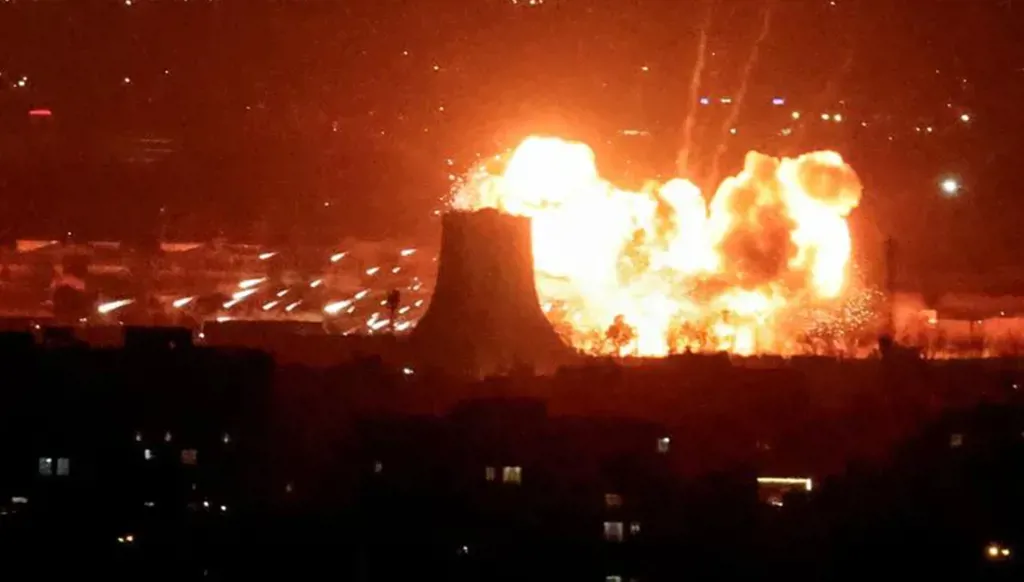
Israel, along with the United States, achieved clear operational gains. Missile launch sites were hit, along with manufacturing facilities and some air and naval defense positions. The strikes revealed deep strategic and military-security fragility in Iran. However, the lesson lies not in pinpointing the location of this leader or that, nor in expanding the target bank, but in the ability to convert military superiority into a sustainable political solution. That is the real test.


So far, the American bet does not seem to have achieved what was hoped for. The notion that decapitating the system would suffice to dismantle it has not proven true. The first strike did not produce a rapid internal collapse, nor did it create a vacuum that would automatically lead to an organized political transition. Iranian crowds did not take to the streets in the manner imagined by proponents of “sufficient shock.” Additionally, various components, including the Kurds, do not trust Trump’s easy promises.


But the deeper quandary does not lie here. It lies in what cannot be bombed: sensitive nuclear materials and what remains beyond full view. When the 60% uranium stockpile, capable of producing several crude nuclear bombs, remains beyond final resolution, the strike ceases to be a conclusion to the problem and becomes instead an entryway to reproducing and expanding the crisis. Hence, the effectiveness of strikes in nuclear issues is not measured by the number of buildings brought down, but by the certainty produced after their fall. If certainty diminishes, the risk of escalation rises.


Here lies the trap: the more the big questions remain unanswered, the greater the pressure to complete the task. What begins as a limited war against a known military structure can quickly become an open pursuit of the unknown.


Then war no longer acts as a tool of control but becomes a coercive search for lost certainty. This is a dangerous moment: when initial success becomes a justification for a second, then a third round, without a clear vision of the end.


On the other hand, Iranian behavior does not suggest an exit plan from the crisis. Instead, Tehran tends to expand the war horizontally—not out of confidence in overturning the balance, but because it finds itself cornered by limited choices. Surrounded regimes often raise the level of danger, seeing escalation as an internal escape from acknowledging weakness. In this sense, expanding the war is not a sign of cohesion, but an indication of the depth of the problem.


This dilemma deepens as Iran itself enters a delicate transitional phase. In moments of existential danger, authority does not usually lean toward moderation, but toward hardline stances. If the centers of gravity within the regime move toward greater reliance on hardened elements in the Revolutionary Guard, political decision-making margins narrow significantly. Even if Mojtaba Khamenei assumes a central role in the new arrangement, his legitimacy would rest not on strategic political consensus, but on the approval of the security structure that effectively holds the tools of coercion. This does not expand the options, but confines them to more impulsive and less rational alternatives.


Thus, Tehran finds itself facing a harsh dilemma. It cannot respond symmetrically to Israeli and American air superiority, but it can—and likely will—increase the cost of war in other ways: by threatening navigation, targeting economic interests, pressuring bases and allies, and expanding the field of engagement. This is not a strategy for victory, but one of spoiling, sabotage, and managed defeat.


However, the dilemma does not concern Iran alone. The United States finds itself realizing the limits of power when foreign policy is managed by insult rather than by the logic of partnership.


Donald Trump spent a long time disparaging Europeans, but now he is begging them to safeguard navigation and contain the economic repercussions of the war. Yet Europe, this time, does not rush; it slows down, calculates its interests, and avoids full engagement in a war it was not properly consulted on.


As for the bet that Moscow might reshape its position to please a personal relationship with Trump, it is merely a poor reading of Russian politics. The relationship between Moscow and Tehran is deeper than the fleeting mood at the White House. Meanwhile, China does not seem ready to allow a complete Iranian collapse. Thus unfolds a confused international scene: no one is prepared to go far enough to settle the matter, yet no one wants to exit the equations either.


For this reason, the war looks less like a contest between victor and vanquished, and more like a race between two dilemmas.


Israel and the United States hold clear military and intelligence superiority, but they still lack a reliable map for converting this superiority into a more stable regional system. Iran possesses a notable capability to disrupt and increase costs, yet it lacks a realistic path to overturn the final result.


Thus, both parties find themselves in a barren equation!


Washington and Tel Aviv cannot venture into an open‑ended finale without incurring costs far greater than those they entered the war for. Nor can Tehran raise the stakes indefinitely without accelerating its internal ruin and depleting whatever margins remain.


From here, Gulf diplomacy regains its essential importance—not as an ethical luxury, but because it is the only tool capable of breaking the logic of this insane war, which offers a clear horizon to no one.


After long striving to avert war, the Arab Gulf states extend their hand to contain the conflict, thereby assuming a vital role in shaping its outcomes.


They do so not because they stand equidistant from the crisis, but because they are best positioned to understand what an open war would mean in this region: energy disruption, threats to navigation, the involvement of major powers, and the erosion of what remains of regional order. Their efforts to contain the crisis are not naive neutrality, but a matter of direct strategic interest.


Usually, wars begin with the illusion of control, but they often end when everyone realizes that the cost has become higher than the promise that launched it. To avoid turning a tactical victory into a strategic trap, there is no sustainable exit from this war except through diplomacy.


Disclaimer: The opinions expressed by the writers are their own and do not necessarily represent the views of Annahar.