

Iran’s New Leader Speaks in Contradictions: Peace Rhetoric, War Reality


 Messenger
 Whatsapp
 Threads
 Email
Email
 Print
Print
 X
X
 Facebook
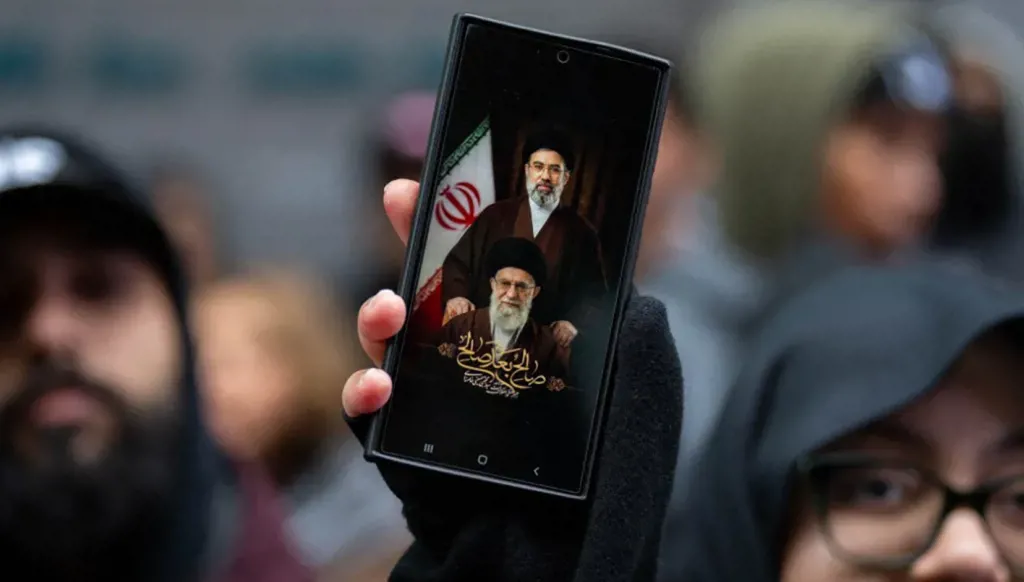


In many political speeches, especially those delivered during times of crisis or war, a striking linguistic phenomenon emerges, often described as "verbal contradictions." This involves combining two opposing or contradictory meanings within the same context. The purpose of this style is not merely linguistic but also political, as it creates a double image: a speech that appears ethical or peaceful on the surface while, in essence, carrying the language of threat or mobilization.
No one knows exactly who wrote this speech or why it was read aloud by a television presenter rather than by the individual himself. Most analyses suggest that the message was issued on behalf of the Islamic Revolutionary Guard Corps (IRGC), reflecting a division at the top of Iran’s political hierarchy between hardliners and more conciliatory factions. What matters most for our purposes is reading and deconstructing the announced speech itself.
The speech attributed to the new Iranian leader is a clear example of this style. Despite its length and the density of its religious and political vocabulary, the verbal contradictions in the speech reveal, upon deconstruction, a series of paradoxes that reflect the tension between the overt message and the underlying political intent.
The first of these contradictions emerges from the combination of language expressing personal humility with language asserting absolute power. The speech opens with extreme expressions of modesty, using phrases such as “this servant” and “my worthless self.” Yet this verbal humility is paired with a political stance that grants the speaker near‑absolute authority over the state and society. In this way, the words of humility become rhetorical tools, portraying the speaker as someone who renounces power while, in reality, exercising it to its fullest extent.
The second contradiction arises in the tension between references to “the public and the republic” and the reality of centralized decision-making. The speech praises the role of the people, claiming that previous leaders “brought the people into all arenas” and that “the people led the country.” Yet this celebration of popular participation exists within a political system fundamentally based on centralized religious authority—now hereditary—where ultimate decisions rest with the supreme leadership rather than elected institutions. Consequently, the concept of “the republic” in the speech functions more as a symbolic tool for mobilization than as a reflection of actual political practice.
The third contradiction is evident in the combination of calls for unity and peace with language of military escalation. The speech emphasizes the necessity of maintaining “the unity of the people” and overlooking differences, even expressing a desire for “warm and constructive relations with all neighbors.” Yet it simultaneously contains explicit threats, such as the call to continue “closing the Strait of Hormuz” or opening “other fronts” in the war. In this way, the text juxtaposes a message of friendship with neighboring countries alongside rhetoric of military confrontation.
The fourth contradiction emerges in the tension between denying hegemony and acting as a hegemonic power. The speech explicitly states that the system “does not seek dominance or colonization in the region,” yet it simultaneously refers to the “resistance front” as a regional, cross-border network led by Tehran, enumerating its components in Yemen, Lebanon, and Iraq. In this way, the speech appears to reject a project of regional influence while simultaneously outlining the instruments through which that influence is exercised.
The fifth contradiction lies in the tension between defense and the rhetoric of revenge. The speech frames military operations as “defense of the homeland” against an “unjust attack,” yet it also declares that “the file of revenge will remain open until it is fully achieved.” In this way, what begins as a defensive posture transforms into a long-term vendetta, representing a linguistic and political shift that turns the nature of the conflict from reactive defense into a continuous policy of retaliation.
Another contradiction emerges in the juxtaposition of divine mercy with language of destruction. The speech is filled with prayers and entreaties, invoking “the divine promise” and “God’s mercy,” yet it simultaneously includes direct threats, such as: “We will take from the enemy's wealth… and if that is not possible, we will destroy their wealth at the same scale.” In this way, spiritual and religious language is combined with overtly destructive rhetoric.
Another notable contradiction lies in the combination of victimhood rhetoric with displays of power. The speech portrays Iran and its people as victims of an “unjust attack” by the “arrogance front,” while simultaneously asserting the capacity to close straits, open new fronts, and impose regional equations. In this way, the speech projects a dual image that merges the portrayal of victimhood with an assertion of overwhelming power.
These verbal contradictions are not mere rhetorical slips; they constitute a deliberate political strategy. The speech aims to achieve multiple objectives simultaneously: rallying domestic support through the language of victimhood, intimidating external audiences by projecting strength through threats, sustaining religious legitimacy via doctrinal vocabulary, and conveying political messages to the international community.
The result is that the text oscillates between two parallel levels: a linguistic level rich in references to patience, unity, and friendship, and a political level centered on revenge, military escalation, and expanding confrontation. Between these two layers, verbal contradictions function as a deliberate tool for embedding opposing messages within a single speech.
This speech serves as a clear example of how language functions in modern politics, where words are not merely descriptive but actively shape and reinterpret reality. The verbal contradictions are not just a linguistic curiosity; they reveal a profound tension between the discourse of religious legitimacy and the pursuit of geopolitical power. When expressions of humility coexist with assertions of authority, calls for peace meet rhetoric of war, and denials of dominance accompany demonstrations of regional influence, the text illustrates how words can simultaneously convey a meaning and its opposite. At the same time, these contradictions highlight a lack of strategic coherence, exposing the challenges Tehran faces in pursuing multiple fronts simultaneously.
Disclaimer: The views expressed by the writers are their own and do not necessarily represent the views of Annahar.