Iranian President Massoud Bezshkian said in a speech broadcast on local television that “disputes between Iran and some countries in the region can be resolved through diplomatic channels,” and that his country “has no intention of attacking these countries.”
His statement suggests that Iran is cautious about engaging in a major war in the region, particularly a direct conflict with Arab countries—especially in the Gulf—despite its missiles and drones striking within these countries’ territories without distinguishing between American or civilian sites, resulting in civilian casualties and the destruction of infrastructure, airports, and vital facilities, especially those related to oil. In light of Iran’s reluctance to be drawn into a regional war, will the Houthis keep their finger on the trigger?
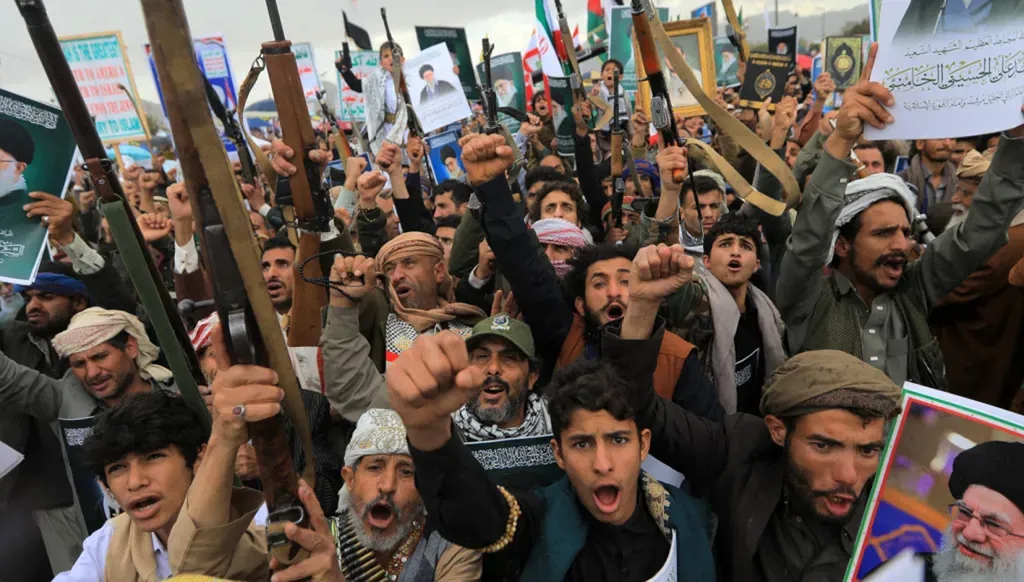
Days after the outbreak of the Iranian war, Ansar Allah leader Abdul Malik al-Houthi announced on Thursday, March 5, that the group stands with Iran’s leadership and people, adding that “our fingers are on the trigger, ready to respond at any moment should developments warrant it.”
This Iranian apprehension about turning the war with American and Israeli forces into a broader conflict involving Iran and Arab states does not reflect concern over the relationship consolidated by China in 2022 as much as it reflects a fear of the conflict becoming an existential battle for the regime—under the slogan that there can be no security or stability in the region unless Iran itself enjoys them.
Undoubtedly, Iran’s Revolutionary Guard follows a calibrated approach in employing its pressure tactics. It does not view targeting Arab countries as limited to American bases and interests in the region, but also as a means of pressuring these countries to urge the United States to halt its war. Another tactic set in motion by the Revolutionary Guard was drawing Hezbollah in Lebanon into the conflict, opening a support front alongside Iran, directly managed by the Guard, which oversees war operations from Beirut to establish an operational front that alleviates military pressure on Iran.
“Hezbollah” showed no hesitation in opening the Lebanese front and supporting the Iranian regime, represented by the Revolutionary Guard. However, what applies to the party may not hold true for the Houthi movement, which—if it were to join the war in support of Tehran—could alter the course of the conflict in the region. In this context, the American newspaper “New York Sun” reported that Saudi Arabia issued a warning to Houthi leadership in Yemen of severe strikes if the group decided to enter the ongoing war against Iran.
The Houthis’ entry into the battlefield would inevitably change the rules of engagement in ways that may not favor the group; it would also be unlikely to offer new advantages for Iran. Instead, it could spiral into a civil war within Yemen, as the Presidential Leadership Council raised the level of security and military alert, reinforcing the internal front and holding the Iranian-backed Houthi group responsible for any escalation threatening the country’s and the region’s security during a meeting held in the temporary capital, Aden.
The Houthis, alongside “Hezbollah,” which receives Iranian funding and training, act as Iranian arms used as bargaining chips in various files. However, a decision not to intervene in support of Iran would place the group in a position of strategic recalibration, reflecting its concern about engaging in a war on multiple fronts. This is not the only factor, as the issue is also tied to fears of provoking international public opinion if they escalate disruptions to navigation in the Red Sea, as they did during their support campaign for Gaza.
The Houthis’ position is unenviable, as keeping a finger on the trigger may persist only as long as there are no tangible gains in joining the war alongside Iran. Such a decision could, in fact, be seen as suicidal for the group. For this reason, the Houthis are likely to remain on edge—hesitant to commit, maintaining readiness without acting—until it becomes clear that no settlement regarding Iran is in sight. At that point, the war may represent their last opportunity to solidify their place in Yemen’s evolving internal equation, so as not to end up in a position similar to that of the Kurds in Syria, still awaiting a resolution.



 Messenger
 Whatsapp
 Threads
 Email
Email
 Print
Print
 X
X
 Facebook