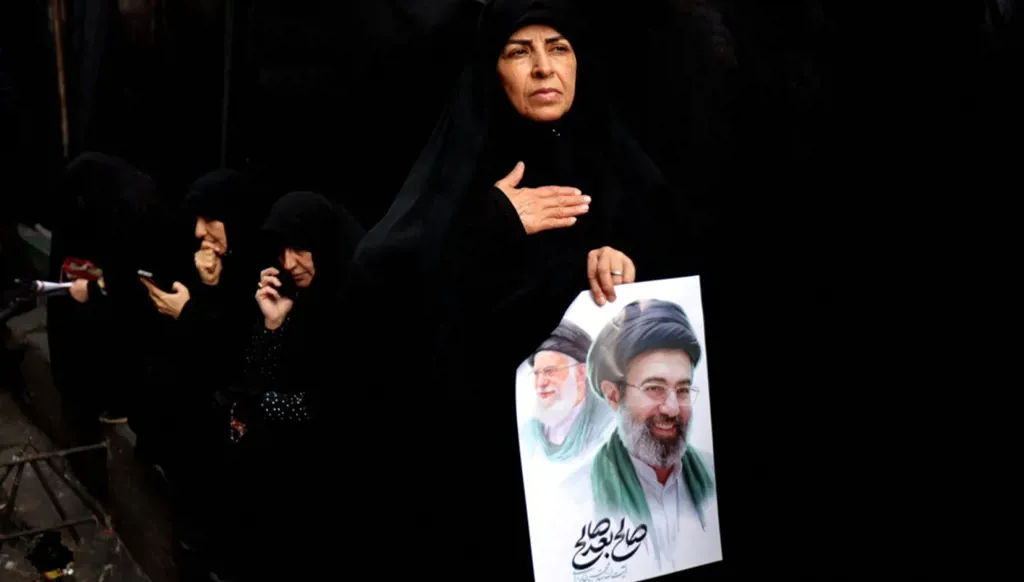
The speech of the new Iranian Supreme Leader, Mojtaba Khamenei, marked a decisive moment in Iran’s strategy, defining victory as the regime’s survival without collapse and the Revolutionary Guards’ unilateral grip on power, armed with a doctrine of vengeance, revenge, and self‑sacrifice. Other governing institutions, including the presidency and the army, appear marginalized today, while the Revolutionary Guards exert chaotic control over Iran, holding it in a state of instability.
The army institution remains silent, observing without intervention for now, signaling its recognition that the capabilities destroyed by American forces dealt a fundamental blow to Iran’s military power, one that will limit the country for many years. They understand that strategic arrogance is one thing, while military strength is another. They are aware that the post-war chaos threatens Iran, and that their role in maintaining order is essential—primarily for the sake of the country rather than the regime.
Any retreat under American military or economic pressures is considered a major defeat from the perspective of the Revolutionary Guards, whom Mojtaba Khamenei entrusted with complete control over domestic Iran and its proxies in Lebanon, Iraq, and Yemen.
Mojtaba Khamenei endorsed the Revolutionary Guards’ strategic recklessness and violated the sovereignty of countries where the Revolutionary Guards’ forces carry out Tehran’s directives under the banner of the resistance axis.
The continuation of chaotic brawling in theaters in Arab Gulf states is considered an essential part of achieving strategic gains, according to the logic of the Revolutionary Guards. The new leader sent out bluffing messages to these countries, imposing an impossible condition if they wished to avoid revenge and retaliation—namely, the closure of U.S. bases on their soil.
Whether Iran wins this war or loses, revenge looms over neighboring, regional, and global countries. Even if the war concludes with a ceasefire deal or understandings, one should not underestimate the Iranian memory of revenge and retaliation.
For U.S. President Donald Trump, victory is defined by the extent of destruction inflicted on Iran’s military arsenal, controlling global oil routes, ensuring the security of Gulf allies and economic interests, reducing Chinese and Russian influence in this vital region for oil and the global economy, dismantling Iran’s ability to threaten the Strait of Hormuz and global energy markets, or retaining the capability to strike America’s allies in the future.
The coming phase, following the new leader’s speech, is characterized by accelerated strategic operations and preemptive decisions. Through the Revolutionary Guards and its proxies, Iran will seek to prolong the war and exhaust the opposing side. The United States, for its part, aims to end the war relatively quickly and is now determined to deliver a knockout blow to strategic targets—such as missile launch platforms and the military infrastructure of the Revolutionary Guards—while maintaining balance with its allies, notably Israel and the Gulf states.
The U.S. decision regarding the Strait of Hormuz is decisive, and Europe is ready to participate in its control. President Trump is also considering seizing the highly strategic Kharg Island, as it is Iran’s most important oil export hub.
In Lebanon, the challenge is twofold. Hezbollah, which takes orders from the Revolutionary Guards, serves as Iran’s escalation tool and poses a direct threat not only to Lebanese sovereignty but also to the unity of its territories. Israel is exploiting Hezbollah’s and the Revolutionary Guards’ drive to avenge the assassination of Ali Khamenei, the former Supreme Leader of the Islamic Republic of Iran, using their provocations—such as missile launches—to establish a buffer zone in southern Lebanon free of Hezbollah and civilians, preparing for a potential reinvasion.
The Lebanese state made critical mistakes by attempting to leap forward and engage in tactical maneuvering, when it should have recognized the danger of hiding behind its finger, a stance that affected all of Lebanon. It relied on dialogue with Hezbollah to enforce its decision to monopolize arms within the state, which exposed its procrastination and evasion of responsibilities.
The state needed to adopt a proactive and bold strategy to protect the country from sliding into a confrontation with Israel, which has the American green light to destroy Hezbollah’s military infrastructure. It should not have made the critical mistake of losing American trust in itself and its institutions, particularly the army.
Today, the state finds itself in a predicament with the Trump administration, the only party capable of deterring Israel and preventing it from permanently occupying Lebanese territories. Gradual concessions and commitments, as the Lebanese state is making, are almost like pouring water on the ground. The declaration of readiness for direct negotiations with Israel was conditioned on halting Israeli attacks, yet lacked any mechanism to disarm Hezbollah or remove the Revolutionary Guards. Israel will not stop destroying everything in its path, leaving Lebanon caught between Israeli aggression and Iranian retaliation.
The Lebanese state needs to regain American confidence, in particular, which requires concrete actions and an end to the “victimhood” posture based on claims of powerlessness amid the looming threat of civil war. Either Israel will disarm Hezbollah militarily, causing widespread destruction of Lebanon’s infrastructure, or the Lebanese state must take decisive steps to save the country and turn to the Trump administration for support. Call it compliance or surrender—the only way to halt brutality, infrastructure destruction, and Israeli occupation is through Trump’s gateway.
Even China and Russia play into Trump’s strategy. They assume the role of relatively neutral observers, focused on protecting their economic and political interests. China avoids escalation with Trump, prioritizing the continuous flow of oil, particularly from the Arab Gulf countries. It aims to exert political pressure rather than act militarily and largely ignores its strategic treaty with Iran. Similarly, Russia, despite its strategic agreements with Tehran, cannot provide effective military support and is unable to serve as a mediator, constrained by the war in Ukraine and its antagonistic relations with European countries.
Today, Iran is in suffocating isolation, relying on attrition and entrapment strategies based on the Revolutionary Guards’ doctrine and its proxies, aimed at provoking Gulf states into direct involvement in the war. The Revolutionary Guards flounder in panic and confusion, following a strategy of vengeance and the doctrine of suicide.
To whom does defeat belong, and to whom does victory belong? Let us wait and see. Donald Trump will not back down before the Revolutionary Guards. Mojtaba Khamenei will not be free from their grip. The Revolutionary Guards will not surrender to defeat. Hezbollah will not stop tying Lebanon’s fate to the decisions of the Revolutionary Guards. Therefore, the fate of Iran and its proxy countries remains bound to one of the regime’s institutions in Tehran—for the coming weeks, not months or years.
Disclaimer: The opinions expressed by the writers are their own and do not necessarily represent the views of Annahar.



 Messenger
 Whatsapp
 Threads
 Email
Email
 Print
Print
 X
X
 Facebook