

Post-war Lebanon: Forced evacuations and the battle over political power


 Messenger
 Whatsapp
 Threads
 Email
Email
 Print
Print
 X
X
 Facebook
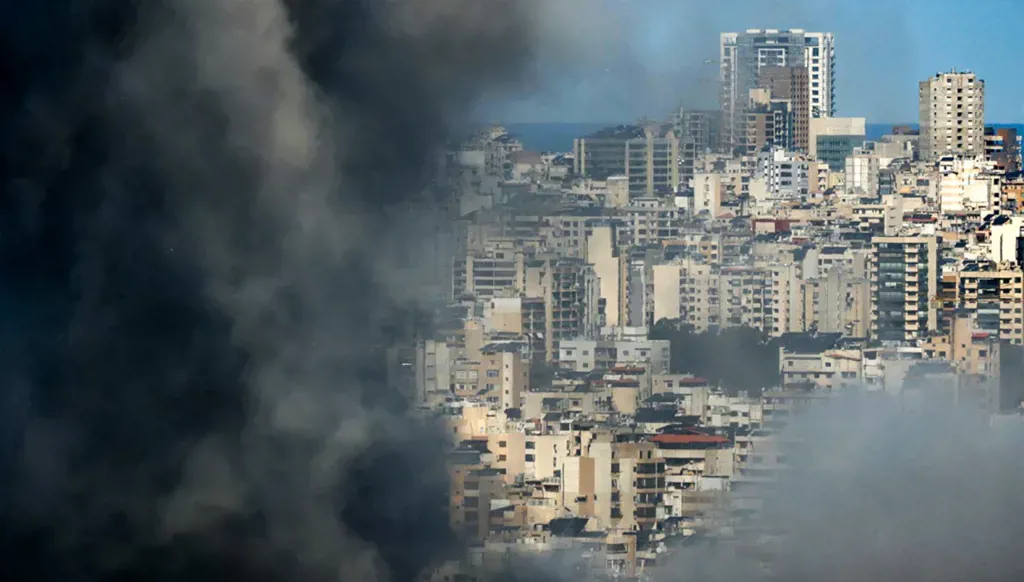


In a striking escalation, Israeli army spokesperson Avichay Adraee issued an urgent warning to residents of the southern suburbs of Beirut on Thursday, March 5, urging them to evacuate their homes immediately and follow specific routes out of the area.
What is notable this time is that the statement included detailed evacuation routes. Hours after this announcement, Adraee issued new warnings, creating a second scene of forced displacement for residents of the Bekaa region, calling for the immediate evacuation of several villages and towns, including Douris, Brital, and Majdeloun.
Strikingly, these areas being warned and ordered to evacuate are considered human “reservoirs” for Hezbollah’s supportive environment, in addition to the southern towns whose residents Israel forced to leave during the early hours of the missile strikes. Is the demographic change in Lebanon’s new areas actually being carried out through the use of force?
Lebanon has effectively entered a phase of direct war with Israel, after Hezbollah, in a statement issued on Monday, March 2, claimed responsibility for launching a salvo of rockets and drones at a military base in Haifa. This was accompanied by waves of population displacement from areas that Israeli army spokesperson Avichay Adraee publicly warned to evacuate immediately, on the grounds that they would be targeted by his forces. This brought back to the minds of Lebanese people the scenes of the 66-day bloody war that Hezbollah fought with the Israeli army following the Gaza support operation, which ended on November 27, 2024, under an agreement based on UN Security Council Resolution 1701, though many of its details remained confidential.
The previous war ended with thousands of martyrs and the destruction of hundreds of thousands of homes and buildings, either completely leveled or partially damaged. Israel also imposed a southern reality by gaining control over seven new hills and preventing the residents of the frontline villages from returning. This raised questions among Lebanese about the seriousness of implementing the so-called “Trump Economic Zone,” given that former U.S. President Donald Trump had previously spoken about restructuring Gaza and the southern areas bordering occupied Palestine to a depth of five kilometers, to turn them into economic zones under the cover of a “secure border strip.”
Lebanese people have endured a tragic reality for a year and four months, marked by daily Israeli attacks and a political situation unprecedented in Lebanon, reflected in two key ways. First, through official government decisions issued on August 5 and 7, the latest following Hezbollah’s support rockets sent to Iran in its war against the region, Israel, and the U.S. presence. These decisions stripped Hezbollah of all legal and legitimate status, labeling it as an organization operating outside the law. This stance was communicated to Arab and international diplomacy, marking a new reality in which the state disclaims any responsibility for actions carried out by Hezbollah or agents of the Iranian Revolutionary Guard in Lebanon.
The new political momentum, initiated by Prime Minister Nawaf Salam’s government with full backing from President Joseph Aoun and tacit support from Parliament Speaker Nabih Berri, signals the start of a new phase. Political changes regarding the legalization of Hezbollah’s activities are expected to dominate the post-war scene. Notably, President Aoun is still in his second year in office, and this decision by his first government indicates there will be no retreat. The political confrontation with Hezbollah is ongoing and inevitable, particularly after the ministerial statement stripped the group of its “resistance” designation.
There is no doubt that by dragging Lebanon into the wars of others and consistently defying government decisions, Hezbollah is shaping Lebanon’s next reality while maintaining its political operations, following the precedent of other parties that transitioned from civil war factions to political parties after the Taif Agreement in 1990. But the scenario no less serious than this is the deliberate forced displacement carried out by the Israeli government at this stage. For the first time, Israeli army statements have addressed entire areas, ordering evacuation, and unlike previous warnings—where people were asked to move only about 500 meters from targeted areas—they are now being directed to regions with Christian, Sunni, and Druze majorities. Will they be able to return to their homes?
The post-war phase in Lebanon, in terms of reconstruction and the return of residents, mirrors what came before but in a harsher form for both Lebanon and the displaced. Donor countries from the Arab world, Europe, and internationally have insisted on linking reconstruction support to Hezbollah’s disarmament. Yet today, Lebanon’s Arab supporters face the most egregious Iranian attacks without justification. Iranian Revolutionary Guard General Ibrahim al-Jaberi has even issued direct threats to strike commercial centers in Gulf countries, putting the Gulf economy at risk and further undermining Lebanon’s reconstruction efforts.
Lebanon now finds itself between the hammer of ongoing Iranian attacks on donor countries—which reduces the chances of reconstruction aid—and Hezbollah’s deep involvement in supporting the Iranian Revolutionary Guard, ensuring the continued systematic destruction of infrastructure in Shiite-majority areas. Will Lebanon’s regional demographics be reshaped if Hezbollah continues to hold onto its weapons amid Israeli efforts to enforce a security belt in southern Lebanon?
Disclaimer: The opinions expressed by the writers are their own and do not necessarily represent the views of Annahar