

Billions pledged to Gaza: What progress was made at Trump's Peace Council?
The U.S.-led initiative ties funding to on-the-ground action, outlining specifics for funding and dispersement and aiming to transform aid into long-term stability.


 Messenger
 Whatsapp
 Threads
 Email
Email
 Print
Print
 X
X
 Facebook
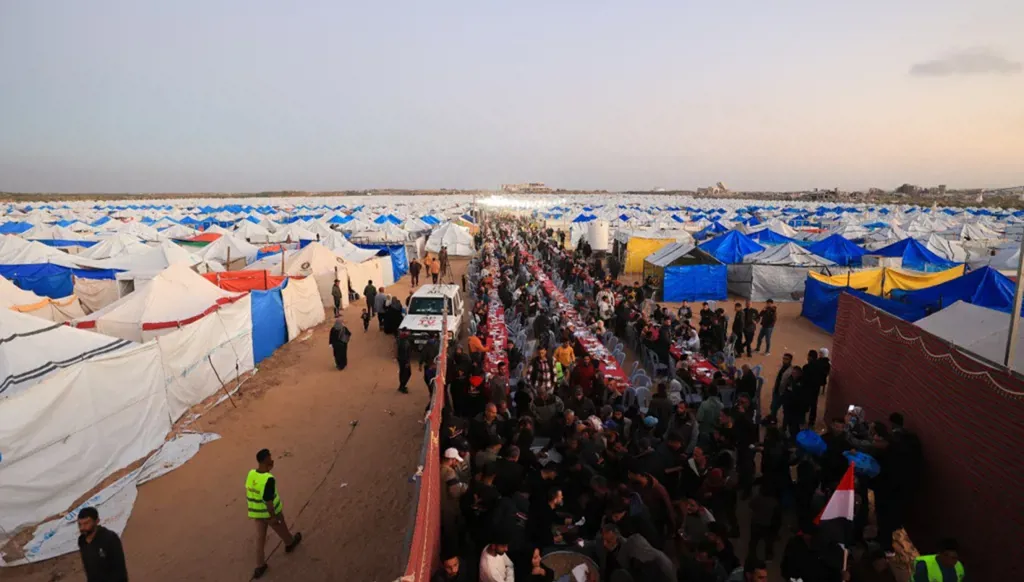


The first meeting of the "Peace Council" in Washington was a practical test of a new American strategy, signaling a move away from the slow pace of traditional frameworks. Pledges of funding to aid the recovery of Gaza exceeded seven billion dollars, to which Trump insists America will add ten billion.
What is needed now is a clear financial mechanism for funding, oversight, and disbursement, along with a disciplined field path for the relief phase, followed by reconstruction, and coordination of efforts on the ground. In parallel, the next-stage issues include disarmament, preparing a Palestinian police force, forming the international stabilization force, and deciding the form of transitional administration along with the conditions for its operation on the ground.
The announcement by His Highness Sheikh Abdullah bin Zayed, Deputy Prime Minister and Minister of Foreign Affairs for the UAE, of allocating 1.2 billion dollars to support Gaza via the Peace Council adds to an ongoing Emirati record since the first day of the war. Dr. Anwar Gargash, Diplomatic Advisor to His Highness the State President, confirms that the UAE provided 45% of the total international humanitarian aid to Gaza. The discussion should now move to the operational capacity necessary to move from relief to recovery and then reconstruction.
The meeting put the funding file at the forefront as the first test of international seriousness. Reports preceding and following the session discussed banking arrangements for managing transfers and payments, as well as oversight controls on accounts and disbursement, with international tools suggested, such as a trust fund managed via the World Bank to administer part of the aid.
The preference to define these pathways is clear given that any financial ambiguity leads to slow disbursement, fragmented channels, and weakened donor confidence—factors capable of disrupting relief and slowing reconstruction. It appears that a clear financial path is present from the start, clarifying management, oversight, and disbursement steps so that commitments turn into measurable execution on the ground.
The heaviest knot in the next stage is both security and political. The Peace Council places the disarmament of "Hamas" as a condition for starting rebuilding, and Israel links any construction to this condition. On the ground, "Hamas" appears to be trying to reorganize its administrative and security presence in areas vacated by the Israeli military, meaning that the transition will be neither swift nor smooth.
Therefore, the new Palestinian police and the international stabilization force need a clear timeline, specified powers, and defined responsibilities for each party. Most importantly, the transitional administration must be linked to a specific political framework guiding the final goal, so that Gaza does not become an open-ended temporary administration without a horizon.
The Europeans entered the scene from the standpoint of observation and reservation. Major European countries did not join the council, attending the session as observers. Within the European Union, a discussion emerged about the extent of participation and its political cover. The most significant positive indication came with the announcement of a meeting between Nikolay Mladenov, tasked with managing the Gaza file in the Peace Council, and European Union foreign ministers, along with a European proposal to expand the missions of the Palestinian police training program to include training Gaza police. This track is practical because the phases of relief followed by reconstruction will require extensive funding, training, and security coordination, making it essential to expand the circle of partners.
The Emirati approach in the Peace Council path is an extension of what Gaza has known since the beginning of the war. Aid reaches the area by air, sea, and land, followed by operational follow-up to ensure continuity. This is what H.E. Reem Al-Hashimy, Minister of State for International Cooperation and member of the executive council for Gaza, summarized in an interview with "Fox News," when she linked humanitarian improvement to the necessity of continuity and not settling for the bare minimum, calling for a dignified solution that ensures a stable life for the people of Gaza. The idea is that Emirati support moves as a work line connecting funding with the organization of humanitarian efforts and presses toward a political arrangement that stabilizes the region and prevents crises from returning whenever arrangements falter.
Stability in Gaza will not be created by aid alone, nor by politics alone. What is required is a single path linking funding with execution, connecting relief with recovery, and placing reconstruction under a clear political ceiling that prevents the recurrence of crises. This is the test of the Peace Council: moving Gaza from a shaky truce to a transitional administration operating on the ground, and then to reconstruction safeguarded by security, stabilized economically, and firmly established politically.
Disclaimer: The opinions expressed by the writers are their own and do not necessarily represent the views of Annahar.