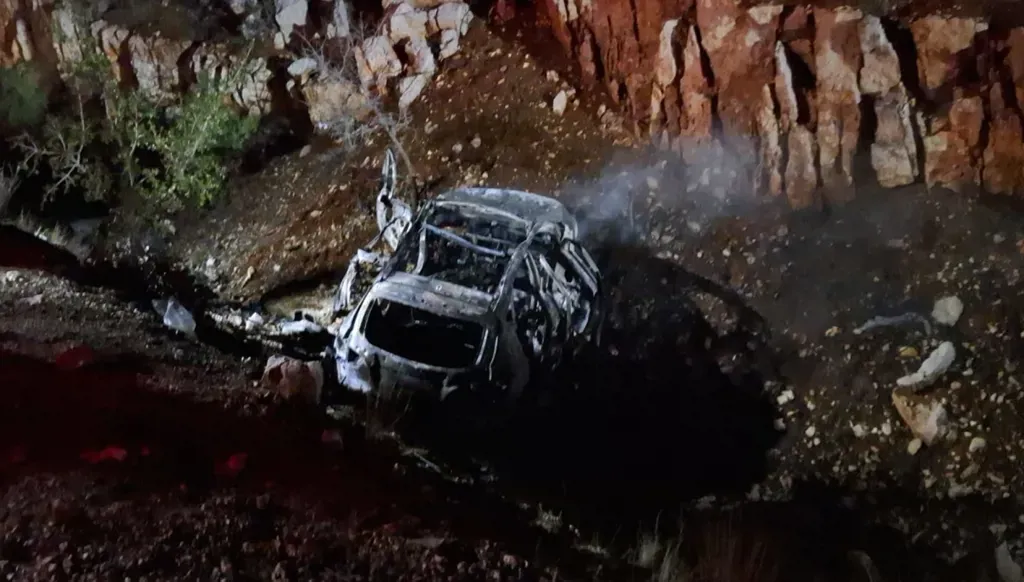
Whether the victims of the Israeli raid targeting a car on the Anjar-Masnaa road on Sunday morning were members of the "Islamic Jihad" movement, according to the Israeli narrative, or not, this development cannot be considered strategically isolated, lacking precursors or consequences.
The facts show that Israeli drones had previously carried out dozens of raids targeting leaders and cadres from the "Hamas" movement and the "Islamic Group" during the "war of attrition" and the fourteen months following the ceasefire, succeeding in "hunting" many of them.
It is well known to the Israelis that the geographical area where the raid took place the day before yesterday is part of a region extending from the central Bekaa westward toward Rachaya and western Bekaa, reaching the high Arqoub area. For the Israelis, it is an area with a Sunni majority that, in one way or another, provides a supportive environment for these two organizations, which have been in a covert state of alliance and coordination since the early days of the "Al-Aqsa Flood" operation.
In addition to this current data, the same area has long constituted, for the Israelis, a "border area" that posed a threat to them, as it served as a passage and settlement for "Palestinian fedayeen" since the late sixties of the last century. It also forms the main artery for movement into the Syrian interior.
It is well known to the Israelis that the current regime in Damascus has not ended the Palestinian military presence in Syrian territories, even if it has reorganized and repositioned it according to the regime’s precise calculations, including "eliminating" the presence of certain factions that operated under the previous regime and took part in its actions against opponents.
Accordingly, Israel has kept this area under close surveillance and military observation, treating it as a "target area" and a constant source of threat to its security.
Based on all these facts, the Israeli strategic mindset has decided to treat this area in the same manner as it treats the southern region. Strategic experts link Sunday’s raid with the kidnapping of "Islamic Group" leader Atwi Atwi from his home in the far reaches of Arqoub, concluding that both incidents fall into the same security category.
In reality, Israel has long exposed its concern over three inherent threats to its security within Lebanese territories, which it continues to address, namely:
"Hezbollah," which, according to Channel 24, "does not rest and regenerates itself very quickly and efficiently."
The emergence of a "Sunni force" that provides any cover for the party, along with the presence of the "Hamas" movement in Lebanon.
The freedom of movement once again granted to Palestinian factions and forces within Lebanon.
The notable aspect of Israel's announcement regarding the raid on the Masnaa road in central Bekaa, targeting a car carrying members of the "Islamic Jihad," is the renewed focus on this organization, which, until recently, had succeeded in remaining completely out of the limelight as part of a policy it pursued after carrying out military missions during the "war of attrition," stemming from its strategic alliance with Hezbollah and Iran.
Thus, genuine concern has arisen among observers that the recent security incident on the Masnaa road may mark the beginning of a phase of heightened Israeli escalation aimed at increasing Tel Aviv’s pressure on the Lebanese scene.
Disclaimer: The opinions expressed by the writers are their own and do not necessarily represent the views of Annahar.



 Messenger
 Whatsapp
 Threads
 Email
Email
 Print
Print
 X
X
 Facebook