

France pushes Lebanon on Hezbollah disarmament


 Messenger
 Whatsapp
 Threads
 Email
Email
 Print
Print
 X
X
 Facebook
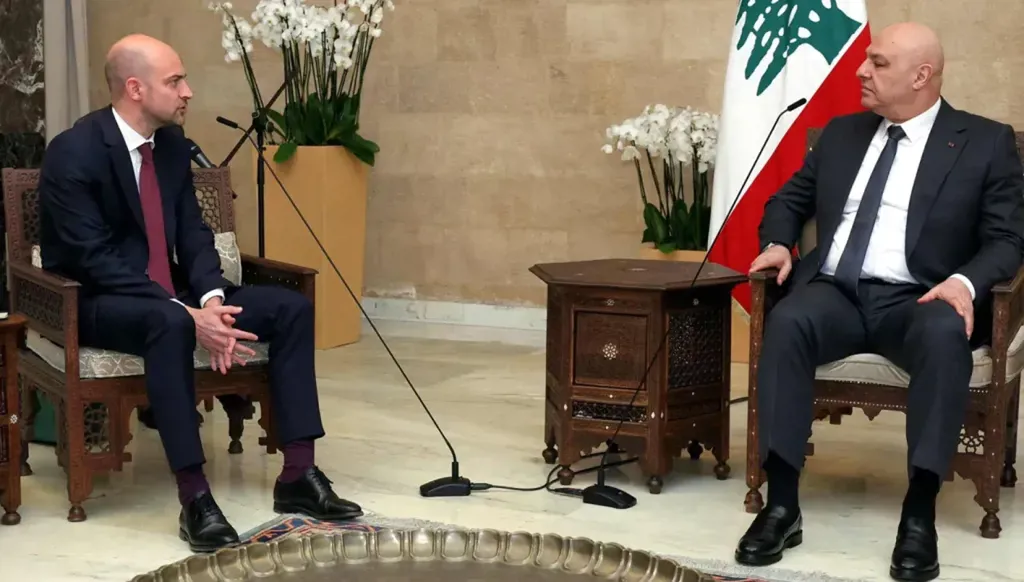


French Foreign Minister Jean-Noël Barrot concluded his visit to Lebanon a few days ago with a clear insistence that the Lebanese army must begin the next phase of its plan to consolidate weapons and present this plan in the coming days in a way that balances the pressure expressed in Washington at the same time.
Barrot’s visit was accompanied by concerns about whether Paris would be able to successfully organize the army support conference it has scheduled in Paris on March 5. Paris had expected that the visit of Army Commander General Rodolphe Haykal to Washington would face significant challenges, given the U.S. capital’s awareness of the situation and its assessment of Lebanon’s authorities, especially regarding the stalled process of disarming Hezbollah. Paris now faces an even greater dilemma in ensuring the success of this conference after the approach taken by U.S. Senator Lindsey Graham nearly overshadowed Haykal’s entire visit.
In reality, Paris’s challenge is not just about the size of the aid that might be announced, although that is important. The bigger issue is having a clear long-term strategy that looks ahead to the next stages, particularly with expectations that the Lebanese army will take on critical missions in protecting borders and maintaining security stability. While the invitation to hold the conference was made with Saudi and American consultations and approvals, meaning its commitment and success is a shared responsibility with Paris, the responsibility largely falls on the French capital, which has been forced in recent times to make concessions in response to U.S. pressure and its approach to Lebanon.
Another concern, in addition to the declining hope for the conference’s success, is that Lebanon’s slow progress in taking serious steps to disarm Hezbollah north of the Litani River could hinder efforts to prevent the renewal of conflict in the country. Israeli electoral calculations and fears about a U.S.-Iran agreement limited to the nuclear file also factor into the equation.
Although Jean-Noël Barrot’s visit to Lebanon was part of a tour that also took him to Iraq and Syria, all these trips are connected by France’s determined efforts to maintain a sphere of influence that has been steadily weakening under U.S. dominance in the regional scene, amid a lack of European willingness to engage and tense, sometimes strained, relations with Washington and former President Donald Trump. This does not, however, prevent Paris from facing significant frustration in Lebanon, a country that wants France by its side and advocates for it with the Americans.
Between General Rodolphe Haykal’s first visit to Washington, which was scheduled before the end of the year, and his most recent visit, Lebanon’s official leadership took important political steps, particularly through statements by President Joseph Aoun regarding Hezbollah’s weapons. It was understood that the cancellation of the earlier visit was directed solely at Lebanon’s political authorities as a clear signal of U.S. objection to the Lebanese approach to implementing the exclusive state control of weapons.
Aoun has notably moved away from his previously cautious stance on Hezbollah’s weapons, especially since previous dialogue had produced no tangible results. On the first anniversary of his election, Aoun stated that Hezbollah’s weapons had become a burden on Lebanon and that the circumstances that had justified them no longer existed. He reiterated before the diplomatic corps the state’s determination to maintain exclusive control over weapons, but this alone does not appear to have been enough.
Many believe that General Haykal did not bring forward his plan for the second phase concerning the area north of the Litani River before his visit. Others questioned the timing of the visit itself, noting that no substantial changes had occurred between the previously canceled visit and the one that finally took place. This latest visit again sent a strong message to Lebanon’s political authorities, particularly through the tense meeting Haykal had with U.S. Senator Lindsey Graham.
At the same time, Paris is concerned about linking any progress within Lebanon to the ongoing U.S.-Israeli tensions with Iran, which could freeze matters for later stages. France now more than ever needs operational evidence to strengthen its position at the upcoming army support conference, unless it is postponed, while also respecting Lebanon’s official approach. Prime Minister Nawaf Salam’s visit to southern Lebanon sent a strong message about consolidating state authority—not just militarily but across all levels. Yet Lebanon’s partners are still waiting for clear, decisive steps to disarm Hezbollah across all regions and at a faster pace, in anticipation of commitments to support the next phases of the Lebanese army’s plan.
Disclaimer: The opinions expressed by the writers are their own and do not necessarily represent the views of Annahar