

Is Television Dead… Long Live YouTube?
From dominant mass medium to content supplier, television has lost its cultural centrality as YouTube reshapes how the world produces, distributes, and consumes video.


 Messenger
 Whatsapp
 Threads
 Email
Email
 Print
Print
 X
X
 Facebook
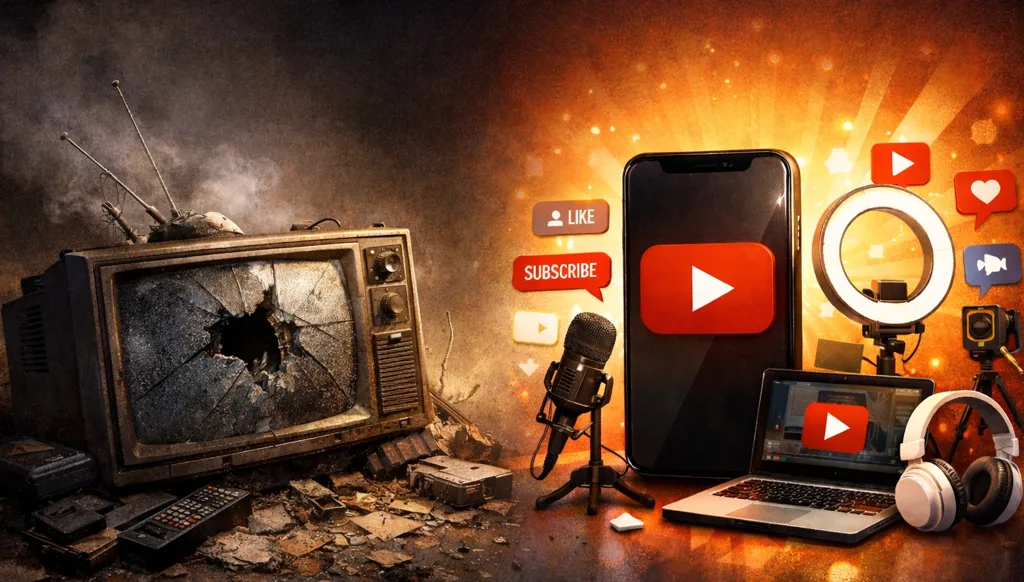


After modest scientific beginnings in the late nineteenth century, followed by promising technical experiments in the 1920s, the year 1936 marked the official birth of television in a form close to what we know today, with the BBC launching the world’s first regular television broadcasting service. Following an enforced interruption during World War II, television gradually became, in the 1950s, a central household device.
From that point on, and for decades, television established itself as the dominant media and communication medium par excellence: a gateway to news, a platform for entertainment, and a key driver of popular culture. It also became the primary advertising channel for companies, shaping the image of the world’s largest brands. Television created stars, imposed collective viewing schedules, and structured the public sphere around screens. Historically, television was not merely a medium; it was a social ritual and a shared framework for interpreting the world.
Television continued to evolve throughout the second half of the twentieth century, particularly with the liberalization of media markets and the multiplication of channels in the 1980s and 1990s, followed by the transition to digital broadcasting and high definition in the early 2000s, eventually leading to internet-connected smart TVs.
Then came the unexpected. YouTube was born.
The year 2005 marked a decisive turning point with the creation of YouTube, which was acquired very rapidly by Google—only one year after its launch—for USD 1.65 billion. Google’s move was both anticipatory and visionary. The American tech giant quickly grasped the revolutionary potential of digital video and the vast developmental and disruptive possibilities embedded within YouTube. This acquisition provided the global infrastructure that enabled massive scale, the transition to what is scientifically referred to as viral diffusion dynamics, and later the development of complex recommendation systems, algorithms, and monetization models.
In less than twenty years, YouTube has not merely competed with television; it has fundamentally redefined the production, distribution, and consumption of video content. Today, the relevant question is no longer whether YouTube competes with television, but rather a deeper and more pertinent one: do we still watch television in the way we once did?
One Model Versus Another
Historically and theoretically, television is built on a linear and vertical logic: a centralized broadcaster, a fixed programming schedule, and a passive audience constrained by time slots and formats. Despite market transformations and the multiplication of channels, this core model has largely remained intact.
This was articulated as early as the 1970s by media scholars Elihu Katz and Jay Blumler in their work Uses of Mass Communication: Current Perspectives on Gratifications Research, where audiences are positioned within a centralized broadcasting system controlled by a limited number of actors.
YouTube, by contrast, introduced a radically different logic: on-demand viewing, free choice, interaction, and algorithmic mediation. Users determine the content, timing, duration, and even the device. They are no longer passive spectators, but fully active participants in their media experience. This transformation aligns closely with Manuel Castells’ analyses of the shift of communicative power from centralized institutions to decentralized networks.
In the same line, advertising itself has evolved. Whereas television relies on forced advertising density, YouTube offers flexible models, sometimes even eliminating traditional advertising altogether for subscribers—while still allowing indirect forms such as sponsorships and product / brand placement embedded within the content consumed by users.
Numbers Do Not Lie
In an exceptionally short time span, YouTube has achieved a level of global penetration that took television nearly half a century to build. It continues to grow without interruption, constantly evolving—from live streaming to ultra-high definition, and from mobile devices to smart TVs. Henry Jenkins describes this transformation as convergence culture, in which older media do not disappear, but lose their centrality.
Today, YouTube exceeds two billion active monthly users and is approaching the threshold of three billion—nearly one third of humanity. Daily consumption surpasses one billion hours of viewing. Notably, consumption via smart TVs is growing faster than via smartphones, indicating that the television screen still exists—but without television itself.
In this context, Dutch scholar José van Dijck explains how digital platforms have become cultural architectures, reshaping habits and media hierarchies not merely as technical tools, but as fully integrated social actors.
Lebanon: A Revealing Case Study
In Lebanon, an interesting example emerged when the Lebanese Broadcasting Corporation (LBC) decided to publish the satirical series Marhaba Dawle on its YouTube channel. Initially, the series did not achieve significant reach. However, as official controversy escalated—accompanied by legal pursuits and security summons targeting its producer and team—the equation shifted entirely.
Search activity surged, videos spread rapidly, and algorithms aggressively amplified the content. This phenomenon corresponds to what is scientifically known as the Streisand Effect, whereby attempts at censorship or restriction produce the opposite outcome, dramatically increasing visibility and reach. Some clips surpassed Lebanon’s population in view count, offering a clear indication that YouTube has become more effective than traditional broadcasting—even for content originally produced for television.
Redefining Entertainment
This shift extends beyond political satire. In music, for example, Lebanese artists achieve tens of millions of views on YouTube, with temporal and geographic reach that no local or regional television channel could provide. In this regard, Stuart Cunningham and David Craig demonstrate that YouTube is no longer merely a platform, but a full-fledged media industry, with its own stars, economy, and rules.
When News Becomes Digital Myth
Even in global political news, the contrast is striking. Numerous videos covering military operations or security events—whether accurate or exaggerated—achieve viewership figures on YouTube that vastly exceed those of traditional news channels such as CNN, BBC, or France 24. The issue here is not the accuracy of information, but the logic of dissemination: YouTube does not merely relay news; it constructs its narrative and its fame.
In this context, and in addition to the Lebanese example above, a recent global event provides further illustration. In early 2026, the United States conducted a rapid and large-scale military operation named Operation Absolute Resolve, resulting in the arrest of Venezuelan President Nicolás Maduro and his wife, who were transferred to the US to face criminal charges. Following the operation, YouTube was flooded at lightning speed with content: footage of fighter jets over Caracas, images of Maduro being transported aboard the U.S. warship USS Iwo Jima, escorted through Manhattan under DEA custody, and disembarking from a helicopter surrounded by agents. These videos amassed incalculable numbers of views, vastly exceeding the audience reached by traditional television coverage of the same event.
Conclusion
Television has not yet disappeared, but it has undeniably lost its central position. YouTube has become the world’s primary screen without contest—the leading visual refuge and the broadest space for visibility and fame.
Television continues to exist, but increasingly as a content producer for another platform.
Television has not yet died technically.
But it has died symbolically.
Long live YouTube.
Disclaimer: The opinions expressed by the writers are their own and do not necessarily represent the views of Annahar.