

Iraq’s political gamble: Can Al-Maliki return without a U.S.-Iran clash?
As Washington issues threats, Iraq’s former prime minister weighs a comeback in a vastly changed political landscape.


 Messenger
 Whatsapp
 Threads
 Email
Email
 Print
Print
 X
X
 Facebook
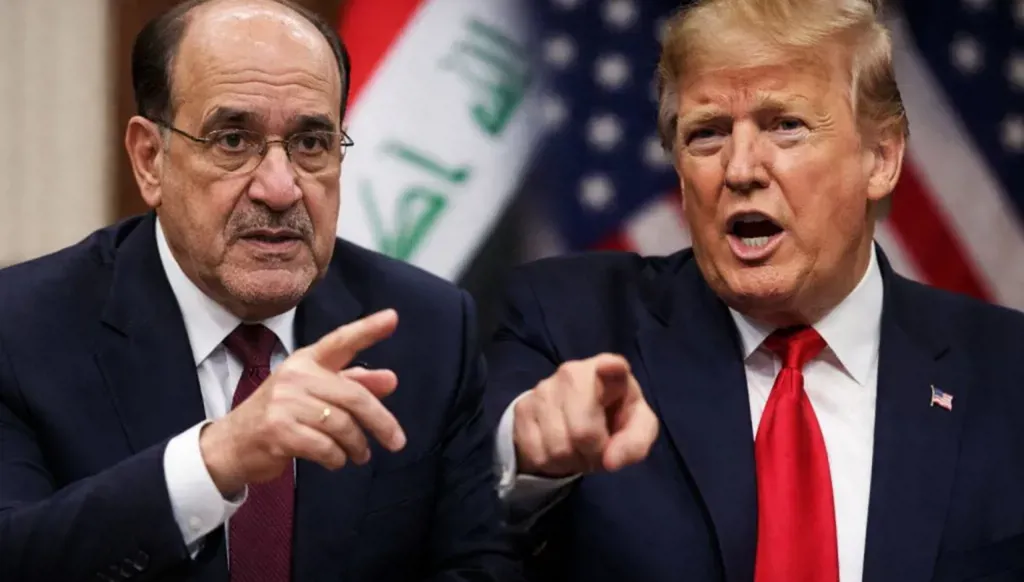


Donald Trump’s statement opposing Nouri al-Maliki’s nomination for the upcoming Iraqi government was seen as the first salvo in a potential conflict with Iran that has yet to erupt. Prior to Trump, figures such as Senator Marco Rubio and envoys Tom Barrack and Mark Savaya had all voiced warnings against forming a government perceived as being “subject to Iranian influence” or “installed by Iran,” arguing that such a government “would not be successful,” “could not prioritize Iraq’s own interests,” “could not keep Iraq out of regional conflicts,” and “could not strengthen the U.S.-Iraq partnership.” Despite these threats, the Shiite powers within the “Coordinating Framework” overlooked internal disagreements among their leaders and approved al-Maliki’s nomination. Because Supreme Leader Ali Khamenei had reportedly “blessed” the decision in advance, Trump deemed it a “very bad choice,” citing al-Maliki’s “flawed policies and ideologies.”
Certainly, Trump’s lightning strike against al-Maliki represented an unwelcome intervention in Iraq’s domestic affairs, raising questions that the ongoing tension between the U.S. and Iran seems poised to answer. At the same time, it included a pointed assessment of al-Maliki’s previous terms (2006–2014), which Trump summarized as “poverty and chaos”—a judgment shared by many both inside and outside Iraq. The “poverty” refers to the country’s dire economic conditions despite its abundant resources and potential, while “chaos” recalls the rise of ISIS in mid-2014 and its rapid occupation of large swaths of Iraq and Syria. At that time, international attention was largely focused on organizing the “coalition to combat terrorism,” and some scrutiny fell on al-Maliki for his role in the “ISIS catastrophe.” Ultimately, a request from Washington, coupled with Tehran’s agreement, prevented him from pursuing a third term as prime minister.
Inside Iraq, al-Maliki faced a flood of accusations extending beyond the ISIS crisis to include widespread corruption during his tenure—most notably the case of the 50,000 “ghost recruits,” who existed only on paper—and the proliferation of militias, later consolidated under the banner of the “Popular Mobilization.” He was also criticized for sectarian fanaticism, antagonizing other segments of society, and maintaining poor relations with neighboring Arab states. Yet he faced little to no real accountability, as his allies—or more accurately, Iran-aligned operatives—within the judiciary and state institutions effectively shielded him from repercussions.
While Trump’s stance was both unsurprising and, in principle, unacceptable in terms of international relations, al-Maliki’s own insistence on regaining power was equally questionable. The twelve years he spent out of office were not enough for Iraqis to forget his legacy—neither in matters of security nor in navigating the country’s extremely sensitive pluralism. Yet in Iraq, much as in Lebanon, anything is possible when mafias and militias ally, and corrupt members cover one another’s flaws. Undoubtedly, one of the most significant aspects associated with al-Maliki is that his affiliation with and leadership of the Dawa Party created open channels for deeper and more institutionalized Iranian interventions.
Perhaps this is the core of the American criticism of al-Maliki: there is now a broad Iraqi current—crossing sectarian and ethnic lines—that rejects his ties to Iran and opposes its militias. This sentiment also explains why Sunni political forces have taken a negative stance on his return. Kurdish acceptance of al-Maliki, however, is more nuanced. His track record of satisfying Erbil, the Kurdistan Democratic Party and Masoud Barzani, through settlements and deals earned their cooperation, while his ties with Suleimaniyah, the Patriotic Union of Kurdistan and Jalal Talabani, have been strengthened by Iran. Still, it remains uncertain whether Erbil’s support will hold if tensions between the U.S. and Iran over al-Maliki intensify.
Maliki dealt with the Trump-ian “veto” with high pragmatism. After firmly rejecting U.S. intervention in what he considered an internal and “sovereign” matter, he met with the U.S. chargé d’affaires in Baghdad, hoping to open a dialogue with Washington. Maliki must now know a lot about Trump, who had previously threatened Iran and bombed its major nuclear facilities—and who could do so again. He also clearly understood the warning of “not continuing to help Iraq” after a series of U.S. messages to Baghdad. On the other hand, Washington knows that he can be a strong ruler in a difficult country; if he seeks an understanding with them, they may not object, but only on their terms.
Can he commit to and pledge to fulfill these conditions, or is he banking on the imminent departure of the last American soldiers from Iraq to free him from pressure? However, Trump is not threatening Iraq with military force but through sanctions, as Iraqi oil revenues—which make up 90% of the Iraqi economy—continue to be held in the U.S. Federal Reserve in New York. At the top of the American list of conditions are the non-transfer of billions of dollars to Iran or its regional proxies, the removal of Iranian advisors from Iraqi institutions, the dismantling and disarming of Iran-aligned factions within a set timeframe, the fight against corruption and money laundering, and the establishment of an independent judiciary.
The return of al-Maliki is possible if he grasps the changes that have taken place in the mission of governance and its broader environment—not just those influenced by Trump.
Disclaimer: The opinions expressed by the writers are their own and do not necessarily represent the views of Annahar.