

Countdown to Lebanon’s elections: What the last parliamentary sessions tell us
As Parliament nears the end of its term, theatrical debates expose deep political divisions and challenges ahead of this year's elections.



 Messenger
 Whatsapp
 Threads
 Email
Email
 Print
Print
 X
X
 Facebook
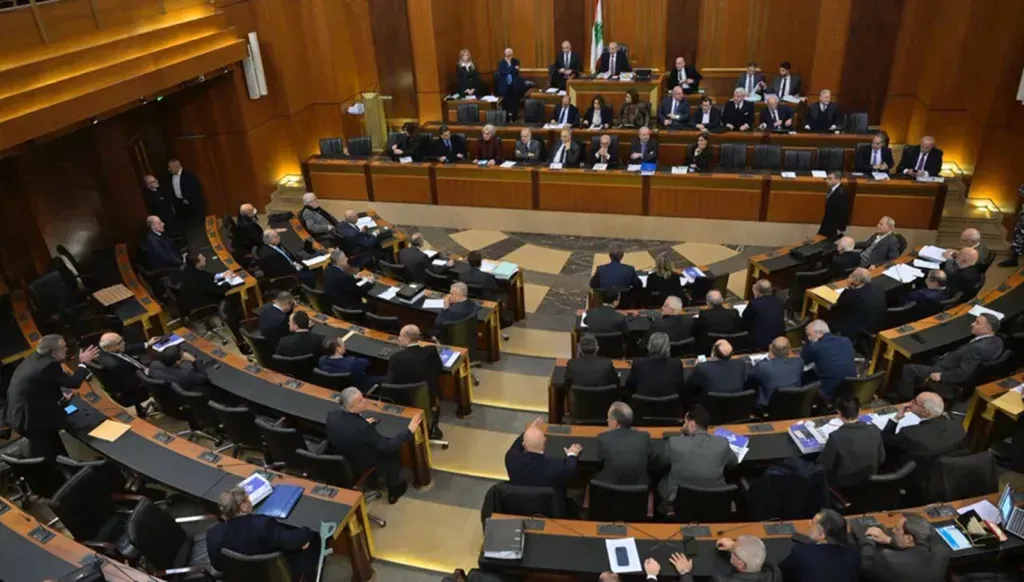


Several days having passed since the tumultuous passage of the budget bill in Parliament, but it remains important to review the dynamics of those sessions—especially as they forecast the success of the ongoing political transformation.
With elections upcoming—on May 3rd and 10th for expatriate and resident voting respectively—there remains, regardless of the lingering ambiguity over technically possible postponements, a serious choice. Over three days Lebanese citizens watched MPs tested on the parliamentary tribune last week; they witnessed the clearest reflection of Lebanon’s current reality and the potential impact of their vote.
This Parliament was elected by just 49 percent of Lebanese voters in 2022, under the second iteration of the 2017 electoral law. While some provisions of the law have been amended, the core system of proportional representation that governs parliamentary composition remains unchanged.
A key observation from the budget sessions is the massive imbalance in parliamentary performance. This disparity was clearly observable as nearly all speeches and interventions belonged to roughly half of Lebanon's MPs over those three days.
The major parliamentary blocs appeared to be on high alert and fully mobilized, reflecting a political reality at its most congested, dominated by the overarching issue of Hezbollah’s disarmament, which overshadowed both the significant and everyday concerns of the public. Meanwhile, citizens’ pressing issues struggled to gain attention, often surfacing only through MPs’ grandstanding aimed at appeasing protesters among retired military personnel, civil servants, and teachers.
Significant issues were lost amid parliamentary interventions and the Speaker of Parliament's responses. The sessions were not just chaotic, they revealed a concerted effort to push political rhetoric over accountability and oversight, with only a few exceptions. As a result, “truth” was largely absent for those who sought to seize the final hours to outmaneuver an agreement that had already been reached between the government and retired military personnel.
These details may seem minor in the larger trajectory of a country standing at a critical crossroads—one that both precedes and coincides with election deadlines, with uncertainty over whether these elections will take place on schedule or be postponed. Yet such details often reveal essential truths.
This Parliament, approaching the end of its term, with its flaws, gaps, and the absence of a decisive majority representing key elites or large segments of the Lebanese population, nonetheless reflects the broadest picture of Lebanon today—its political, sectarian, and party divisions—regardless of what is claimed otherwise.
If this council is taken as the primary indicator for what the next Parliament might look like, anticipating fundamental change will be extremely difficult, except under two conditions: the reinstatement of expatriate voting from their countries of residence—a move that now seems nearly impossible—or an overwhelming “tsunami” turnout across all sects, which remains highly unlikely even if participation rises compared with the previous elections.
Disclaimer: The opinions expressed by the writers are their own and do not necessarily represent the views of Annahar.