

Hezbollah speaks to Iran as much as the US
Hezbollah Secretary-General Naim Qassem tries to assure Iranian sponsors of the continued value of their investment.


 Messenger
 Whatsapp
 Threads
 Email
Email
 Print
Print
 X
X
 Facebook
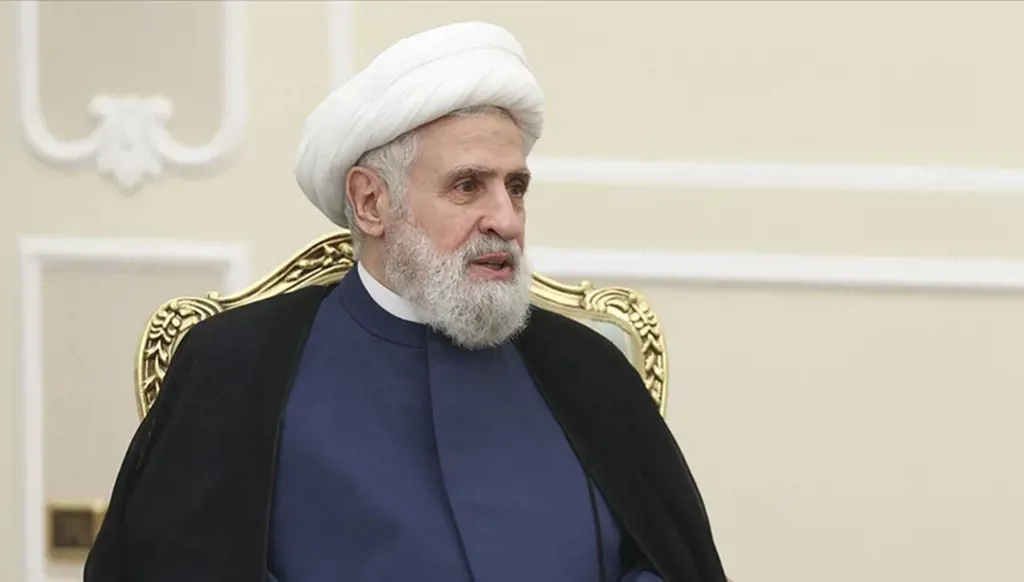


The speech delivered by Hezbollah’s Secretary-General, Sheikh Naim Qassem—in which he declared support for Iran and its Supreme Leader Ali Khamenei—evokes the Iranian song “Salam Farmandeh” chanted by students in the party’s schools to reaffirm allegiance to the doctrine of "Wilayat al-Faqih," a doctrine whose modern interpretation vests supreme religious and political authority in the Iranian Supreme Leader.
Qassem once again chants loyalty to a religious authority that claims to act on behalf of the Imam of Justice, granting the Supreme Leader the final say in all matters of state and binding the Shiite community to the Iranian state. In doing so, his speech serves as a enunciation of Iran’s management of Hezbollah—an administration that oversaw the party’s reconstruction and provided it with funding after the blows it sustained during the 66-day Israeli war. That war culminated in the assassination of Sayyed Hassan Nasrallah and senior party leaders, along with the loss of thousands of cadres and fighters.
This time, Qassem’s speech comes at one of the weakest moments for Iran's support network, especially compared to Hezbollah’s position before the "support war" backing Gaza. Then the party boasted surplus power, a so-called “balance of deterrence,” and the ability to eliminate Israel. Today, Qassem stresses standing with Iran, even as he proves incapable of confronting the Israeli attacks he is facing. Hezbollah has tacitly cooperated in arms reductions with Israel and accepted a highly-uneven ceasefire agreement, even as they refuse to acknowledge defeat.
Qassem’s words confirm Hezbollah’s subordination to the system of the Guardianship of the Jurist and with it the Iranian Republic. Its remaining power may soon be tested, as Hezbollah facing the prospect of an American war far broader than the 12-day conflict of June 2025. The result may prove disastrous, pushing Hezbollah toward a settlement akin to unconditional surrender.
Qassem’s speech makes clear just how deeply Hezbollah breathes through Iran’s lung. The party has cultivated a generation within the Shiite community that identifies with the state of the Guardianship of the Jurist and follows its institutions with obedience framed as sacred, giving this allegiance both political and ideological significance. In turn, the party aligns itself with Iran’s political system and its reference authority. Hezbollah also speaks to an Iranian audience—seeking to reassure them of the continued value of investing in the party in Lebanon and among the Shiite community. Most importantly, it signals that the party remains a functional arm of Tehran, continuing to receive support and funding, as the time has not yet come for the regime to abandon it before reaching a settlement with the Americans.
By openly declaring that Hezbollah is not neutral in Iran’s struggle, Qassem gives Israel justification to carry out further operations against the party and to expand the scope of destruction in border villages. In their rhetoric, Hezbollah reveals an abandonment of its core base, the Shiite community in the south which is already suffering under displacement and hardship. In his position of weakness, Qassem chooses to direct his concern away from the people, doubling down on Iran to restore the party’s strength. He frames this as a sacred duty, preparing Lebanese Shiites to follow Iran’s decisions into new ventures. These ventures could the people and the party toward self-destruction.
Disclaimer: The opinions expressed by the writers are their own and do not necessarily represent the views of Annahar.