

U.S. tightens grip on Lebanon as Hezbollah and Israeli threats mount
As the U.S. pushes for Hezbollah’s disarmament and Israel demands a weapon-free zone, Lebanon confronts escalating political and military challenges.


 Messenger
 Whatsapp
 Threads
 Email
Email
 Print
Print
 X
X
 Facebook
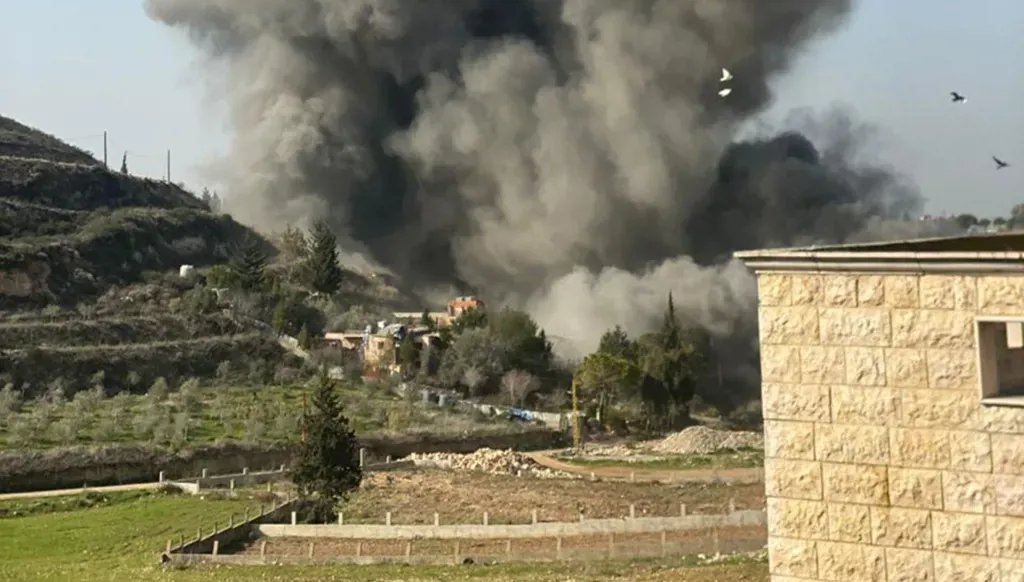


Global diplomatic initiatives in Lebanon continually return to the risks of Israeli military expansion against Hezbollah, pressing Lebanon to makes progress in limiting armaments north of the Litani River. In Prime Minister Nawaf Salam’s meeting with President Emmanuel Macron in Paris, the latter emphasized the need to address issues of arms and reform, while reaffirming France's support for Lebanese sovereignty.
Lebanon has once again received international warnings to take a decisive stance in negotiations with Israel, following news that United States is moving toward a firmer position as the deadline for limiting armaments passes. This comes as President Trump, who briefly mentioned Hezbollah in Davos, is determined to finalize negotiation options and disarm the party. The Americans want the Lebanese state to engage in trilateral talks with Israel, a departure from procedures of the current mechanism which ensure United Nations and French involvement. Paris encountered this shift in priority when committee meetings were suspended following envoy Jean-Yves Le Drian's refusal to participate in talks. This shift moves the negotiations into a new political and economic direction, bringing issues such as bilateral relations, the buffer zone, and borders to the fore.
Since the end of the South Litani phase, the United States has pushed for the complete disarmament of Hezbollah, signaling that the proposal for “containment” is no longer regarded as an option by the Americans—especially after the party refused to discuss handing over its arms. Diplomatic sources indicate that American officials will ask Army Commander General Rodolphe Haykal to present the army’s plan to interdict weapons north of the river during the latter's visit to Washington. However, information suggests that the American administration is going further; no longer satisfied with simply disarming Hezbollah, it may seek to dismantle the group entirely, including its social institutions and its financial network.
American pressure on Lebanon is one part of Trump’s plan to end Iranian influence in the region, hoping ultimately to encourage internal change in Iran. If he achieves these goals, he can leverage them domestically in the midterm elections, as well as by reducing Hezbollah’s influence, advancing Lebanon-Israel negotiations, and helping establish the Peace Council around Gaza.
Notably, the Americans now hold sole authority over the Lebanese file, with the work of the quintet countries operating under the U.S. framework, regardless of their influence inside Lebanon. It has become clear that Trump’s plan for Lebanon has shifted following recent developments. He seeks negotiations to be conducted exclusively under American supervision while deferring to Israel on particulars, even as Israel's conditions prove increasingly challenging for Lebanon. According to unnamed sources, Hezbollah is reticent to participate in a political settlement that involves relinquishing its arms making Israel's aims of a weapon-free zone up to the Awali River difficult without the use of force.
As Hezbollah seeks to create obstacles to disarmament, Lebanon once again must balance the risk of civil war against the possibility of Israeli incursions, caught in the crossfire of regional tensions.
Disclaimer: The opinions expressed by the writers are their own and do not necessarily represent the views of Annahar.