

From disarmament to political erasure: Targeting Hezbollah’s civil presence


 Messenger
 Whatsapp
 Threads
 Email
Email
 Print
Print
 X
X
 Facebook
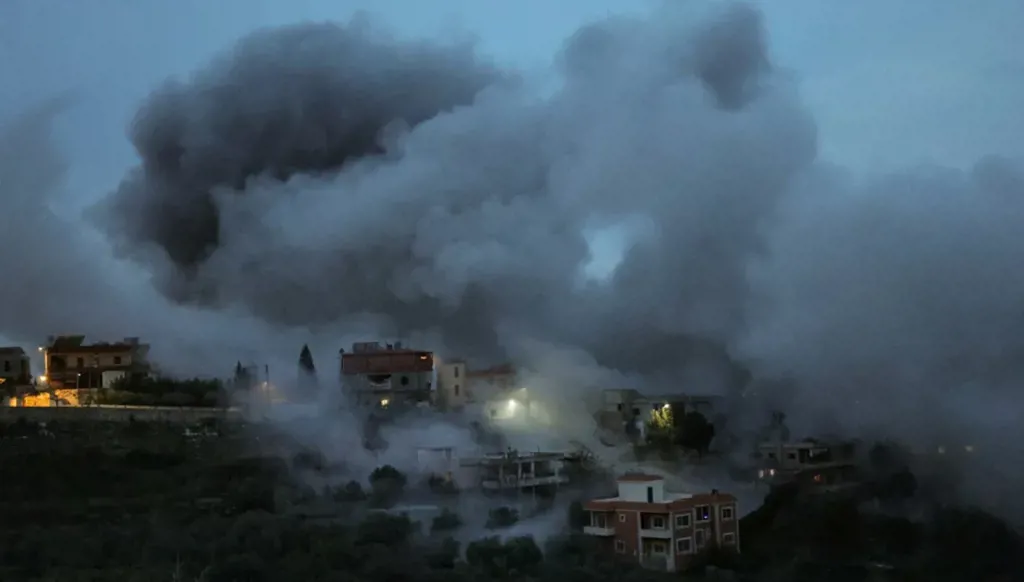


While Hezbollah waves at the Lebanese authorities with options of chaos and an existential war in defense of its weapons, described as “the weapon that protects us,” Israel is revealing a different track in its open war against it. This track does not stop at targeting military capabilities, but moves clearly toward an attempt to uproot the party politically from southern Lebanon. The conflict, as recent developments suggest, is no longer confined to the balance of deterrence or the rules of engagement. It has come to target the party’s function, role, and ability to represent the land and the social environment in which it operates.
In this context, the statement issued by the Israeli army spokesperson’s unit last Thursday evening cannot be treated as a passing detail or a mere operational justification. When placed within the broader debate over the party’s future in the south, the statement may constitute one of the clearest indicators of the shift underway in the objectives of the war and the tools used to pursue them.
According to the statement, the Israeli army announced that its forces carried out, over recent months, a series of operations in southern Lebanon that led to the killing of ten individuals from nine different villages, as part of activities led by Division 91 (an Israeli army division responsible for the northern border). Based on the information provided, the targeted individuals were working as an executive arm of Hezbollah inside southern villages, operating from within the civilian environment, particularly in reconstruction, education, social services, and infrastructure. The statement added that these activities included taking control of civilian areas and private property, transferring weapons and personnel, and establishing infrastructure within residential communities, considering these practices a violation of Israeli Lebanese understandings.
What does this statement mean?
Quite simply, it indicates that any move carried out by Hezbollah, regardless of its nature or cover, is deemed a violation of the understandings in place between Lebanon and Israel. This is a clear reference to the ceasefire agreement declared under US sponsorship on November 26, 2024. According to this logic, Israel makes no distinction between direct military activity and political, social, educational, or development-related activity. It considers the party’s overall presence in the south to be a single, integrated structure whose ultimate purpose is the reproduction of military power, even if the tools differ.
Accordingly, the deeper message of the statement is not limited to justifying specific targeting operations, but rather to redefining the very concept of a “violation.” The presence of Hezbollah as a political, social, and service-providing entity in southern Lebanon is presented by Israel as prohibited in and of itself, not as legitimate activity outside the military sphere. From this perspective, Israel grants itself the right to target anyone working in the party’s name or interest within these civilian fields, considering them, by its own description, part of a structure that later paves the way for its military reconstitution.
Thus, regardless of the position of the Lebanese authorities or any ambiguity in their reading of the existing understandings, Israel is declaring, for the first time with such clarity, that it is not content with seeking to dismantle Hezbollah’s military arsenal alone. In parallel, it aims to eliminate its presence within its Shiite support base. The pattern being targeted, according to the statement, does not lie at the core of direct military action, but at the heart of the civilian structure that constitutes the keys to the party’s electoral and social influence. Turning these groups into legitimate targets effectively means seeking to dismantle the network of relations that allows the party to remain active within its community, and to gradually remove it from its environment, not through sheer force, but by drying up its daily presence in villages, municipalities, and local institutions.
This Israeli military approach against Hezbollah’s “civil” presence intersects with a US-led position that rejects any role for the party, or for entities linked to it, in Lebanon’s reconstruction, or even in providing forms of protection and municipal-type services to the population. This reflects a convergence between military pressure on the ground and attempts to redraw the political and social landscape in the south, based on separating the social environment from the party and stripping it of its ability to reproduce itself outside the military equation.
This approach raises the level of tension within Hezbollah’s leadership, which sees the ultimate target as going beyond its weapons to its active political existence within the Lebanese system. This begins with its parliamentary representation, extends to its participation in governments, and may later reach efforts to declare the party dissolved and to classify it, in all its branches, as an illegal organization. From this perspective, current pressures are not viewed as temporary measures, but as an accumulative path aimed at gradually excluding the party from Lebanese political life.
Based on this reading, the party’s leadership believes that safeguarding its existence does not pass only through preserving its military capabilities, but also through weakening the Lebanese state itself, in order to prevent it, at any point, from acquiring the political or legal capacity to deliver a decisive blow to the party’s very existence. A strong state, according to this view, represents the real danger, not a weak one.
In this context, some observers argue that the Israeli approach aligns with the mood of the current US administration and does not conflict with its vision of Hezbollah’s role in the coming phase. They point to remarks made by US President Donald Trump at the Davos Forum, where he described the party as “remnants that we will see how to deal with,” a phrase reflecting an approach that does not see the party as a potential political partner, but as a file awaiting a moment of resolution.
In sum, the conflict appears to have entered a phase that goes beyond the war–peace binary, touching the very core of Lebanon’s political and social system. If attempts to disarm Hezbollah over past years ran up against deterrence equations and on-the-ground realities, the new bet rests on stripping it of representation and drying up its ability to manage territory and its surrounding social environment.
Disclaimer: The opinions expressed by the writers are their own and do not necessarily represent the views of Annahar