

Trump nearly orders strike on Iran, exposing Tehran’s military vulnerabilities


 Messenger
 Whatsapp
 Threads
 Email
Email
 Print
Print
 X
X
 Facebook
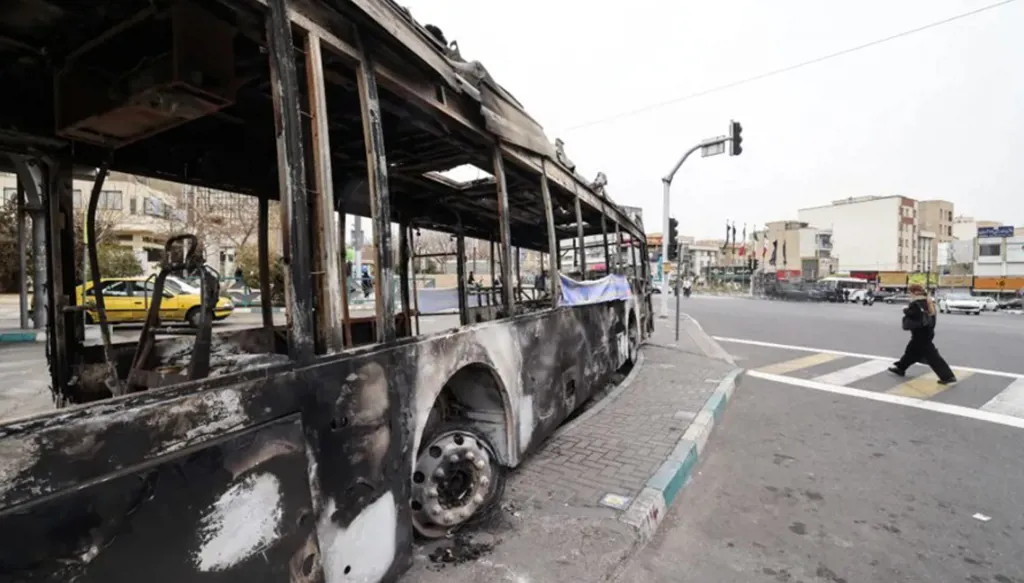


US President Donald Trump almost issued an order to attack Iran Wednesday night into Thursday. Tehran took the possibility of a U.S. strike very seriously, clearing its airspace starting at midnight Eastern Mediterranean Time. Observers only realized later that Trump had refrained from issuing the order, and tensions and alert levels subsided by sunrise the following day.
The episode, criticized by the regional public - most of whom oppose the Iranian regime - was mentally exhausting and underscored a strategic vulnerability: the continuous alerting of Iranian forces itself strains the military. The more the regime raises readiness in anticipation of an attack, the more its pre-planned defensive measures are exposed to U.S. and Israeli observers.
In other words, Iran is compelled to reveal its defensive posture repeatedly, depleting key capabilities while allowing adversaries to learn its contingency measures. Maintaining a constant state of alert due to the threat of an attack puts severe pressure on the army and the Revolutionary Guard. Wednesday-Thursday night, at the peak of tension, highlighted the extent of the regime’s military fragility.
Tehran has claimed, via Foreign Minister Abbas Araghchi, that the regime maintains full control over the country. Yet that control is tenuous. Despite thousands of citizens killed by security forces, stability is lacking, as the regime’s balance of power cannot solve the underlying economic and financial crises - problems that machine guns and drones cannot fix. The tightening grip under Supreme Leader Ali Khamenei continues to strain the regime, and protests may surge again if citizens see credible foreign support rather than empty rhetoric.
This is not a critique of the United States, whose president has actively sought to weaken the regime, particularly in the Middle East. Rather, it is a reminder that the Iranian street is not split simply between supporters and opponents - the real problem is the regime itself, which appears increasingly hopeless after failing to deliver meaningful reforms to its people beyond repression and sectarian control.
Even if neighboring countries work to reduce tensions between the United States and Iran, this does not make the “Islamic Republic” a trustworthy or cooperative partner. Pressure on Washington to avoid an attack does not transform Iran into a state with which regional actors can collaborate to stabilize the Middle East. Temporary de-escalation may succeed for the moment but does not address the underlying reality: the regime remains fragile and beyond repair.
We are currently witnessing high-stakes maneuvers between Washington and Tehran. These moves could either prolong the regime’s survival or mask an American strategy aimed at accelerating its collapse across military, economic, financial, and social fronts. Trump’s calculations remain complex, balancing the risks of toppling the regime with the potential fallout. What is certain, however, is that killings in the streets will not save Khamenei or his exhausted government.
Disclaimer: The opinions expressed by the writers are their own and do not necessarily represent the views of Annahar