

Ink against authority: The untold story of Egypt’s press and its fight for freedom
From courtroom battles to political defiance, Mohamed Tawfik’s trilogy uncovers the journalists who risked everything to challenge power, proving that ideas and words can outlast rulers and revolutions.


 Messenger
 Whatsapp
 Threads
 Email
Email
 Print
Print
 X
X
 Facebook
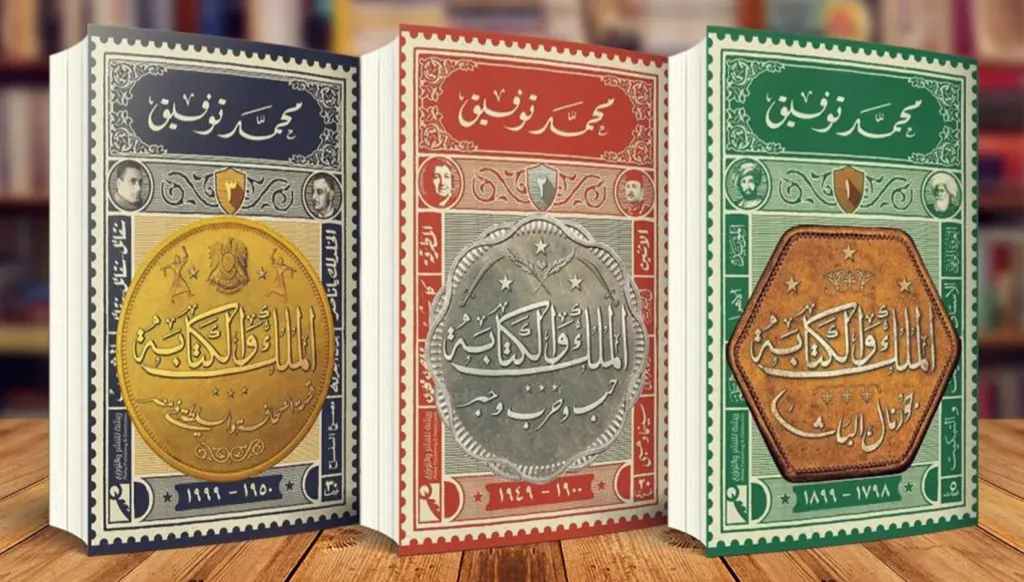


The trilogy by the late Ambassador Mohamed Tawfik, titled "The King and Writing" goes beyond merely recording facts or chronicling events; it seeks to deconstruct the very structure of the conflict itself. For Tawfik, ink transforms from a professional tool into an instrument of resistance.
He uncovers events that, if understood by the new generation, would highlight the power of words and the century-long struggle of the Egyptian elite - not only against authorities but also against entrenched, outdated ideas. The Arab Renaissance owes much to this constellation of Egyptian journalists, guided by a spirit of the Enlightenment.
Tawfik traces the history of the Egyptian press from before the dawn of the twentieth century to its maturation, showing how journalism gradually took shape and gained strength.
He emphasizes that the struggle for freedom of expression predates partisan and organizational conflicts, and that the calls for liberation had long been planted seeds awaiting growth.
During this period, journalists were not alone in the struggle; some Al-Azhar sheikhs, Christian clergy, and even artists joined this early confrontation with the Khedivial authority.
Tawfik documents numerous cases of sheikhs and priests using pulpits, newspapers, and written petitions to challenge the Khedive’s policies - particularly regarding administrative injustice, interference in endowments and educational affairs, and the suppression of freedoms. Some paid the price for their dissent, facing dismissal or forced transfers, sending a clear message that words, even when voiced by religious authorities, remained a source of concern for those in power.
Mounira al-Mahdia, the most renowned singer of the early twentieth century, intervened to secure the release of an activist from prison. A British officer, aiming to steer her away from political involvement, made their engagement a condition - and indeed, the marriage went ahead.
Tawfik cites the early twentieth-century magazine As-Sufur, which declared, “The veil is not on Egyptian women, but on society,” asserting that the time had come to lift society’s veil - long before the outbreak of the First World War.
With the July Revolution of 1952, the relationship between the press and the authorities entered a dramatically new phase. At first, a clear alliance seemed to form. Many journalists viewed the revolution as a liberation from the monarchy’s corruption and colonial domination, supporting it enthusiastically and seeing themselves as part of the project of change. However, this “love” was short-lived. The new regime soon began to see the press not as a critical partner but as an adversary, and early signs of conflict quickly emerged. It became clear that the relative freedom enjoyed before the national rule was preferable to the restrictions that followed. Writing an article could now lead to imprisonment; later, even making a joke could land you behind bars.
Mahmoud al-Saadani, for example, after Sadat assumed power, privately quipped to friends: “The one who frightened us to death is gone, but now we face one who kills us with laughter.” That very joke led to his imprisonment.
In the following decades, amid what appeared to be a period of relative openness and a revival of partisan and private journalism, Mohamed Tawfik clarifies that the conflict had not ended - it had simply changed form. The authorities no longer needed to confiscate newspapers outright; instead, they became more skilled at managing and containing criticism. While the margins of expression were widened, they remained sharply defined, and anyone who overstepped these boundaries faced economic boycotts, moral attacks, or protracted legal battles that drained both energy and resources.
What sets the trilogy "The King and Writing" apart is Mohamed Tawfik’s refusal to romantically sanctify journalism. He acknowledges that some journalists willingly served the authorities out of fear or sycophancy, while others used their pens for personal gain or political leverage. At the same time, he clearly aligns himself with those who viewed the written word as an ethical commitment to society, often paying the ultimate price with their freedom - and in some cases, their lives.
In this sense, the trilogy "The King and Writing: Love, War, and Ink" is far more than a chronicle of the history of journalism in Egypt; it is a profound meditation on the meaning of freedom, the responsibility of the intellectual, and the struggles of generations of Egyptian journalists striving toward modernity and societal progress. Readers may be struck by how the spirit of independence, freedom of the press, and respect for the law have underpinned the calls of the Egyptian press for more than a century. The work serves as a reminder that the courage to express one’s opinion has never been an exception in Egyptian history but remains one of its enduring hallmarks. It also demonstrates that ink - though seemingly fragile - remains one of the most powerful tools for confronting authority, leaving a mark far more lasting than that of the sword.
Disclaimer: The opinions expressed by the writers are their own and do not necessarily represent the views of Annahar.