

Iran’s bazaar protests signal deeper cracks in economic stability and state legitimacy


 Messenger
 Whatsapp
 Threads
 Email
Email
 Print
Print
 X
X
 Facebook
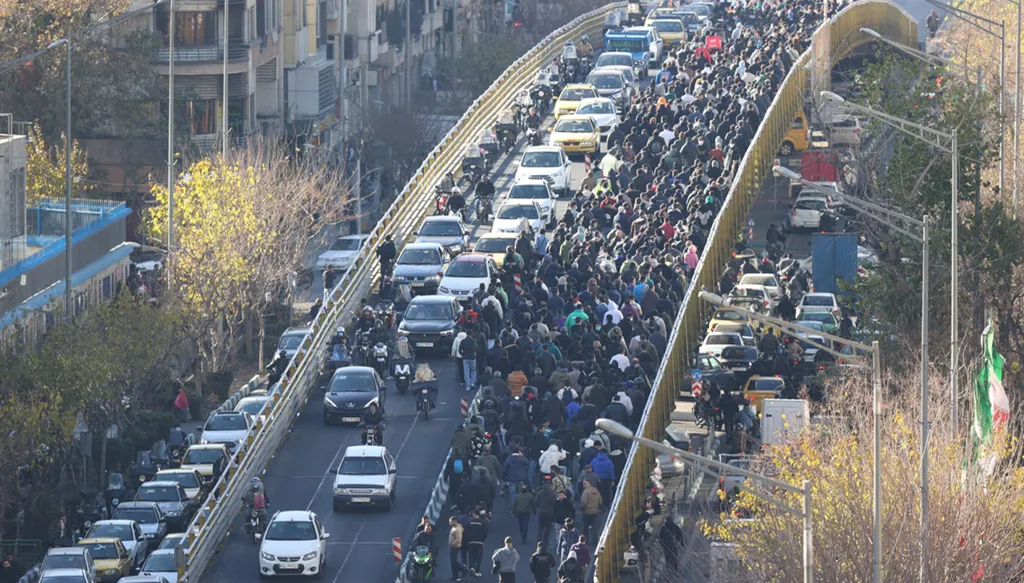


When Iran’s bazaar takes to the streets, the matter goes beyond a purely economic act or a fleeting reaction to living conditions. In Iran’s political history, the bazaar is not merely a social class, but an unwritten political institution that has long acted as a silent intermediary between the state and society, providing, over decades, an invisible safety net for stability.
Its breaking of silence, therefore, is not read as momentary anger, but as a disturbance to one of the traditional pillars of balance within the system.
What Iran is witnessing today, an expanding wave of protests, deaths and injuries on both sides, and mass arrests, is the largest since the “Woman, Life, Freedom” movement of 2022. Yet the fundamental difference lies not only in the scale, but in the source.
This time, the spark came from the market, not the margins, from daily calculations rather than from grand existential questions. A suffocating economic crisis, with inflation exceeding 40 percent in December under the weight of long-standing sanctions that have exhausted Tehran, has turned protest into a legitimate right before it is a political stance. As anger spread to students and various social groups, and moved across several cities, it became clear that what is unfolding is not an isolated eruption, but a steadily expanding trajectory.
The authorities’ response was swift, but revealing. The dismissal of the central bank governor, President Masoud Pezeshkian instructing the interior minister to listen to “legitimate demands,” the appointment of Abdolnaser Hemmati to replace Mohammad Reza Farzin, and the accompanying temporary improvement in the rial’s exchange rate, all point to an attempt to contain the situation rather than an ability to address it at its roots. Pezeshkian, the reformist figure presented as less confrontational, now finds himself facing a test he was not elected for: managing a crisis that cannot be resolved, only postponing its explosion. The temporary currency improvement does not repair what has collapsed in terms of trust, nor does it restore the bazaar’s former role as a silent ally that absorbs anger in the name of stability.
Here emerges the more dangerous question: How did the system lose its silent ally? The difference between street protests and market protests lies not in form, but in meaning. The street can be dispersed, contained, even exhausted. The market, however, when it protests, declares that the equation of mutual benefit has been disrupted, and that patience is no longer a rational investment.
Historically, the bazaar was part of the stability framework because it saw the state as a guarantor of economic continuity. When that guarantee falters, silence ceases to be a virtue and becomes a deferred loss.
Alongside this internal scene, a flawed assumption previously embraced by Tel Aviv and Washington comes into view: that military strikes and external pressure could push the Iranian street to turn against its system. The latest Israeli strike, and the escalation that preceded it, failed to produce the expected effect. On the contrary, they reinforced a lesson that has become clear in regional calculations: The Iranian system does not collapse from the outside. Only the inside holds the key to collapse, if it occurs. This is what concerned capitals have learned after long experiences of sanctions, threats, and limited strikes.
Meanwhile, Donald Trump entered the fray with a threatening post, declaring his readiness to intervene if protesters were subjected to repression. Reading this stance outside its personal and political context, however, leads to analytical error. Trump is not defending protesters’ rights, nor does he carry an ethical project to protect the Iranian street. The same man faced protests in his own country, where slogans such as “No more kings” were raised, without concern, responding instead with an AI-generated video mocking the very idea, and what mockery it was. His threat here is certainly not a defense of protesters; he does not believe in protest as a value, but as a tool. What he says about Iran is not alignment with the street, but the instrumentalization of it.
The U.S. role here is not innocent, but opportunistic-strategic: It sees the moment of internal disarray as a chance to reshuffle the cards. The threat of intervention, even when framed in the language of “protecting civilians,” opens the door to a more dangerous scenario, a limited strike, or a series of calibrated strikes, presented as deterrence rather than war, a message rather than an invasion.
The United States realizes that the Iranian regime will not collapse with a single blow but also recognizes that smart strikes, when coinciding with internal exhaustion, can accelerate decay. This is the core of the American–Israeli calculation: The bet is not only on a street uprising, but on disrupting the state itself.
But the paradox is that this kind of intervention carries a double risk. As experience has shown, the cruder and more direct the external pressure, the more it grants the Iranian system an opportunity to reunify the internal front under the banner of sovereignty and existential threat. Any American strike, however limited, may accelerate erosion, but it may also delay the explosion by reproducing a temporary security-based legitimacy.
And do not speak to me of allies - the answer there is colder than pain itself. Iran cannot rely on them to determine its internal fate. Russia, despite its aircraft landing at Tehran airport and the limited logistical and technical support they carry, will not sacrifice the Ukraine file or open a confrontation with Washington for Iran’s sake. Moscow calculates its interests with meticulous precision and understands that calibrated support is preferable to costly entanglement. China, for its part, immersed in its expansive economic project, will not antagonize “Uncle Sam” for the sake of the clerical regime. Beijing prefers a stable Iran, but it will not pay a political or economic price to defend it.
Thus, Iran today appears alone before an exceptionally sensitive internal test. Tehran stands at a pivotal threshold. Yet when the outside fails to break the state, and the inside - long the guardian of stability - rises in protest, the most dangerous question emerges: Is Iran still capable of redefining stability as a meaning that persuades, rather than a burden that is merely endured?
That is the hardest and most honest question.
Disclaimer: The opinions expressed by the writers are their own and do not necessarily represent the views of Annahar