

Iran in survival mode


 Messenger
 Whatsapp
 Threads
 Email
Email
 Print
Print
 X
X
 Facebook
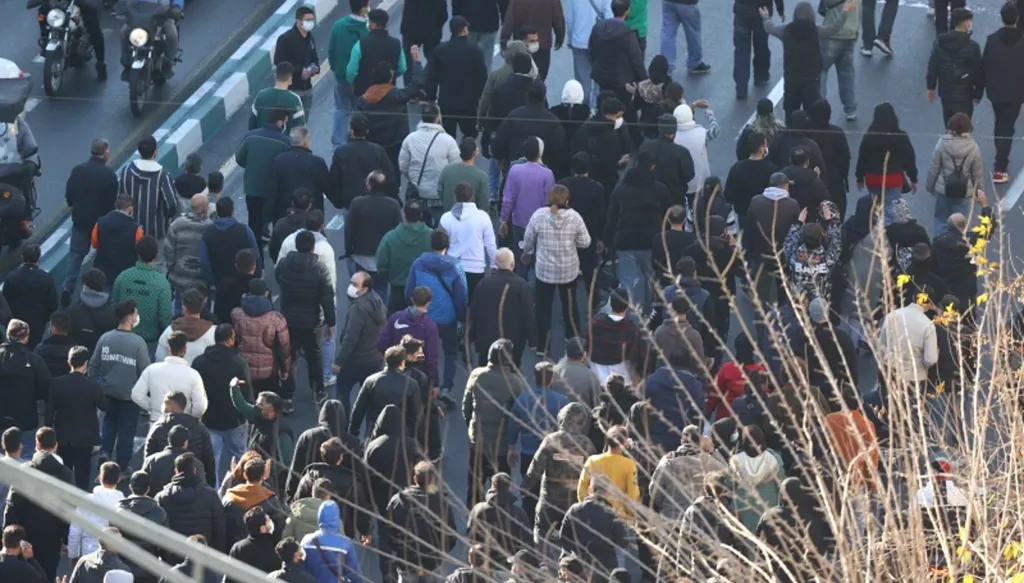


Protests have flared up in Iran ahead of the approval of the state budget, which is accompanied by economic adjustments in a country suffering from an escalating inflation crisis and a continuous decline in the value of its national currency under the weight of Western sanctions. Yet these protests, shifting from sectoral and social demands to overtly political ones, are unfolding alongside external transformations and pressures, revealing the impact of what could be described as a new mechanism of confrontation. At the same time, these protests are a logical outcome of accumulated internal developments and transformations, as society, particularly the younger generation, reaches a new stage of maturity, while the regime continues to repeat policies that have already proven their failure.
Between the Domestic and the External
In the Iranian case, the domestic and the external are no longer separate tracks. The protests come after the reimposition of international sanctions and intensified pressure on Tehran, as part of an effort to force it to respond to U.S. demands that verge on irrationality such as calling on Iran to abandon its defensive capabilities in favor of another state far beyond its geographical borders. This is a policy rejected not only by the Iranian regime, but also by anyone who might succeed it, given Iran’s geopolitical standing.
The protests, which spread from merchants to university students, were sparked by the rise in the dollar exchange rate, driven by disruptions in its management and availability, particularly as the government seeks to curb its depletion and redirect it toward strengthening defensive capabilities in anticipation of any potential confrontation amid U.S. and Israeli threats. From this perspective, the Iranian state is managing a highly complex equation between preserving internal stability and not relinquishing its external leverage, leaving Iran’s future open to multiple scenarios as domestic and external factors become increasingly intertwined.
While the Iranian regime is currently prioritizing a logic of survival rather than dominance, reflected in a shift in the conflict equation from a Shiite Crescent to a Sunni one in countries such as Syria, Yemen, and Sudan—this does not mean that Tehran has entirely abandoned its foreign policy cards. Following the experience of the twelve-day war with Israel, part of Iran’s domestic audience has come to view support for the Axis of Resistance as a component of national security. Iran is currently using this card in confronting Western pressure, alongside other tools such as maintaining ambiguity over the future of its nuclear program. In this context, internal protests factor into the calculations of external powers, which view them as an indicator of the regime’s capacity to endure or of its need to engage in dialogue with the West to ease mounting pressure.
This approach to dealing with the protests also falls within a strategy of preserving survival. Unlike in previous years, the government has not relied on a purely security-based response; instead, it has sought to confine the demonstrations to the framework of economic demands, acknowledged the crisis and the right to protest within the law in order to distinguish between protesters and vandals, and opened the door to dialogue. This is because the protests have not been limited to young people anxious about their future but have also included other segments such as merchants and public employees, who reflect the broader economic situation, giving the protests a political weight that could genuinely threaten the regime’s stability.
This approach reveals the Iranian decision-maker’s awareness that a worsening domestic crisis weakens Tehran’s negotiating position abroad and grants its adversaries additional pressure tools. It also reflects the realism of the government’s outlook under President Masoud Pezeshkian, who warned at the start of his term that imbalance, sanctions, and the widening gap between the state and society constitute three major crises which, if left unaddressed, would not threaten the government alone but Iran as a whole, at a heavy cost that could reach the point of destruction. This explains his insistence on dialogue with the West as a fundamental prerequisite for any economic reform, which in turn requires a stable domestic environment.
Disclaimer: The opinions expressed by the writers are their own and do not necessarily represent the views of Annahar