

Sanctions, street protests, and Yemen: Iran searches for leverage after the Al-Aqsa flood


 Messenger
 Whatsapp
 Threads
 Email
Email
 Print
Print
 X
X
 Facebook
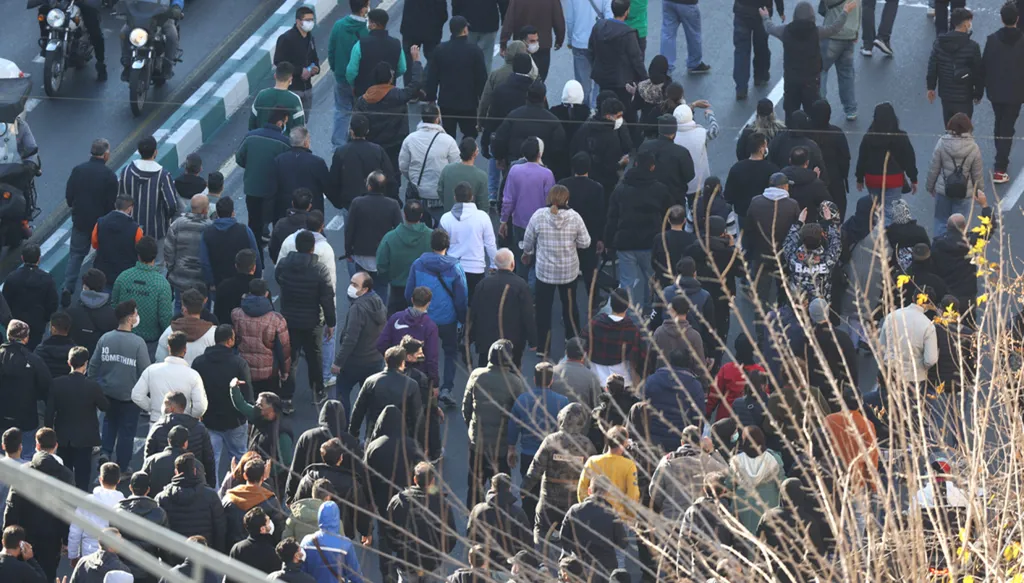


It is too early to arrive at a fully informed reading of street movements in Iran in order to discern a real shift in the country’s trajectory. It is also a mistake to hastily interpret the emergence of “demands-based” protests, given that the country has already experienced stronger and more widespread waves that did not amount to a threat to the regime’s stability. While Iranian President Masoud Pezeshkian seeks to absorb public discontent and calls for listening to the street, the “state” still views it as a marginal footnote to a main narrative it sees unfolding elsewhere.
Iran pins the country’s problems on the peg of economic sanctions, even as Pezeshkian’s opponents insist on attributing the crisis to mismanagement by a reformist government. In conservative discourse, emphasis is placed on inflating what the country considers its available sources of strength to threaten its enemies, and on promoting a model of a “resistance economy” that relies on shadow networks and smuggling.
The street movement may suggest something new that the United States would welcome and that Israeli Prime Minister Benjamin Netanyahu would applaud. Perhaps against the backdrop of events in Iran, US President Donald Trump sent threats in the presence of his Israeli guest. Yet the positions of both sides may serve the discourse of the system in Tehran more than they serve the Iranian street movement accompanying the slide in the value of the national currency and the decline in growth indicators.
While Tehran appears to be living with the “uprisings” fueled by blockages in domestic policymaking and by its strained links with the outside world, it remains stuck in mechanisms that seem outdated after the war last June and the shift in the balance of power following “Al-Aqsa Flood” (the name used by Hamas for its October 7, 2023 attack on Israel).
An article by Iranian Foreign Minister Abbas Araghchi in the British newspaper The Guardian on Tuesday reflects a loss of the deft imagination needed to read the world. He repetitively states that his country “does not fear serious negotiations to reach a fair agreement on the nuclear program,” and that it remains ready to strike a deal provided it is “based on mutual respect and the achievement of shared interests,” and, most importantly, that it “includes the lifting of sanctions”, and that is the crux of the matter.
The solution in Iran, it is argued, lies in lifting sanctions, almost as if to say “immediately”, and there is no harm in adorning the “deal” with some basic rhetoric of dignity and respect, along with whatever seasoning of defiance and adherence to constants is available. Iran appears to have lost its sense of the direction of time after its dynamics inside Palestine cost it influence in Damascus, as it seeks to counter Washington’s competition in Iraq and to toy with Lebanon’s fate through messages delivered by Hezbollah leader Sheikh Naim Qassem, the head of the Iran-backed Lebanese armed group.
In recent hours, Iran has sought to volunteer for a role within the latest crisis in southern Yemen and the regions of Hadhramaut and Al-Mahra. On the 28th of last month, Tehran said that Araghchi discussed developments in southern Yemen in a call with his Saudi counterpart, Prince Faisal bin Farhan, stressing the need to preserve Yemen’s unity and territorial integrity and to implement the roadmap.
On the 29th, observers noted a step described as unusual: Iran’s Foreign Ministry officially announced a phone call between Araghchi and a Houthi militia official, Abdulwahid Abu Ras, the acting foreign minister of the Houthi government in Sanaa. This marked the first time Iran’s Foreign Ministry publicly disclosed details of direct contact of this kind with a Houthi official, after years in which such communications were handled away from official announcements.
According to the Iranian Foreign Ministry’s statement, the call focused primarily on discussing ongoing developments in southern Yemen. Tehran appeared to seize the occasion as an opportunity to showcase its influence in Sanaa and to present it as a “necessity” for intervention in a matter that seems to have become a permissive environment for policies behind Yemen’s catastrophe since 2014.
Even if Iran finds no market in Yemen or the region for its goods, through Araghchi’s article it is once again knocking on Washington’s door, tempting the occupant of the White House with an understanding based on conditions that have grown outdated in the post-“Flood” era.
Disclaimer: The opinions expressed by the writers are their own and do not necessarily represent the views of Annahar