

A society under pressure: Why 2026 could be a turning point for Iran


 Messenger
 Whatsapp
 Threads
 Email
Email
 Print
Print
 X
X
 Facebook
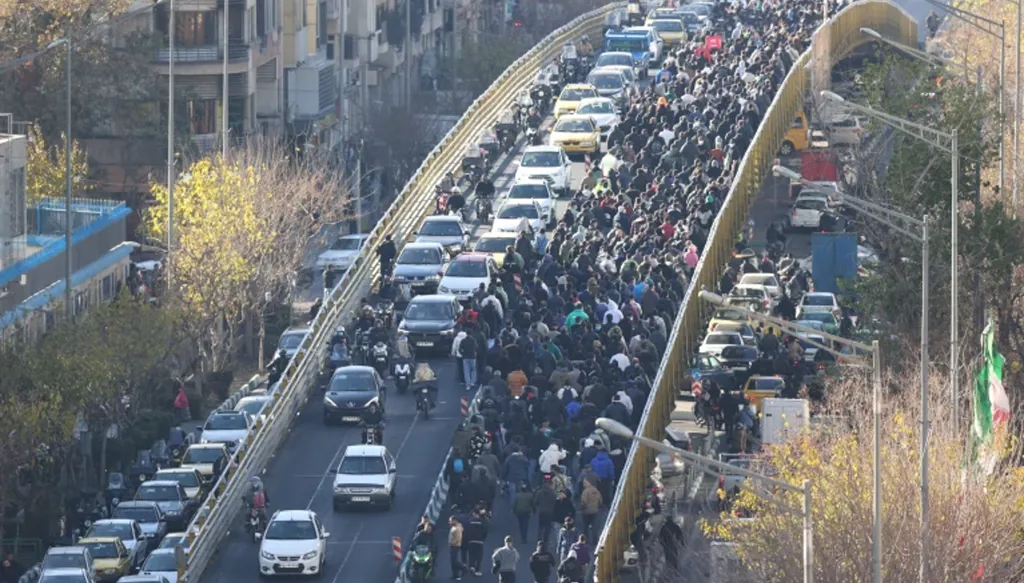


In 2026, Iran is set to face multiple challenges across three main domains: economic, social, and political-security. Unless the government adopts effective measures grounded in public will and societal demands to contain these pressures, they are likely to manifest as larger, interconnected challenges, often described as “converging crises”, that could escalate into massive, unmanageable breakdowns.
These three challenges are not new. Rather, their roots lie in the performance of successive Iranian governments over past years. However, five key factors are expected to act as major catalysts for their intensification: international sanctions, particularly those imposed by the United States; inefficient domestic governance; persistent tensions in foreign relations, especially with the United States and Europe; the 12-day war with Israel in June 2025; and mounting environmental problems, including drought and air pollution.
If current conditions persist, these pressures are likely to emerge in 2026 as major challenges across the three core arenas: economic, political-security, and social. This analysis focuses on examining these three challenges and their implications for Iran in the year ahead.
Economic challenges: Recession and inflation...Can Iranians withstand rising poverty?
The economy is widely seen as Iran’s most pressing challenge in 2026, as economic problems both fuel other crises and are themselves quickly affected by them, causing concern for both the public and the authorities. The most prominent economic challenges Iran is expected to face in 2026 include:
- Persistently high inflation (exceeding 40%), which is placing severe strain on the country’s most vulnerable social groups. According to official figures, more than 60 million people, out of Iran’s total population of around 85 million, are adversely affected by high inflation and require some form of government support to meet their daily needs. Among them, those without stable housing or secure employment are particularly exposed and may slip below the poverty line with even minor economic shocks, joining the ranks of the poor and destitute.
(According to World Bank reports, the recent economic slowdown is expected to push nearly two million additional people into poverty in 2025, with this trend likely to continue into 2026.)
- The absence of foreign investment and the suspension of major infrastructure projects, particularly in the energy sector including oil, gas, electricity, water, and transportation.
Without a fundamental shift in Iran’s foreign relations, prospects for attracting foreign investment remain bleak. Estimates indicate that Iran requires at least $50 billion in foreign investment annually in infrastructure sectors to convert its abundant natural resources, mineral wealth, and reserves into sustainable national assets, as well as to rebuild and modernize its aging air, rail, and road transport networks.
- A sharp increase in the share of taxes in government revenue, projected to reach around 70% next year, despite negative economic growth and a prolonged recession in Iran’s economy. This shift is expected to place additional pressure on both the private sector and ordinary citizens.
Iran’s president has said the government has little choice but to raise taxes in order to finance a 20% increase in public-sector wages. However, many Iranians argue that with inflation running at about 40%, a 20% salary increase would in practice result in at least a 20% decline in real purchasing power in 2026.
Some experts also note that tax-based budgets are typically viable in countries where government revenues and expenditures are fully transparent and where authorities are accountable to public demands and protests. In Iran, by contrast, government income and spending lack transparency, while powerful state-linked institutions that are not accountable to the public or the media receive a substantial share of the budget. Under such conditions, increasing the reliance on taxation is likely to fuel further public dissatisfaction.
- An unprecedented surge in foreign currency and gold prices, highlighting the severe weakness of the national currency. In the final days of 2025, Iranians witnessed daily increases in the prices of the US dollar and gold, raising concerns that the trend may continue into the coming year. Such a trajectory could trigger what economists describe as “hyperinflation,” in which the rial is effectively pushed out of everyday transactions or reduced to a marginal role in the economy.
Iranian economic experts have warned that annual inflation could exceed 60% by the end of the Iranian calendar year in March 2026.
- Economy-linked environmental challenges: If drought driven by climate change persists, alongside ongoing energy imbalances, particularly in the electricity sector, the government may be forced to continue scheduled cuts to power, gas, and water supplies. These disruptions would likely deepen the production slowdown, further weigh on Iran’s economy, and intensify public dissatisfaction.
Security and political challenges: Does the specter of war return... and who will succeed the Supreme Leader?
Despite more than six months passing since the war between Iran and Israel, the situation in the Islamic Republic remains in a state of "neither war nor peace," and the possibility of a new war has not been excluded. The reason is the unchanged policies of Tehran and Tel Aviv towards each other. Israel states that despite its attack on Iranian nuclear facilities, the Iranian missile threat still exists, and it demands the destruction of Iran's missile capability. As for Iran, it has not changed its policy towards Israel, still considering this regime illegitimate and regards its destruction as one of the main slogans of Iranian officials. There are no positive signals about resuming negotiations between Iran and the United States for a political agreement. The United States claims it destroyed Iranian nuclear facilities and does not need an agreement, while Iran regards the United States as its primary enemy in the international system and Israel's main ally in the recent war against Iran, and considers dialogue with Washington to be humiliating.
This military and security challenge, with the ongoing threat from Israel targeting the leader of the Islamic Republic, can also become a significant political challenge in Iran in the upcoming year. For years, Iranian and international media have circulated reports and analyses about the future of Ayatollah Ali Khamenei, the powerful 86-year-old Supreme Leader of the Islamic Republic, who has held the post since 1989. Despite this sustained attention, no official list of successors has been announced. Several names are frequently mentioned in political and media circles, including Hassan Rouhani, Iran’s former president; Seyed Hassan Khomeini, the grandson of Ayatollah Ruhollah Khomeini, the founder of the Islamic Republic; Mojtaba Khamenei, the Supreme Leader’s son; Alireza Arafi, head of the Qom Seminary and a member of the Assembly of Experts; and Sadeq Larijani, head of the Expediency Discernment Council.
In this regard, important questions arise, such as whether the leadership position in the Islamic Republic will continue in its current form after Ayatollah Khamenei. This raises a series of critical questions: Will the position of Supreme Leader continue in its current form after Ayatollah Khamenei, or will the system undergo structural change? With none of the potential successors appearing to command the experience, authority, and influence wielded by Khamenei, the leadership position will undergo significant changes after his death.
Social unrest and protests: a society on the brink of explosion?
For various reasons, Iranian society has been poised for civil, political, and labor unrest and protests for years, and the events of the last 15 years, especially after the presidential elections in 2009 (which led to widespread protests), underscore a persistent reality: the conditions for protest and instability are always present, requiring only a trigger to erupt.
According to Hadi Khaniki, a prominent professor of communications at Allameh Tabataba’i University in Tehran, public dissatisfaction with the current situation stands at 92%, with most Iranians deeply anxious about the future.
This sentiment could be rapidly transformed by events such as price hikes, the outbreak of war, a major policy misstep by the government, or even environmental disruptions, turning into a social crisis or widespread labor and public protests. In 2026, Iran appears particularly vulnerable to this risk, as many issues that would not normally constitute a crisis could become flashpoints for broader social unrest. On the other hand, social issues like drug addiction, divorce, theft, and fraud are expected to rise in the coming months, driven by economic hardship and growing psychological instability across society.
Hope for the future despite challenges
Despite all these problems and challenges, if the Iranian society, which boasts a rich history and culture, finds hope in improving conditions in areas such as the economy, politics, and international relations, it possesses the capability and talent for social rebuilding and creating a foundation for a peaceful transition through these challenges. It will also accompany the political system if it sees the government and system committed and determined to improve conditions.
The Islamic Republic continues to have the potential to reinvent itself, but only through a serious reassessment of past policy failures, the adoption of a more pragmatic approach, and the willingness to take consequential decisions in governance, economic management and political strategy. Otherwise, it appears unlikely that the system will be able to confront, manage, or contain the converging crises outlined in this analysis.
Disclaimer: The opinions expressed by the writers are their own and do not necessarily represent the views of Annahar