

What lies behind Hezbollah secretary-general’s "Do not ask anything of us anymore" statement


 Messenger
 Whatsapp
 Threads
 Email
Email
 Print
Print
 X
X
 Facebook
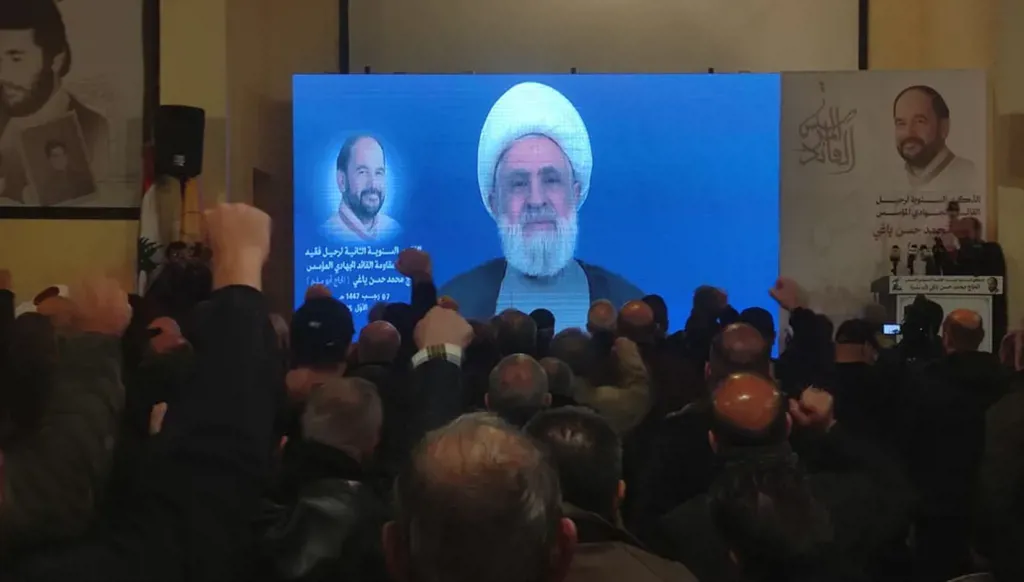


As the deadline approaches for the Lebanese state to formally announce that it has fully met its obligations in the South Litani region under the cease-fire agreement - which has been theoretically in place for about 13 months - both the Lebanese army and the UNIFIL force have confirmed progress through field presentations to ambassadors and accredited diplomatic missions.
In this context, Hezbollah’s Secretary-General, Sheikh Naim Qassem, signaled that “the period of free concessions by both the party and the state has ended and will not return.”
He emphasized that both sides must now stabilize the balance between security and sovereignty while ensuring Lebanon’s stability, ending the Israeli occupation in the south, and preventing further Israeli exploitation of Lebanese territory.
Sources within Hezbollah stress that Sheikh Naim Qassem’s statement should not be interpreted as a call for war or an immediate escalation. Rather, it carries a more subtle political weight: it drastically narrows the margin for maneuver and serves as an internal deterrent while simultaneously sending a clear message externally. The party signals that the period of “buying time” and making concessions has ended, and it expects the Lebanese state to act accordingly.
Building on these points, Qassem reaffirmed that the ongoing tensions are not caused by internal issues, but stem from continued Israeli aggression and blatant violations of Lebanese sovereignty.
The party’s demand that the state uphold the terms of the original cease-fire agreement, based on established principles, is not new. However, the party now considers its position stronger, having committed to halt military activity and withdraw south of the river, which reinforces its right to voice stronger objections to future measures, such as disarming north of the river.
Based on this framework, Qassem’s remarks were not just a political statement at a critical moment but a declaration marking the end of a prolonged period of adaptation, pressure absorption, and strategic repositioning of the party in response to on-the-ground realities.
Thus, it was unsurprising that he framed his speech around the case of retired General Security officer Ahmed Shukr, whose disappearance - initial investigations suggest - occurred under Israeli breach, leading to his abduction. Qassem highlighted the incident as a serious warning of the challenges facing the country, illustrating the state’s inability to confront Israeli violations of Lebanese security, and emphasizing the urgent need for a firmer official stance to protect the nation and its citizens.
The sources assert that the foundation on which the party bases the legitimacy of its vision and the strength of its position - compared to the perceived fragility of the opposing stance - has grown firmer, supported by the following evidence:
- The party has fully and diligently carried out all tasks requested of it.
- Several Arab capitals are showing openness toward the party, recognizing that its flexibility helps establish a new political-security balance both domestically and regionally.
- Experiences following the cease-fire agreement have reassured the party that expectations of a potential clash with the Lebanese army are mistaken, as neither side has any interest in such a confrontation.
In essence, while the party, through its Secretary-General, declares, “Do not ask anything of us anymore,” it simultaneously puts forward an alternative proposal: to agree on a plan for confronting the upcoming phase, beginning with the inaugural speech that explicitly promised the development of a “National Security Strategy.” Just as the party has fully adhered to the cease-fire agreement, it insists that others must also honor their commitments.
Disclaimer: The opinions expressed by the writers are their own and do not necessarily represent the views of Annahar.