

Netanyahu elevates Iran threat ahead of Trump meeting, eclipsing Gaza phase two


 Messenger
 Whatsapp
 Threads
 Email
Email
 Print
Print
 X
X
 Facebook
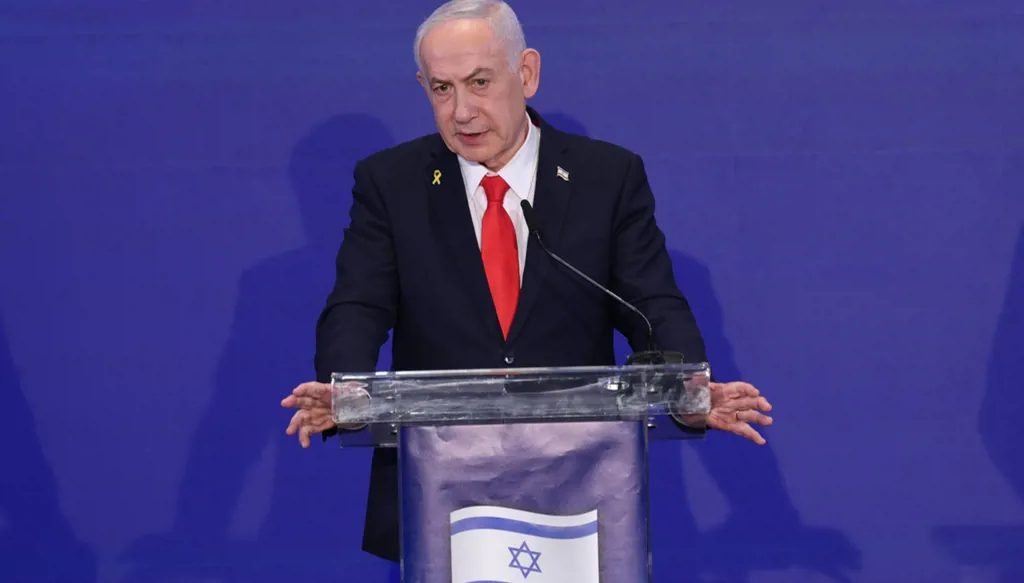


Days before his meeting with U.S. President Donald Trump in Florida, Israeli Prime Minister Benjamin Netanyahu has been pushing the possibilities of resuming war with Iran to the forefront, overshadowing the transition to the second phase of the U.S. plan for Gaza.
During a joint press conference with Greek Prime Minister Kyriakos Mitsotakis and Cypriot President Nikos Christodoulides in Jerusalem, Netanyahu focused on the recent maneuvers of the Iranian Revolutionary Guard, stating: "I want to make it clear to Iran that any action will be met with a very harsh response."
This warning seemed to respond to reports in Israeli media these days accusing Iran of preparing for a preemptive strike, after it managed to restore its missile capabilities that were damaged in the twelve-day war last June.
The paradox in Israel today is the prioritization of the threat posed by Iran's missile capabilities over the threat from its nuclear program, given that the nuclear capabilities in Natanz, Isfahan, and Fordow have been set back years according to U.S. and Israeli assessments, following their targeting during the war.
U.S. Ambassador to Israel Mike Huckabee also issued a warning, stating that Iran "did not fully grasp the message" from the American bombing of the Fordow nuclear facility "as they are attempting to reconstruct this facility and find ways to deepen the fortifications and make it more secure."
U.S. Senator Lindsey Graham, after meeting with Netanyahu, endorsed "launching an attack on Iran," embracing Israel's narrative regarding what it describes as the growing threat of Iranian missiles.
Amid rising regional tensions, Israeli Chief of Staff Eyal Zamir contacted U.S. Central Command General Brad Cooper to convey Israel's concerns about Iranian Revolutionary Guard missile drills.
These positions indicate that Netanyahu is preparing a strong dossier on Iran before the Florida Summit on December 29, to divert attention from the U.S. plan for Gaza or at least engage in negotiations with Trump to reassess regional priorities.
In this context, the Israeli site "Ynet" reported that "Netanyahu is compelled to make concessions in one field, like Gaza, to gain American support for more active (Israeli) moves in another field," such as Iran and Lebanon.
In June, Netanyahu succeeded in drawing Trump into his war on Iran. Can he repeat this today amidst U.S. military preparations to invade Venezuela and the diplomatic focus on halting the Russian-Ukrainian war?
It is noteworthy that Netanyahu may benefit from the absence of any U.S.-Iran dialogue since the last war, strengthening military options in dealing with Tehran. In Israel, the talk never subsided after the ceasefire on June 24 that a new war or at least additional strikes seem inevitable.
At the Florida Summit, the thrusting of the Middle East into another war or maintaining the gray situation hangs in balance.
Disclaimer: The opinions expressed by the writers are their own and do not necessarily represent the views of Annahar.