

Netanyahu: No to 'Gaza Agreement', Yes to War on Iran


 Messenger
 Whatsapp
 Threads
 Email
Email
 Print
Print
 X
X
 Facebook
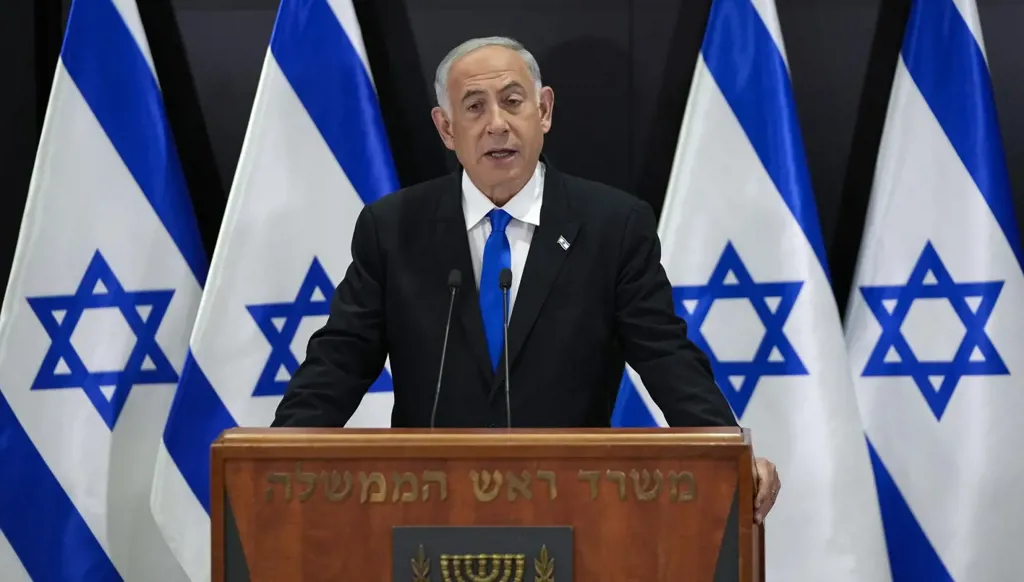


In preparation for the difficult meeting with the American president, the Israeli Prime Minister chose to 'escape' from Gaza to Iran.
In Gaza, he managed to satisfy Washington with a relative ceasefire, which he intentionally breaches, costing the Palestinians so far four hundred dead and more than a thousand injured, as he continues to ration aid, including shelter supplies after rains flooded the tents of the displaced.
Perhaps what encouraged him in these violations is that scenes of cold, homelessness, and floods did not provoke any reactions in the White House.
As for Iran, Benjamin Netanyahu wants to convince Donald Trump of a 'package of military options to deal with the escalating Iranian threat', but Trump awaits to ask him: What about Gaza? He might even tell him: Forget Iran for a while... This does not mean that the American president is no longer concerned with the 'Iranian threat', but he sees that his plan in Gaza is faltering due to Israeli obstacles.
A meeting was held in Miami between the American envoy and the mediators in Gaza, the Egyptian, Turkish, and Qatari, to review what was implemented in the first phase and to 'enhance preparations for the second phase'.
A headline in the 'Sunday Times' summed up the situation: 'The first phase was difficult, and the next may be impossible'. What makes this impossibility revolve around two axes: the yellow line, and the disarmament of 'Hamas'.
The first is continually expanded by the Israelis contrary to the agreement and is considered a 'new boundary', and the second, everyone wonders who will undertake the task, to which Israel answers that it is the only one qualified for this, evidenced by its record of a genocidal war which claimed at least a quarter of a million Palestinian lives either dead or injured, yet it forgets that despite this criminal record, it could not eliminate Hamas' weaponry.
Special envoy Steve Witkoff does not publicly declare that his president’s plan faces difficulties, therefore he said after the meeting with his mediator counterparts: 'We have made progress', listing the achievements, for instance 'expanding the scope of humanitarian aid', despite the fact that UN organizations repeatedly state that the entered aid is far less than needs, some of which were urgent recently, specifically medicines, medical supplies, fuel, as well as new tents or prefab houses, all available at the Rafah crossing (which was not opened under phase 1) and aren't allowed entry.
What's inferred from the discussions is that steps required for the second phase are left to decisions Trump will announce, and whenever administration members implied they were ready, it appears the matter is still under study. An Arab diplomat wonders why Minister Marco Rubio repeatedly 'confirms' that several countries will participate in the 'International Stability Force', certainly, several countries are initially willing, but their commitments are limited and conditional. It was significant that the mediators insisted on the 'importance of establishing a governing body in Gaza under a unified Palestinian authority', knowing that Israel rejects this formula, and Washington does not endorse it, which fuels doubts about the objectives of the 'Trump plan'.
Trump has always spoken of the Gaza war as though it had 'ended', while Netanyahu makes every effort to inform his major ally that for him, the war 'has not ended', and if what is happening in Gaza and the West Bank isn’t enough to inform him, then he escalates in Lebanon and Syria. Moreover, Netanyahu hopes to change Trump's compass direction with 'updated intelligence information' on developments in Iran's ballistic missile program. Mossad head David Bernia preceded him days ago, focusing on new activity in Iran’s nuclear program. Moreover, far-right leader Bezalel Smotrich contributed to revealing Netanyahu's intentions, as he demands waging war in Gaza and Lebanon before the Israeli elections next October.
Iranian missiles were tested during the '12-day War' last June, which is not new to Trump and his administration, as it was one of the reasons for his withdrawal from the nuclear agreement in 2018, but Washington relies on Iran's weakness to address the missile issue within the framework of a final nuclear dossier closure, through negotiation and not a new war, unless circumstances necessitate it. However, Netanyahu does not practically give Trump a choice but goes to inform him that Israel feels 'threatened', necessitating 'urgent action' before Tehran doubles its missile stockpile. He also proposes the usual scenarios: 'a solo Israeli strike or limited American support, a joint operation, or a direct American move against targets inside Iran'. Yet Netanyahu's maneuver appears transparent to administration officials in Washington, as he needs a war before the elections due to his increasingly difficult internal dilemma and his accumulating disagreements with Washington regarding Gaza prompting him to gamble, even if it means embarrassing Trump. The proposed options only mean that Israel's independent move against Iran is determined whereas America's involvement will come later, and definitely. Meanwhile, the 'Gaza Agreement' would have lost all momentum and 'Trump's peace' becomes just another mirage.