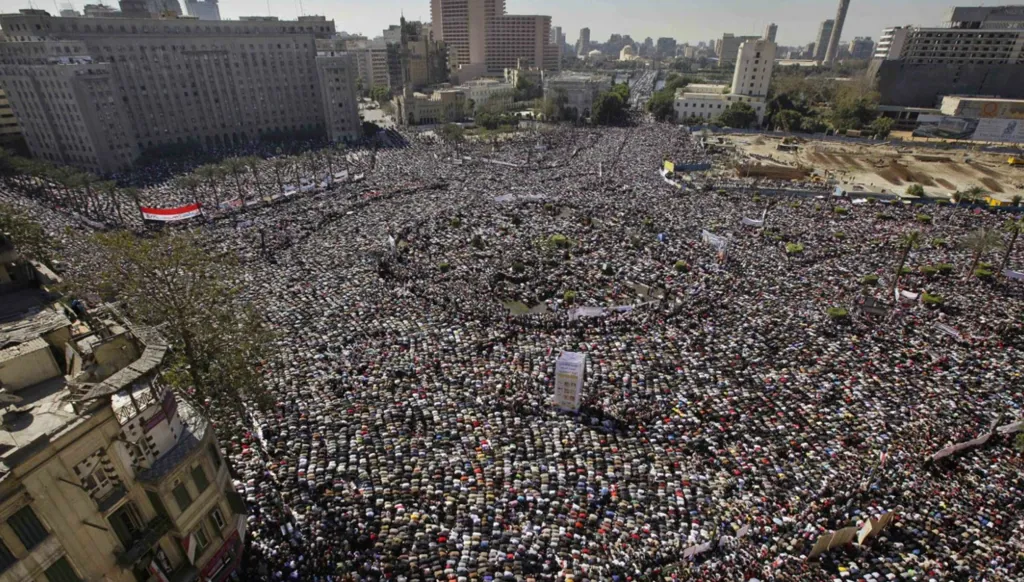
n this Feb. 18, 2011 file photo, Egyptians pray and celebrate the fall of the regime of former President Hosni Mubarak, and to maintain pressure on the current military rulers, in Tahrir Square in downtown Cairo, Egypt. The 2011 uprising led to the quick ouster of autocrat Mubarak. A decade later, thousands are estimated to have fled abroad to escape a state, headed by President Abdel Fattah el-Sissi, that is even more oppressive. (AP Photo/Ben Curtis, File) FILE - In this Jan. 25, 2012 file photo, people wave flags in Tahrir Square to mark the first anniversary of the popular uprising that led to the quick ouster of autocrat President Hosni Mubarak, in Cairo, Egypt. A decade later, thousands are estimated to have fled abroad to escape a state, headed by President Abdel Fattah el-Sissi, that is even more oppressive. (AP Photo/Amr Nabil, File) 2 of 14 | FILE - In this Jan. 25, 2012 file photo, people wave flags in Tahrir Square to mark the first anniversary of the popular uprising that led to the quick ouster of autocrat President Hosni Mubarak, in Cairo, Egypt. A decade later, thousands are estimated to have fled abroad to escape a state, headed by President Abdel Fattah el-Sissi, that is even more oppressive. (AP Photo/Amr Nabil, File) Read More Egyptian political exile and doctor by training, Mohamed Aboelgheit poses for a photograph at his home in London, Jan. 18, 2021. The Jan. 25, 2011, uprising in Tahrir Square led to the quick ouster of autocrat Hosni Mubarak. A decade later, thousands are estimated to have fled abroad to escape a state, headed by President Abdel Fattah el-Sissi, that is even more oppressive. (AP Photo/Kirsty Wigglesworth) 3 of 14 | Egyptian political exile and doctor by training, Mohamed Aboelgheit poses for a photograph at his home in London, Jan. 18, 2021. The Jan. 25, 2011, uprising in Tahrir Square led to the quick ouster of autocrat Hosni Mubarak. A decade later, thousands are estimated to have fled abroad to escape a state, headed by President Abdel Fattah el-Sissi, that is even more oppressive. (AP Photo/Kirsty Wigglesworth) Read More FILE - In this Jan. 26, 2011 file photo, Egyptian riot police group push back protesters, during clashes in downtown Cairo, Egypt. The 2011 uprising led to the quick ouster of autocrat Hosni Mubarak. A decade later, thousands are estimated to have fled abroad to escape a state, headed by President Abdel Fattah el-Sissi, that is even more oppressive. (AP Photo/Ben Curtis, File) 4 of 14 | FILE - In this Jan. 26, 2011 file photo, Egyptian riot police group push back protesters, during clashes in downtown Cairo, Egypt. The 2011 uprising led to the quick ouster of autocrat Hosni Mubarak. A decade later, thousands are estimated to have fled abroad to escape a state, headed by President Abdel Fattah el-Sissi, that is even more oppressive. (AP Photo/Ben Curtis, File) Read More FILE - In this Jan. 25, 2011 file photo, demonstrators deface a poster of Egyptian President Hosni Mubarak in Alexandria, Egypt. The 2011 uprising led to the quick ouster of autocrat Mubarak. A decade later, thousands are estimated to have fled abroad to escape a state, headed by President Abdel Fattah el-Sissi, that is even more oppressive. (AP Photo, File) 5 of 14 | FILE - In this Jan. 25, 2011 file photo, demonstrators deface a poster of Egyptian President Hosni Mubarak in Alexandria, Egypt. The 2011 uprising led to the quick ouster of autocrat Mubarak. A decade later, thousands are estimated to have fled abroad to escape a state, headed by President Abdel Fattah el-Sissi, that is even more oppressive. (AP Photo, File) FILE - In this Feb. 11, 2011 file photo, an Egyptian woman cries as she celebrates the news of the resignation of President Hosni Mubarak, who handed control of the country to the military, in Tahrir Square, Cairo, Egypt. A decade later, thousands are estimated to have fled abroad to escape a state, headed by President Abdel Fattah el-Sissi, that is even more oppressive. (AP Photo/Tara Todras-Whitehill, File) 6 of 14 | FILE - In this Feb. 11, 2011 file photo, an Egyptian woman cries as she celebrates the news of the resignation of President Hosni Mubarak, who handed control of the country to the military, in Tahrir Square, Cairo, Egypt. A decade later, thousands are estimated to have fled abroad to escape a state, headed by President Abdel Fattah el-Sissi, that is even more oppressive. (AP Photo/Tara Todras-Whitehill, File) Read More FILE - In this Feb. 10, 2011 file photo, protesters wave their shoes in the air in contempt as they watch a projection of the televised speech of Egyptian President Hosni Mubarak, in Cairo, Egypt. The 2011 uprising led to the quick ouster of autocrat Mubarak. A decade later, thousands are estimated to have fled abroad to escape a state, headed by President Abdel Fattah el-Sissi, that is even more oppressive. (AP Photo/Ben Curtis, File) 7 of 14 | FILE - In this Feb. 10, 2011 file photo, protesters wave their shoes in the air in contempt as they watch a projection of the televised speech of Egyptian President Hosni Mubarak, in Cairo, Egypt. The 2011 uprising led to the quick ouster of autocrat Mubarak. A decade later, thousands are estimated to have fled abroad to escape a state, headed by President Abdel Fattah el-Sissi, that is even more oppressive. (AP Photo/Ben Curtis, File) Read More FILE - In this Jan. 29, 2011 file photo, a protester jumps from a burned armored personnel carrier in Tahrir Square, Cairo, Egypt. The 2011 uprising led to the quick ouster of autocrat Hosni Mubarak. A decade later, thousands are estimated to have fled abroad to escape a state, headed by President Abdel Fattah el-Sissi, that is even more oppressive. (AP Photo/Lefteris Pitarakis, File) 8 of 14 | FILE - In this Jan. 29, 2011 file photo, a protester jumps from a burned armored personnel carrier in Tahrir Square, Cairo, Egypt. The 2011 uprising led to the quick ouster of autocrat Hosni Mubarak. A decade later, thousands are estimated to have fled abroad to escape a state, headed by President Abdel Fattah el-Sissi, that is even more oppressive. (AP Photo/Lefteris Pitarakis, File) Read More FILE - In this Jan. 28, 2011 file photo, anti-government activists clash with riot police in Cairo, Egypt. The 2011 uprising led to the quick ouster of autocrat Hosni Mubarak. A decade later, thousands are estimated to have fled abroad to escape a state, headed by President Abdel Fattah el-Sissi, that is even more oppressive. (AP Photo/Ben Curtis, File) 9 of 14 | FILE - In this Jan. 28, 2011 file photo, anti-government activists clash with riot police in Cairo, Egypt. The 2011 uprising led to the quick ouster of autocrat Hosni Mubarak. A decade later, thousands are estimated to have fled abroad to escape a state, headed by President Abdel Fattah el-Sissi, that is even more oppressive. (AP Photo/Ben Curtis, File) FILE - In this June 2, 2012 file photo, a worker in a downtown cafe watches the final session of the trial of former Egyptian President Hosni Mubarak, in Cairo, Egypt. The 2011 uprising led to the quick ouster of autocrat Mubarak. A decade later, thousands are estimated to have fled abroad to escape a state, headed by President Abdel Fattah el-Sissi, that is even more oppressive. (AP Photo/Thomas Hartwell, File) 10 of 14 | FILE - In this June 2, 2012 file photo, a worker in a downtown cafe watches the final session of the trial of former Egyptian President Hosni Mubarak, in Cairo, Egypt. The 2011 uprising led to the quick ouster of autocrat Mubarak. A decade later, thousands are estimated to have fled abroad to escape a state, headed by President Abdel Fattah el-Sissi, that is even more oppressive. (AP Photo/Thomas Hartwell, File) Read More FILE - In this May 2, 2012 file photo, Egyptian riot police eat ice cream while securing the courthouse where ex-President Hosni Mubarak received a verdict in his trial for charges related to the death of protesters in Cairo, Egypt. The 2011 uprising led to the quick ouster of autocrat Hosni Mubarak. A decade later, thousands are estimated to have fled abroad to escape a state, headed by President Abdel Fattah el-Sissi, that is even more oppressive. (AP Photo/Manu Brabo, File) 11 of 14 | FILE - In this May 2, 2012 file photo, Egyptian riot police eat ice cream while securing the courthouse where ex-President Hosni Mubarak received a verdict in his trial for charges related to the death of protesters in Cairo, Egypt. The 2011 uprising led to the quick ouster of autocrat Hosni Mubarak. A decade later, thousands are estimated to have fled abroad to escape a state, headed by President Abdel Fattah el-Sissi, that is even more oppressive. (AP Photo/Manu Brabo, File) Read More Egyptian political exile and academic Taqadum al-Khatib poses for a photograph in Berlin, Jan. 18, 2021. The Jan. 25, 2011, uprising in Tahrir Square led to the quick ouster of autocrat Hosni Mubarak. A decade later, thousands are estimated to have fled abroad to escape a state, headed by President Abdel Fattah el-Sissi, that is even more oppressive. (AP Photo/Michael Sohn) 12 of 14 | Egyptian political exile and academic Taqadum al-Khatib poses for a photograph in Berlin, Jan. 18, 2021. The Jan. 25, 2011, uprising in Tahrir Square led to the quick ouster of autocrat Hosni Mubarak. A decade later, thousands are estimated to have fled abroad to escape a state, headed by President Abdel Fattah el-Sissi, that is even more oppressive. (AP Photo/Michael Sohn) Read More FILE - This March 29, 2020 file photo, shows a general view of Tahrir Square, which was the focal point of the Jan. 25, 2011 Egyptian uprising that toppled autocrat Hosni Mubarak, closed off by police during curfew hours as a prevention measures due to the coronavirus outbreak, in Cairo. A decade after the uprising, thousands are estimated to have fled abroad to escape a state, headed by President Abdel Fattah el-Sissi, that is even more oppressive. (AP Photo/Nariman El-Mofty, File) 13 of 14 | FILE - This March 29, 2020 file photo, shows a general view of Tahrir Square, which was the focal point of the Jan. 25, 2011 Egyptian uprising that toppled autocrat Hosni Mubarak, closed off by police during curfew hours as a prevention measures due to the coronavirus outbreak, in Cairo. A decade after the uprising, thousands are estimated to have fled abroad to escape a state, headed by President Abdel Fattah el-Sissi, that is even more oppressive. (AP Photo/Nariman El-Mofty, File) Read More FILE - In this Oct. 12, 2015 file photo, policemen guard a courtroom holding Gamal and Alaa Mubarak, sons of deposed president Hosni Mubarak, in Tora Prison, Cairo, Egypt. The 2011 uprising led to the quick ouster of autocrat Mubarak. A decade later, thousands are estimated to have fled abroad to escape a state, headed by President Abdel Fattah el-Sissi, that is even more oppressive. (AP Photo/Mohamed Elraai, File) 14 of 14 | FILE - In this Oct. 12, 2015 file photo, policemen guard a courtroom holding Gamal and Alaa Mubarak, sons of deposed president Hosni Mubarak, in Tora Prison, Cairo, Egypt. The 2011 uprising led to the quick ouster of autocrat Mubarak. A decade later, thousands are estimated to have fled abroad to escape a state, headed by President Abdel Fattah el-Sissi, that is even more oppressive. (AP Photo/Mohamed Elraai, File)
Several religious movements associated with the “Islamic awakening” emerged in the 1970s. The Egyptian public labelled them 'Sunnis' because they claimed to preserve the 'Prophetic Sunnah' and to be 'the people of the Sunnah and the community'.
Members quickly became known for their unusual appearance among Egyptians: thick, unkempt beards, shaved moustaches, and short white robes. With gentle faces, broad smiles and soft voices, their discourse was readily accepted by a people known for being 'religious by nature'.
Within a few years, these movements had spread rapidly, encouraging large numbers of Egyptian Muslims to pray in the mosques where the groups were active. At first, this was accepted, and even welcomed, by many Egyptians.
As their numbers grew and their influence expanded, however, rapid and fundamental changes occurred in their rhetoric and behavior. Friendly demeanors hardened, and quiet speech became loud shouts projected through mosque loudspeakers.
From within the Salafi movement, armed jihadist factions emerged that revolted against the state and society. They committed massacres that claimed hundreds of lives and cost the state tens of billions of pounds and many years to defeat. This happened twice: first in the 1990s and again after the Muslim Brotherhood and its Salafi allies were ousted from power in 2013.
Tools of the age
Salafists use all available tools to spread their ideology, especially technology. In the past, their ideology spread rapidly via cassette tapes, which were widely purchased by Egyptians as their popularity grew. Today, we are seeing a repeat of this with smartphones and social media. Experts on political Islam movements are warning of a new, more widespread and dangerous digital version of the 'Islamic awakening'.
Amr Farouk, a researcher on Islamic movements and one of the most prominent voices of caution, has written a series of articles and blog posts warning of the Salafists' renewed penetration into society through technology. In an interview with Al-Nahar, he said: “After the state took control of Salafi mosques in recent years and set rules for ascending the pulpit, the Salafists moved all their activities to social media.”
Some observers believe this is happening under the watchful eye of the state and its security apparatus, while others insist it is deliberately encouraged to counter the Muslim Brotherhood. However, Farouk emphasizes that 'the real problem is that the Salafists are not a single organization with one leader, but rather a broad and diverse intellectual movement with several leaders, which makes it difficult to control them.'
Despite his belief that the state is not directly involved, Farouk stresses the need for the government to control the use of social media and the internet for broadcasting extremist religious discourse due to the danger it poses.
The state’s response
Rami Yahya, a writer interested in Islamic heritage, agrees that the state has taken steps to curb the activities of these movements. However, he believes that it is focusing on fighting terrorists, rather than religious extremism itself. In an interview with An-Nahar, he said: “The state is treating the symptoms and letting the disease spread.”
He adds: 'The ruling regime is outbidding religious hardliners and trying to appear more religious than them. They build a mosque, so the state builds an even bigger one. It opens the door for clerics to get involved in areas outside their expertise, such as inviting them to the official space agency to discuss jurisprudence in space! What do clerics have to do with space?'
Yahya disagrees with the view that Salafists have disappeared from the scene. He asserts that they are 'clearly widespread.'The number of women wearing the niqab has risen, debates have emerged over calls to wear the niqab on public transport, and even technicians setting up television receivers now place Salafist channels at the top of the list. “They are present, and the state is promoting their presence, either directly or indirectly,” Yayha said.
Is terrorism making a comeback?
In its early days, the 'awakening' began with a tolerant and cautious approach. However, today's advocates are adopting extremism with greater confidence, despite their desire to appear modern and own the latest cars and phones. This may be partly because many people are inclined to accept their discourse unquestioningly, viewing it as 'the true religion,' while reason is considered insufficient. In the words of one Salafi sheikh, 'reason is like a donkey that must be left aside when discussing matters of religion.”
Farouk warns against repeating this experience: 'The regime of former President Hosni Mubarak said it was against organizations, but not preaching. This opened the door for Salafists to spread their message through mosques and television. Then the Brotherhood took advantage of this, and we witnessed the violence and bloodshed that ensued. Today, we are still suffering from that legacy, and we must learn from the lessons of the past.'
Although Egyptian security forces have defeated armed Salafi organizations twice before, today's confrontation may be more costly and uncertain, especially amid Egypt's volatile regional environment.



 Messenger
 Whatsapp
 Threads
 Email
Email
 Print
Print
 X
X
 Facebook

