

March 14: where are the “loyalists” of that revolution?


 Messenger
 Whatsapp
 Threads
 Email
Email
 Print
Print
 X
X
 Facebook


nabil bou monsef
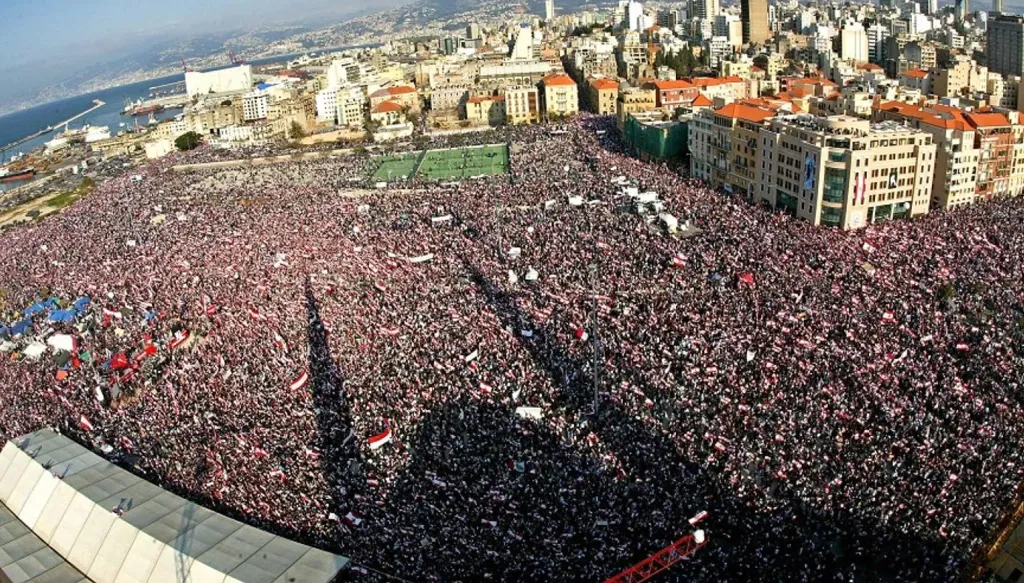
Two decades after its “eruption” on March 14, 2005, Lebanon’s most significant modern uprising for sovereign independence remains a defining milestone—one that merits neither nostalgia nor regret for what has endured or faded. On that day, the streets were flooded with the largest gathering the country had ever witnessed: nearly two million Lebanese from every sect, confession, and region. This unprecedented display cemented March 14 as a sovereignty-driven movement in the fullest sense—an event whose standards and implications must be reexamined on the 20th anniversary of its birth.
Far from any internal political and media flattery in Lebanon, the “Cedar Revolution,” as Western media most aptly described it, emerged as the rebellious embodiment of a long-suppressed Lebanese pulse that had endured years of suffocating occupation under the Assad regime, enabled by outside forces and domestic submission. This prompted the downfall of that regime through the assassination of former Prime Minister Rafik Hariri followed by several other high-profile killings.
However, the revolution demonstrated that it was the Lebanese people—rather than the political and partisan entities of the March 14 Alliance—who were the driving force behind the movement.The subsequent dissolution of that political alliance and its inability to develop the independence and sovereignty revolution towards a fully-fledged, strong state are proof of it. Even attempts to attribute failures to Hezbollah’s influence could not erase the historical reality: the sovereign pulse of the Lebanese people remains undeniable, without which Lebanon would have likely become a global diaspora.
That sovereign revolution managed to fuse political ideologies and create sectarian alliances that Lebanon had never seen before, even since its independence from French mandate in 1943. However, it is also a painful fact that the Shiites, with their considerable weight, were absent from the anti-guardianship rally, even as they were subject to Syrian and Iranian influence until the recent dramatic explosion in the bloodiest Israeli war on Hezbollah and Lebanon.
It must be acknowledged that the March 14 demonstration was recently preceded by the March 8 rally, an enormous gathering in central Beirut held under the banner “Thank you, Syria.Against this backdrop, the March 14 movement emerged as one of Lebanon’s greatest historical achievements in a million-strong spectacle that brought the world the image of a peaceful sovereign revolution and challenged the false belief that the Lebanese people are a collection of “sectarian tribes.”
The revolution’s achievements at that tim— most notably the withdrawal of Bashar al-Assad's regime from Lebanon— should not be overstated, as they were not solely responsible for ending two decades of Syrian dominance. However, on this anniversary, Lebanon must recognize that the spirit of March 14 currently has neither a political alliance to protect it nor a functioning state to embody it, despite the recent positive developments. It is a pulse, and Lebanon cannot survive if its people abandon it before the foundations of a stable state are laid by new, modern forces based on a civil, secular, and democratic cultural revolution. Otherwise, betting on the glories of the anniversary alone will amount to little.