


 Messenger
 Whatsapp
 Threads
 Email
Email
 Print
Print
 X
X
 Facebook


“Leafing through paper gives a feeling that digital media cannot provide,” says thinker and writer Henri Sfeir, a Lebanese intellectual and author, adding: “The touch of written pages builds a different relationship with knowledge, one that is deeper and more precise.”
From this tactile bond with paper begins the story of home libraries, not as places for stacking books, but as living spaces that accompany individuals in shaping their thought and awareness.

In another home, Ziad Najjar, son of the late writer Marwan Najjar, a well-known Lebanese playwright and author, sums up this relationship through a simple daily image: “We grew up with books around us. My father’s library began as modest shelves in the living room then spread into the hallway and the bedrooms.”
These are not passing details in family memory, but a foundational scene of a home whose culture was shaped by the constant presence of books, and by becoming accustomed to seeing them as an integral part of life and its routine.
Between Sfeir's words about paper and Najjar’s memories of the home, the importance of home libraries comes into focus as a hidden link between culture and everyday habits, where the house becomes a cradle for knowledge and the library becomes part of its identity.
Home libraries play a central role in shaping thought and nurturing culture. They are not merely shelves for books but living spaces that shelter the mind and nourish the spirit. A book at home is not only a source of information; it is a companion to the imagination, a catalyst for creativity, and a silent school that teaches values and fosters critical thinking in both children and adults alike. In this sense, the home library represents a space for reflection, a meeting place for ideas and a window opening onto the worlds of literature, philosophy, the arts, and history, allowing the home to pulse with cultural life and offering its inhabitants a cumulative intellectual experience.
Home libraries… platforms for dialogue within the household
The role of home libraries is not limited to the individual dimension; it extends clearly into the social sphere. They encourage family dialogue, strengthen cultural discussion among family members, and contribute to shaping aware personalities capable of expression and debate.
Books also provide a sense of calm and psychological comfort, becoming a refuge from the pressures of daily life and a gateway to exploring new realms of thought and knowledge.
Henri Sfeir: The library as a necessity
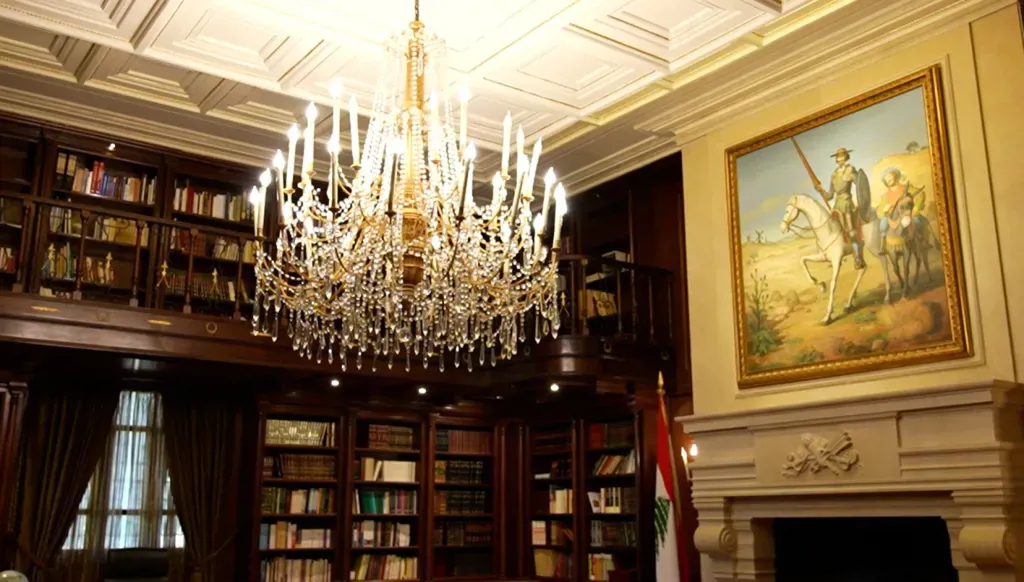
In this context, Henri Sfeir stresses that the foundation of any genuine cultural act begins with the library. Annahar previously visited his home, which houses a two-story library containing thousands of volumes and reference works, a scene that reflects an organic relationship between the house and the book. This library is not reduced to a place for storing books; it resembles a living cultural center that brings together readers and thinkers and plays an active role in spreading culture.
Sfeir says: “I believe a person needs scientific and literary references in order to draw accurate information that enables understanding, writing, and delving into the essence of certain subjects,” considering that “the library is the only refuge that provides all of this.”
Despite technological advancement, he believes the need for books remains essential, because leafing through pages and touching paper offers a feeling that digital media cannot provide, while fast information, despite its abundance, remains vulnerable to gaps and inaccuracy.
Ziad Najjar: The library as a living family memory
From intellectual experience to family memory, Ziad Najjar recalls his upbringing in a home where books were a fundamental part of everyday life. From modest shelves in the living room, the library of his late father, Marwan Najjar, a prominent Lebanese playwright and author, expanded to include the hallway and bedrooms, before evolving into a cultural space that today holds around three thousand books in literature, philosophy, history, politics, and sociology, alongside encyclopedias, dictionaries, and plays.
Najjar does not speak of the library as a material inheritance, but as a continuing presence. The grandchildren enter their grandfather’s study, leaf through his books, and write him letters, forming a living relationship with a body of thought that has not been interrupted. In this way, the library remains a means of communication between generations, preserving memory and granting culture its deeply human dimension.
Culture is not a luxury
These experiences demonstrate that home libraries are not a cultural luxury, but a necessity for building coherent awareness. Every book within them is a bridge toward deeper self-understanding and a fuller grasp of the world, and every library is a long-term investment in thought. In an age of digital speed, these homes bring us back to a calm relationship with knowledge and to the value of cultural accumulation.
In the end, home libraries affirm that houses which embrace books are not inhabited by walls alone, but by ideas. They are homes that lay the foundations for a living culture, instill a love of reading in generations, and help build a society capable of facing the challenges of the age with mature awareness and critical thinking.