Allies drift East: How the U.S. is losing its global economic grip

World 08-02-2026 | 17:50

Allies drift East: How the U.S. is losing its global economic grip

Trade disputes, geopolitical tensions, and shifting alliances signal the emergence of a new international order.
Allies drift East: How the U.S. is losing its global economic grip
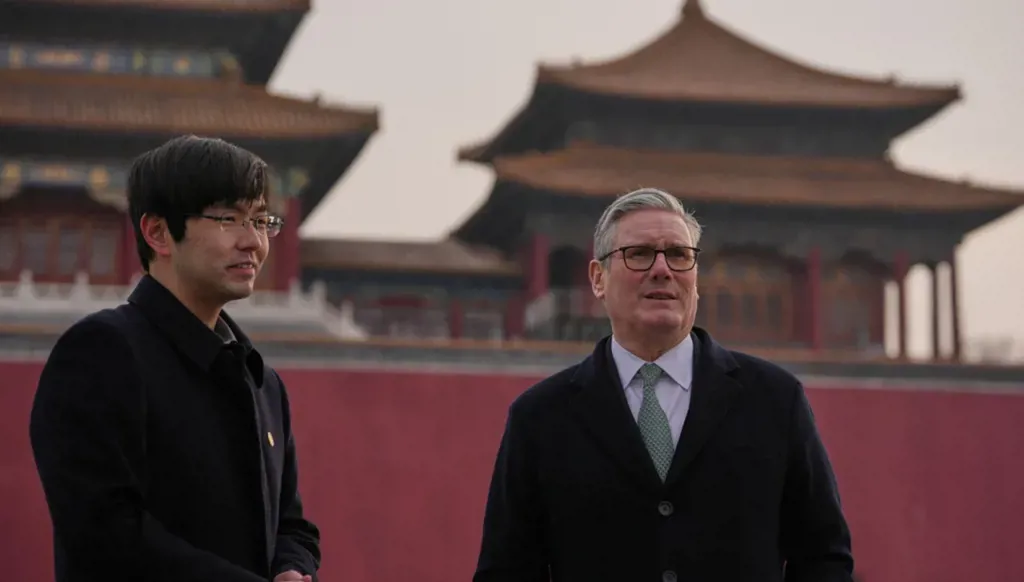
British Prime Minister Keir Starmer Visits Beijing’s Bustling Hub. (AFP)
Smaller Bigger


Allies whose trade relations with the United States have worsened since President Donald Trump returned to the White House more than a year ago have increasingly turned to China to offset the losses caused by trade wars and disagreements on international issues.


Following French President Emmanuel Macron’s visit to Beijing in December last year, Canadian Prime Minister Mark Carney and British Prime Minister Keir Starmer visited China in January, aiming to strengthen ties with the world’s second-largest economy.


Notably, this “shift” of allies from the United States toward China has not been accompanied by any concessions from Beijing on contentious issues such as human rights, espionage, election interference, or Taiwan.


The visits of Carney and Starmer drew a reaction from Trump, who warned of the “risks” of Canada and Britain seeking to address their economic challenges through China. Notably, Carney is the first Canadian Prime Minister to visit China in ten years, while Starmer is the first British Prime Minister to set foot in China since 2018.


Starmer prioritized signing trade agreements with China, setting aside the dispute over Beijing’s arrest of pro-democracy activist Jimmy Lai in Hong Kong. This followed his decision to approve the construction of a large Chinese embassy in London, despite allegations of espionage against Beijing.


Similarly, Carney opted to restructure relations with China despite the arrest of Canadian citizens and allegations of Beijing’s interference in Canadian elections, including campaigns targeting former Prime Minister Justin Trudeau. More significantly, a “new strategic partnership” was established, which included reducing tariffs on electric cars imported from China. At the same time, Carney reaffirmed his commitment to the free trade agreement with the United States and Mexico.


Trump viewed Canada’s rapprochement with China as a provocation by Carney. He quickly threatened to impose a 100 percent tariff on Canadian imports if the country moved forward with a free trade agreement with China. Notably, after returning to the White House, Trump even raised the idea of annexing Canada and making it the 51st U.S. state, a proposal that angered Canadians.


The shift toward China is not driven solely by economic factors. It also occurs against the backdrop of a growing rift between the United States and its NATO allies, largely due to Trump’s insistence on annexing Greenland, which is part of Denmark and a NATO member within the European Union. This demand prompted major European countries, particularly France and Germany, to seriously consider pursuing greater “independence” from American military protection.


America’s allies are turning not only to China but also to India, the other Asian giant. On January 27, the European Union and India signed an agreement to establish a “free trade zone encompassing two billion people,” along with a security and defense partnership to strengthen cooperation between the two sides.


With the major transformations occurring during Trump’s second term, a new trade system is emerging, in which the United States is no longer the primary focus for other countries.


Trump claims that the substantial tariff increases he imposed are intended to stop the world from economically exploiting the United States. However, this assertion is self-contradictory, as America remains the world’s largest economy and possesses the strongest military—achievements built over decades, particularly through its alliances. The current shifts indicate the end of the old system, yet the contours of the emerging new system remain unclear.


Disclaimer: The opinions expressed by the writers are their own and do not necessarily represent the views of Annahar.

Tags
India ، China ، Canada ، Trump ، Trade