

U.S. ambassador captivates Jordanians with community work and iconic beard


 Messenger
 Whatsapp
 Threads
 Email
Email
 Print
Print
 X
X
 Facebook
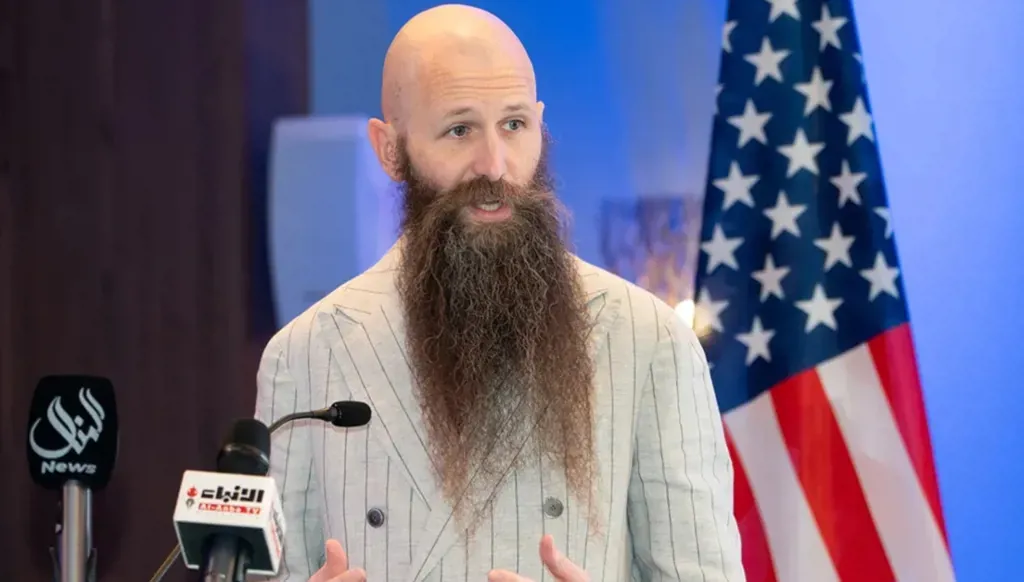


It wasn’t just the striking beard of U.S. Ambassador to Jordan, James Holtsnider, that caught the attention of Jordanians; his active engagement and frequent visits - including stops at condolence houses - also drew widespread discussion among media outlets and commentators.
The ambassador’s beard, first widely noticed when photos of James Holtsnider circulated following his appointment as extraordinary and plenipotentiary ambassador to the Hashemite Royal Court of Jordan a few months ago, quickly sparked reactions on social media. While some users responded with sarcastic comments, others found it controversial or even objectionable.
However, attention around the ambassador quickly shifted from his beard to his active presence and movements, which have sparked curiosity and discussion - particularly because they appear more intensive and visible than those of previous American ambassadors.
Writer Moaid Al-Majali noted in his article: "Thanks to his frequent travels between provinces and local communities, the man has gained a social presence rivaled only by candidates during election seasons."
He added: "Jordanians may agree or disagree on interpreting the intensity of the American ambassador’s activities, but it is certain that he has become one of the most prominent public figures in the community recently."
"Soft power"
In this context, journalist Ibrahim Abu Samaka emphasizes that "the movement of the American ambassador cannot be seen merely as social activity, as it is considered a political and diplomatic act par excellence. It can also be viewed as an effort to engage closely with Jordanian society, serving as a tool of soft power for countries seeking to strengthen their presence, influence discourse, and advance their policies with local populations."
Abu Samaka added to Annahar that "these movements cannot be viewed in isolation from the strong and longstanding ties between Jordan and the United States, which have developed over decades."
He continued: "In light of this, I believe that the objections and mockery surrounding the ambassador’s movements - which serve Jordan and provide a deeper understanding of its communities and environment, while potentially creating further opportunities -are unjustified. Such criticisms amount to mere fault-finding, as long as the ambassador remains within the bounds of diplomatic norms."
Unprecedented openness
According to Dr. Amer Abdel Raouf Al-Sa'aydeh, speaking to Annahar: "It didn't take long for the ambassador in Jordan to start making his mark in Jordanian society directly and swiftly. Instead of being content with offices and protocol meetings, Holtsnider opened up to Jordanian society in an unprecedented way that raises a series of questions in the mind of every Jordanian who witnessed his movements. The Western engagement with Arab societies, particularly in Jordan, is not driven purely by goodwill or openness, but is clearly guided by the objectives and agendas outlined in this ambassador’s mission.”
He added: "The ambassador has been seen expressing condolences to tribes, sharing meals at Mansaf tables, wearing the red keffiyeh, and participating in olive and oil festivals. While these actions may at first appear to be simple social gestures, they are in fact part of a carefully crafted American strategy aimed at building influence that extends beyond institutions to reach the people directly. From the perspective of his administration in Washington, this diplomatic approach is considered entirely appropriate."
Al-Sa’aydeh observes that "with Jordan considered a cornerstone of regional stability, it is a space that does not tolerate vacuums. In the midst of a regional phase where power dynamics are being reshaped, Washington is pursuing what can be called “smart popular diplomacy” - a form of diplomacy that blends politics with culture, symbolism with community engagement, creating a network of influence that extends from tribes to the middle class, and from the local economic sphere to the broader public consciousness."
Reading public mood
Al-Sa’aydeh explains: "The Mansaf, the keffiyeh, and Jordanian social events become instruments of soft political strategy, used to gauge public sentiment and build trust even before official meetings take place. The message is clear: The United States seeks not only to be a partner within institutions, but to be present within the daily social life of Jordanians. In this context, the new American ambassador operates with a different approach than his predecessors - not to fulfill a temporary protocol role, but to establish lasting influence, beginning with the people and extending to decision-making centers."
He continued: "Ultimately, the ambassador’s actions - driven by his field experience, clear vision, and initiatives targeting Jordanian society - go far beyond mere social courtesies or the observance of local customs and traditions. They form part of a broader American influence strategy, reminiscent of the British approaches to integrating into Jordanian society during the mandate period.
In this sense, the new ambassador is not simply following the traditional path; he is reshaping it, laying the foundations of influence that begin in the daily lives of Jordanians and extend to the highest decision-making circles."