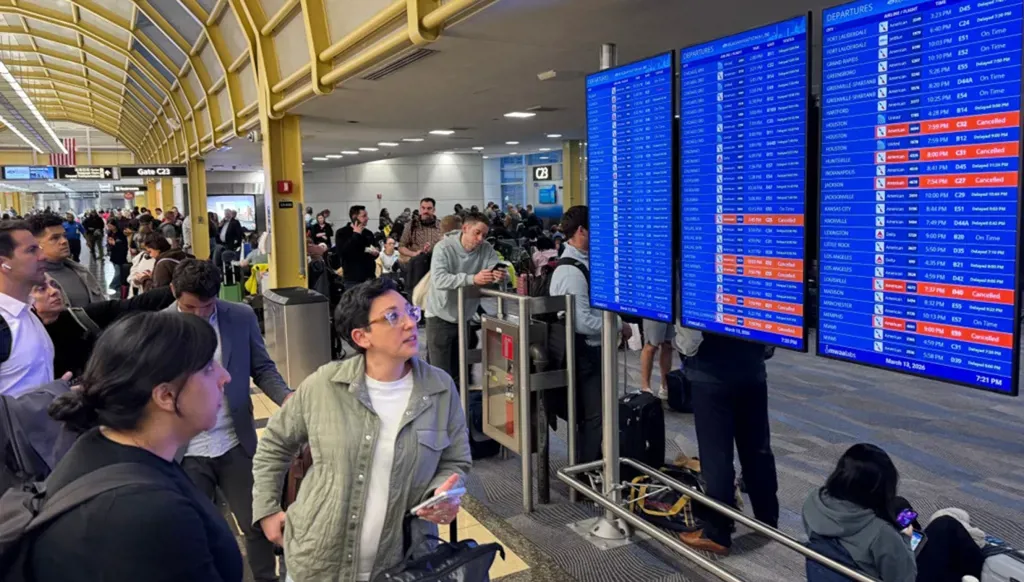
Amid the closure of the Strait of Hormuz, which threatens a fifth of global oil supplies, the aviation sector is facing a fuel crisis that is reshaping global competition: American companies are struggling to remain profitable, Europeans are protected by smart hedging, and Gulf carriers are turning pressure into growth opportunities. Brent crude prices have surged above $95 a barrel, doubling fuel costs that account for 15–30% of operating expenses, with thousands of flights canceled and routes diverted due to airspace closures. How does the closure of Hormuz reshape the profitability landscape?
Three survive the $4 shock
Most American airlines entered the Hormuz crisis unprotected, having abandoned regular fuel hedging during years of relatively stable prices. A UBS analysis reported by Oilprice shows that only Delta, United, and Southwest can remain profitable if jet fuel prices stabilize at $4 per gallon or higher—a level that current prices have already surpassed in some markets.
Delta and United benefit from strong operating margins and a resilient demand base, allowing them to pass on increases through fuel surcharges, while Southwest retains partial hedging that cushions the shock. Others, such as American and Aloha, face immediate losses, with the JETS aviation stock index falling below its 200-day average, indicating that markets view this crisis as a complete repricing of the U.S. model. “They have no place to hide anymore,” as described by the Economic Times.
Europe and Asia: Hedging provides strategic advantage
Unlike the United States, European and Asian airlines cover a large share of their fuel needs with crude-linked hedging contracts, helping to mitigate the gap between crude and jet fuel prices.
Large European and Asian companies entered the Hormuz shock having secured a significant portion of their fuel bills in advance. For instance, the Air France-KLM Group had locked in prices for about 87% of its annual fuel needs through hedging contracts before the price increases, meaning much of its current consumption is being paid for at below-market prices.
Ryanair says that over 70% of its fuel for the fiscal year through the end of March 2026 is covered by contracts at around $76–80 a barrel, with the next quarter about 84% hedged at roughly $77.
In Asia, analysts indicate that companies such as Singapore Airlines and Cathay Pacific have strong hedging programs against rising fuel prices, helping to cushion the shock compared with other airlines that are either unhedged or only hedge Brent crude prices.
Asian carriers, including Japanese and Korean airlines, have raised prices while adding capacity on long-haul routes, taking advantage of the gap left by Gulf disruptions. This hedging provides a “time-out” for restructuring but does not fully protect against prolonged crises.
The Gulf: Hormuz chokes but opens doors to efficiency
In the Middle East, higher risk premiums and fuel prices have increased the cost per available seat (CASK), with flights canceled and routes diverted. FT reports indicate that travel and aviation costs in the Gulf have risen due to higher fuel and insurance expenses, squeezing the margins of major carriers.
But low-cost carriers like flynas stand out as a resilient model: their profits jumped 28% in 2025, and CEO Bandar Al-Muhanna stated in a television interview that their situation is “better than their Gulf counterparts” thanks to high solvency and rapid turnover. The company serves 70 destinations, with plans to expand to 165, benefiting from a 70% increase in cargo on some routes.
The closure of the Strait not only doubles fuel prices but also redistributes passenger and cargo traffic to alternative routes, threatening Gulf profitability hubs while strengthening Asian competitors. Airlines with effective hedging and operational capacity are likely to emerge stronger, while others may face forced restructuring.



 Messenger
 Whatsapp
 Threads
 Email
Email
 Print
Print
 X
X
 Facebook