

Trump steps in: U.S. pushes for breakthrough in Nile Dam talks between Egypt and Ethiopia


 Messenger
 Whatsapp
 Threads
 Email
Email
 Print
Print
 X
X
 Facebook


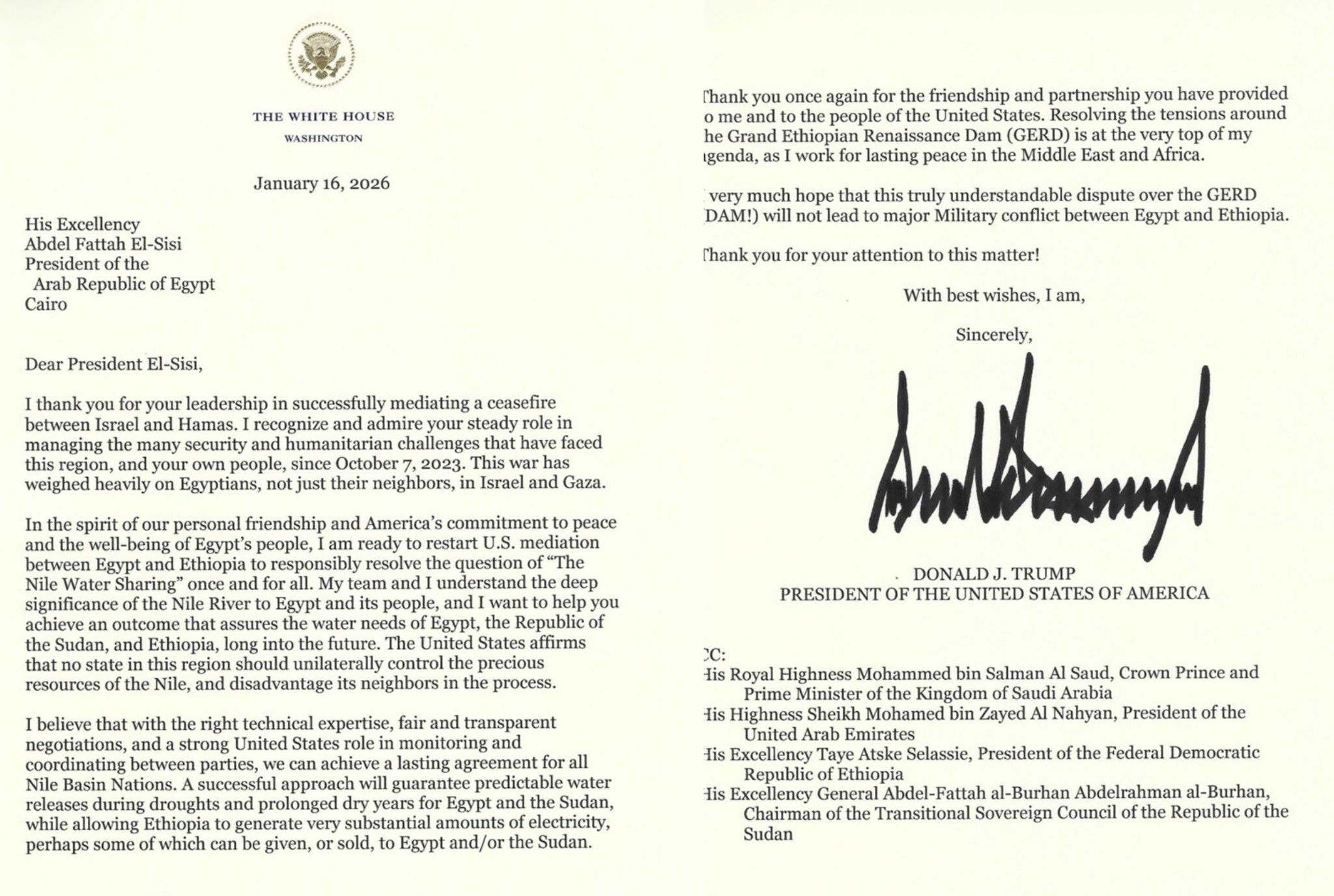
On Friday, January 16, U.S. President Donald Trump sent a message to Egyptian President Abdel Fattah el-Sisi, thanking him for his role in the Gaza ceasefire and expressing the United States’ readiness to resume mediation between Egypt and Ethiopia to reach a final solution to the dispute over the Grand Ethiopian Renaissance Dam. The question now is what scenarios are available to Egypt and Ethiopia following the latest American offer.
In his letter, Trump expressed his readiness to resume mediation to definitively resolve the issue of Nile water sharing, noting that he and his team understand the Nile River’s vital importance to Egypt and its people. He said he wants to help reach an agreement that secures the water needs of Egypt, Sudan, and Ethiopia over the long term, stressing that no country in the region should unilaterally control the Nile’s critical resources at the expense of its neighbors.
Trump added in his letter that he believes the presence of capable technical experts, fair and transparent negotiations, and a strong U.S. role in monitoring and coordinating among the parties could lead to a permanent agreement. Such an agreement, he said, would guarantee expected water flows to Egypt and Sudan during drought periods, while also allowing Ethiopia to generate large amounts of electricity, some of which could be exported to Egypt and Sudan.
Professor Abbas Sharaki, a geology and water resources expert at Cairo University, told Annahar that President Trump had sponsored negotiations over the Grand Ethiopian Renaissance Dam from November 2019 to February 2020, but the talks failed to produce an agreement after Ethiopia did not attend the signing session, despite Egypt initialing the deal.
He noted that Trump was angered by the Ethiopian position and suspended some U.S. aid at the time, which was later restored under President Biden. Sharaki added that the COVID-19 pandemic and Trump’s focus on the elections prevented him from pursuing the dam issue further. However, during his second term, Trump has mentioned the Renaissance Dam on four occasions while alluding to the Nobel Prize, and he has now officially expressed his readiness to mediate for the first time—signaling a serious U.S. intention to reach an agreement that benefits all three countries.
Sharaki added that President Trump described the Nile as “the lifeline of the Egyptians,” underscoring the importance of its waters and his commitment to ensuring their continued flow. He said Trump stressed that the United States should play a role in reaching a fair agreement, free of other agendas.
Commenting on the American offer, he said that Trump wants to reach an agreement through which he can claim that he prevented a military conflict between Egypt and Ethiopia, even though developments surrounding the Renaissance Dam do not suggest that such a conflict was imminent.
Scenarios of the Renaissance Dam Negotiations: Water in Exchange for the Sea
Sharaki explains that the Gaza issue has not yet been resolved and that Ethiopia has a strong desire to gain access to the Red Sea through Somali territory or Somaliland. Egypt, he notes, is standing in the way of this ambition through legitimate means. He therefore expects that Ethiopia may agree to the American call for an agreement if it is guaranteed access to the sea.
He adds that “the Renaissance Dam is not a matter of life or death for Egypt,” noting that its construction and initial storage have already been completed. He explains that the years 2020–2024 were the most challenging for Egypt, as they witnessed the first filling phases of the dam’s reservoir, which withheld a portion of the annual flow of 64 billion cubic meters—the equivalent of the lake’s capacity—while more than 40 billion cubic meters were lost to evaporation and leakage over those five years. He emphasizes that without the Aswan High Dam and Egypt’s mitigation measures, a serious disaster would have occurred.
Scenario Two: Regulation, Not Division
Sharaki believes that the scenario of dividing the Nile’s waters into fixed shares is “completely unacceptable” given the steadily growing population. He points out that such a division would open the door for other downstream countries to demand their official shares, potentially leading in the future to these countries selling unused portions of water that naturally flowed through the Nile for free.
Sharaki adds that President Trump could bring together the three parties—Egypt, Sudan, and Ethiopia—to reach an agreement within a few days, as conditions are currently more favorable than before due to the completion of the first filling, which had been a major point of contention in previous negotiations regarding the number of filling years. He suggests supporting Trump’s initiative to establish an agreement that regulates subsequent fillings and operations, and, if possible, reduces Ethiopia’s storage capacity, which poses a significant threat to the water security of Sudan and Egypt in the event of unexpected floods or heavy rainfall. He also emphasizes the importance of reaching an agreement that ensures consultation and coordination for any future water projects.